Swapnil C Devarkar, Christina R Budding, Chathuri Pathirage, Arundhati Kavoor, Cassandra Herbert, Patrick A Limbach, Karin Musier-Forsyth, Yong Xiong
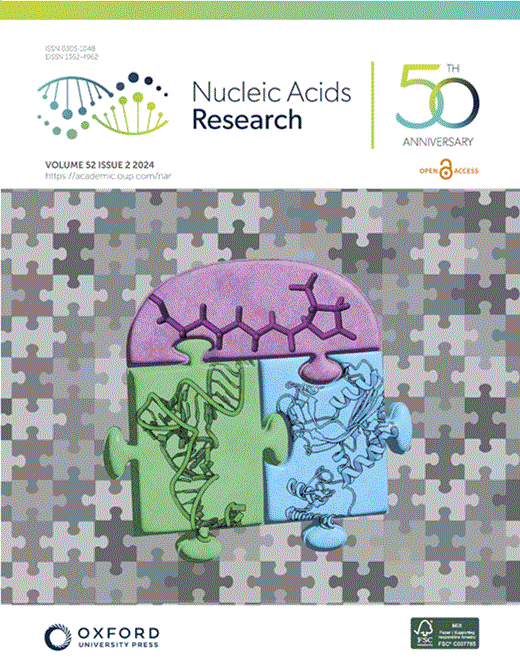
{"title":"Structural basis for aminoacylation of cellular modified tRNALys3 by human lysyl-tRNA synthetase.","authors":"Swapnil C Devarkar, Christina R Budding, Chathuri Pathirage, Arundhati Kavoor, Cassandra Herbert, Patrick A Limbach, Karin Musier-Forsyth, Yong Xiong","doi":"10.1093/nar/gkaf114","DOIUrl":null,"url":null,"abstract":"<p><p>The average eukaryotic transfer ribonucleic acid (tRNA) contains 13 post-transcriptional modifications; however, their functional impact is largely unknown. Our understanding of the complex tRNA aminoacylation machinery in metazoans also remains limited. Herein, using a series of high-resolution cryo-electron microscopy (cryo-EM) structures, we provide the mechanistic basis for recognition and aminoacylation of fully modified cellular tRNALys3 by human lysyl-tRNA synthetase (h-LysRS). The tRNALys3 anticodon loop modifications S34 (mcm5s2U) and R37 (ms2t6A) play an integral role in recognition by h-LysRS. Modifications in the T-, variable-, and D-loops of tRNALys3 are critical for ordering the metazoan-specific N-terminal domain of LysRS. The two catalytic steps of tRNALys3 aminoacylation are structurally ordered; docking of the 3'-CCA end in the active site cannot proceed until the lysyl-adenylate intermediate is formed and the pyrophosphate byproduct is released. Association of the h-LysRS-tRNALys3 complex with a multi-tRNA synthetase complex-derived peptide shifts the equilibrium toward the 3'-CCA end \"docked\" conformation and allosterically increases h-LysRS catalytic efficiency. The insights presented here have broad implications for understanding the role of tRNA modifications in protein synthesis, the human aminoacylation machinery, and the growing catalog of metabolic and neurological diseases linked to it.</p>","PeriodicalId":19471,"journal":{"name":"Nucleic Acids Research","volume":"53 5","pages":""},"PeriodicalIF":13.1000,"publicationDate":"2025-02-27","publicationTypes":"Journal Article","fieldsOfStudy":null,"isOpenAccess":false,"openAccessPdf":"https://www.ncbi.nlm.nih.gov/pmc/articles/PMC11878792/pdf/","citationCount":"0","resultStr":null,"platform":"Semanticscholar","paperid":null,"PeriodicalName":"Nucleic Acids Research","FirstCategoryId":"99","ListUrlMain":"https://doi.org/10.1093/nar/gkaf114","RegionNum":2,"RegionCategory":"生物学","ArticlePicture":[],"TitleCN":null,"AbstractTextCN":null,"PMCID":null,"EPubDate":"","PubModel":"","JCR":"Q1","JCRName":"BIOCHEMISTRY & MOLECULAR BIOLOGY","Score":null,"Total":0}
引用次数: 0
Abstract
The average eukaryotic transfer ribonucleic acid (tRNA) contains 13 post-transcriptional modifications; however, their functional impact is largely unknown. Our understanding of the complex tRNA aminoacylation machinery in metazoans also remains limited. Herein, using a series of high-resolution cryo-electron microscopy (cryo-EM) structures, we provide the mechanistic basis for recognition and aminoacylation of fully modified cellular tRNALys3 by human lysyl-tRNA synthetase (h-LysRS). The tRNALys3 anticodon loop modifications S34 (mcm5s2U) and R37 (ms2t6A) play an integral role in recognition by h-LysRS. Modifications in the T-, variable-, and D-loops of tRNALys3 are critical for ordering the metazoan-specific N-terminal domain of LysRS. The two catalytic steps of tRNALys3 aminoacylation are structurally ordered; docking of the 3'-CCA end in the active site cannot proceed until the lysyl-adenylate intermediate is formed and the pyrophosphate byproduct is released. Association of the h-LysRS-tRNALys3 complex with a multi-tRNA synthetase complex-derived peptide shifts the equilibrium toward the 3'-CCA end "docked" conformation and allosterically increases h-LysRS catalytic efficiency. The insights presented here have broad implications for understanding the role of tRNA modifications in protein synthesis, the human aminoacylation machinery, and the growing catalog of metabolic and neurological diseases linked to it.
期刊介绍:
Nucleic Acids Research (NAR) is a scientific journal that publishes research on various aspects of nucleic acids and proteins involved in nucleic acid metabolism and interactions. It covers areas such as chemistry and synthetic biology, computational biology, gene regulation, chromatin and epigenetics, genome integrity, repair and replication, genomics, molecular biology, nucleic acid enzymes, RNA, and structural biology. The journal also includes a Survey and Summary section for brief reviews. Additionally, each year, the first issue is dedicated to biological databases, and an issue in July focuses on web-based software resources for the biological community. Nucleic Acids Research is indexed by several services including Abstracts on Hygiene and Communicable Diseases, Animal Breeding Abstracts, Agricultural Engineering Abstracts, Agbiotech News and Information, BIOSIS Previews, CAB Abstracts, and EMBASE.



 京公网安备 11010802042870号
京ICP备2023020795号-1
京公网安备 11010802042870号
京ICP备2023020795号-1

 分享
分享
 求助内容:
求助内容: 应助结果提醒方式:
 扫码关注我们
