{"title":"Significance in scale space for Hi-C data.","authors":"Rui Liu, Zhengwu Zhang, Hyejung Won, J S Marron","doi":"10.1093/bioinformatics/btaf026","DOIUrl":null,"url":null,"abstract":"<p><strong>Motivation: </strong>Hi-C technology has been developed to profile genome-wide chromosome conformation. So far Hi-C data have been generated from a large compendium of different cell types and different tissue types. Among different chromatin conformation units, chromatin loops were found to play a key role in gene regulation across different cell types. While many different loop calling algorithms have been developed, most loop callers identified shared loops as opposed to cell-type-specific loops.</p><p><strong>Results: </strong>We propose SSSHiC, a new loop calling algorithm based on significance in scale space, which can be used to understand data at different levels of resolution. By applying SSSHiC to neuronal and glial Hi-C data, we detected more loops that are potentially engaged in cell-type-specific gene regulation. Compared with other loop callers, such as Mustache, these loops were more frequently anchored to gene promoters of cellular marker genes and had better APA scores. Therefore, our results suggest that SSSHiC can effectively capture loops that contain more gene regulatory information.</p><p><strong>Availability and implementation: </strong>The Hi-C data used in this study can be accessed through the PsychENCODE Knowledge Portal at https://www.synapse.org/#! Synapse: syn21760712. The code utilized for Curvature SSS cited in this study is available at https://github.com/jsmarron/MarronMatlabSoftware/blob/master/Matlab9/Matlab9Combined.zip. All custom code used in this research can be found in the GitHub repository: https://github.com/jerryliu01998/HiC. The code has also been submitted to Code Ocean with the doi: 10.24433/CO.1912913.v1.</p>","PeriodicalId":93899,"journal":{"name":"Bioinformatics (Oxford, England)","volume":" ","pages":""},"PeriodicalIF":5.4000,"publicationDate":"2025-03-04","publicationTypes":"Journal Article","fieldsOfStudy":null,"isOpenAccess":false,"openAccessPdf":"https://www.ncbi.nlm.nih.gov/pmc/articles/PMC11879645/pdf/","citationCount":"0","resultStr":null,"platform":"Semanticscholar","paperid":null,"PeriodicalName":"Bioinformatics (Oxford, England)","FirstCategoryId":"1085","ListUrlMain":"https://doi.org/10.1093/bioinformatics/btaf026","RegionNum":0,"RegionCategory":null,"ArticlePicture":[],"TitleCN":null,"AbstractTextCN":null,"PMCID":null,"EPubDate":"","PubModel":"","JCR":"","JCRName":"","Score":null,"Total":0}
引用次数: 0
Abstract
Motivation: Hi-C technology has been developed to profile genome-wide chromosome conformation. So far Hi-C data have been generated from a large compendium of different cell types and different tissue types. Among different chromatin conformation units, chromatin loops were found to play a key role in gene regulation across different cell types. While many different loop calling algorithms have been developed, most loop callers identified shared loops as opposed to cell-type-specific loops.
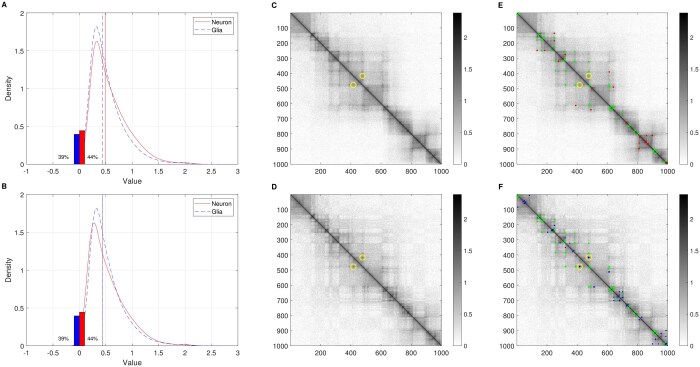
Results: We propose SSSHiC, a new loop calling algorithm based on significance in scale space, which can be used to understand data at different levels of resolution. By applying SSSHiC to neuronal and glial Hi-C data, we detected more loops that are potentially engaged in cell-type-specific gene regulation. Compared with other loop callers, such as Mustache, these loops were more frequently anchored to gene promoters of cellular marker genes and had better APA scores. Therefore, our results suggest that SSSHiC can effectively capture loops that contain more gene regulatory information.
Availability and implementation: The Hi-C data used in this study can be accessed through the PsychENCODE Knowledge Portal at https://www.synapse.org/#! Synapse: syn21760712. The code utilized for Curvature SSS cited in this study is available at https://github.com/jsmarron/MarronMatlabSoftware/blob/master/Matlab9/Matlab9Combined.zip. All custom code used in this research can be found in the GitHub repository: https://github.com/jerryliu01998/HiC. The code has also been submitted to Code Ocean with the doi: 10.24433/CO.1912913.v1.





 京公网安备 11010802042870号
京ICP备2023020795号-1
京公网安备 11010802042870号
京ICP备2023020795号-1

 分享
分享

 求助内容:
求助内容: 应助结果提醒方式:
 扫码关注我们
