In silico screening and validation of natural compounds with fabrication and characterization of a lead compound-loaded chitosome for targeting lung fibrosis†
{"title":"In silico screening and validation of natural compounds with fabrication and characterization of a lead compound-loaded chitosome for targeting lung fibrosis†","authors":"Ajay Kakati, Amartya Banerjee, Parikshit Das, Gourav Rakshit, Rahul Ghosh, Reshmi Chakraborty, Buddhadeb Saha, Danswrang Goyary, Yangchen D. Bhutia, Sanjeev Karmakar, Sumit Kishor, Bhaskar Mazumder and Pronobesh Chattopadhyay","doi":"10.1039/D4TB01664E","DOIUrl":null,"url":null,"abstract":"<p >Lung fibrosis (LF) is a serious complication with very limited therapeutic options. This study aimed to find a potential compound for targeting LF and develop a chitosome formulation to minimize any inherent drawbacks of the compound and achieve effective drug delivery. In total, 79 natural compounds were screened using an <em>in silico</em> approach against five targeted proteins (3HMG, 6B8Y, 2FAP, 3CQU, and 3DK9). Amongst these, quercetin (QER) exhibited the best efficacy (−14.725 kcal mol<small><sup>−1</sup></small>) and Δ<em>G</em> average (−86.45 ± 6.24) kcal mol<small><sup>−1</sup></small> against the TGF-β receptor (PDB ID: 6B8Y). <em>In vitro</em> studies revealed that bleomycin-challenged A549 cells showed a fibrosis-like behaviour. Upon treatment with QER, the cell viability decreased owing to a reduction in the mitochondrial membrane potential and increased apoptosis. Furthermore, cell migration was inhibited with an improvement in cellular morphology. A QER-loaded chitosome formulation (QCF) was prepared through modified thin-film hydration. Variables were optimized using a response surface methodology Box–Behnken design. The QCF was further characterized on the basis of microscopic observation, zeta potential, entrapment efficiency, drug release and kinetics and by evaluating the effect of temperature on the QCF. Its zeta potential was +24.83 ± 0.32 mV, while microscopic observation showed that it had a spherical morphology with slightly rough surfaces after chitosan coating. Furthermore, the EE% was determined to be 81.75 ± 0.46%. The QCF also demonstrated a 74.23 ± 1.01% release of QER till 24 h, following Higuchi model kinetics. In conclusion, the <em>in silico</em> and <em>in vitro</em> cell line studies provided evidence for QER as a lead molecule for targeting LF. Moreover, the prepared QCF demonstrated sustained release with prospective QER targeted delivery. However, further extensive research is required to provide a promising strategy for the management of LF in the future.</p>","PeriodicalId":83,"journal":{"name":"Journal of Materials Chemistry B","volume":" 13","pages":" 4118-4137"},"PeriodicalIF":6.1000,"publicationDate":"2025-03-05","publicationTypes":"Journal Article","fieldsOfStudy":null,"isOpenAccess":false,"openAccessPdf":"","citationCount":"0","resultStr":null,"platform":"Semanticscholar","paperid":null,"PeriodicalName":"Journal of Materials Chemistry B","FirstCategoryId":"1","ListUrlMain":"https://pubs.rsc.org/en/content/articlelanding/2025/tb/d4tb01664e","RegionNum":3,"RegionCategory":"医学","ArticlePicture":[],"TitleCN":null,"AbstractTextCN":null,"PMCID":null,"EPubDate":"","PubModel":"","JCR":"Q1","JCRName":"MATERIALS SCIENCE, BIOMATERIALS","Score":null,"Total":0}
引用次数: 0
Abstract
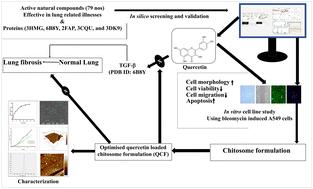
Lung fibrosis (LF) is a serious complication with very limited therapeutic options. This study aimed to find a potential compound for targeting LF and develop a chitosome formulation to minimize any inherent drawbacks of the compound and achieve effective drug delivery. In total, 79 natural compounds were screened using an in silico approach against five targeted proteins (3HMG, 6B8Y, 2FAP, 3CQU, and 3DK9). Amongst these, quercetin (QER) exhibited the best efficacy (−14.725 kcal mol−1) and ΔG average (−86.45 ± 6.24) kcal mol−1 against the TGF-β receptor (PDB ID: 6B8Y). In vitro studies revealed that bleomycin-challenged A549 cells showed a fibrosis-like behaviour. Upon treatment with QER, the cell viability decreased owing to a reduction in the mitochondrial membrane potential and increased apoptosis. Furthermore, cell migration was inhibited with an improvement in cellular morphology. A QER-loaded chitosome formulation (QCF) was prepared through modified thin-film hydration. Variables were optimized using a response surface methodology Box–Behnken design. The QCF was further characterized on the basis of microscopic observation, zeta potential, entrapment efficiency, drug release and kinetics and by evaluating the effect of temperature on the QCF. Its zeta potential was +24.83 ± 0.32 mV, while microscopic observation showed that it had a spherical morphology with slightly rough surfaces after chitosan coating. Furthermore, the EE% was determined to be 81.75 ± 0.46%. The QCF also demonstrated a 74.23 ± 1.01% release of QER till 24 h, following Higuchi model kinetics. In conclusion, the in silico and in vitro cell line studies provided evidence for QER as a lead molecule for targeting LF. Moreover, the prepared QCF demonstrated sustained release with prospective QER targeted delivery. However, further extensive research is required to provide a promising strategy for the management of LF in the future.
期刊介绍:
Journal of Materials Chemistry A, B & C cover high quality studies across all fields of materials chemistry. The journals focus on those theoretical or experimental studies that report new understanding, applications, properties and synthesis of materials. Journal of Materials Chemistry A, B & C are separated by the intended application of the material studied. Broadly, applications in energy and sustainability are of interest to Journal of Materials Chemistry A, applications in biology and medicine are of interest to Journal of Materials Chemistry B, and applications in optical, magnetic and electronic devices are of interest to Journal of Materials Chemistry C.Journal of Materials Chemistry B is a Transformative Journal and Plan S compliant. Example topic areas within the scope of Journal of Materials Chemistry B are listed below. This list is neither exhaustive nor exclusive:
Antifouling coatings
Biocompatible materials
Bioelectronics
Bioimaging
Biomimetics
Biomineralisation
Bionics
Biosensors
Diagnostics
Drug delivery
Gene delivery
Immunobiology
Nanomedicine
Regenerative medicine & Tissue engineering
Scaffolds
Soft robotics
Stem cells
Therapeutic devices



 京公网安备 11010802042870号
京ICP备2023020795号-1
京公网安备 11010802042870号
京ICP备2023020795号-1

 分享
分享
 求助内容:
求助内容: 应助结果提醒方式:
 扫码关注我们
