Ahmed Muthana, Haneen A Salih, Mubarak Jolayemi Mustapha, Hussein Salih Abed, Alkawthar M Abdulsada, Aktham O Al-Khafaji, Zainab K A Alaraji, Mayur Sharma, Samer S Hoz
{"title":"Trigeminal nerve palsy associated with intracranial aneurysms: Scoping review.","authors":"Ahmed Muthana, Haneen A Salih, Mubarak Jolayemi Mustapha, Hussein Salih Abed, Alkawthar M Abdulsada, Aktham O Al-Khafaji, Zainab K A Alaraji, Mayur Sharma, Samer S Hoz","doi":"10.25259/SNI_1104_2024","DOIUrl":null,"url":null,"abstract":"<p><strong>Background: </strong>Trigeminal nerve palsy (TNP) in patients with intracranial aneurysms (IAs) results from the disease process or its treatment. We systematically reviewed the literature on trigeminal palsy in patients with IAs.</p><p><strong>Methods: </strong>PubMed, ScienceDirect and Web of Science were searched according to the Preferred Reporting Items for Systematic Reviews and Meta-Analyses guidelines. Data extraction and quality assessment were performed according to preestablished guidelines.</p><p><strong>Results: </strong>Twenty studies were included, yielding 69 patients with TNP and IAs. The mean age was 56.9 years and females accounted for 76%. Among the total cases, a cavernous internal carotid artery aneurysm was found in the vast majority (93%), followed by 7% of aneurysms in the basilar artery-superior cerebellar artery, posterior communicating artery, and anterior communicating artery. 96% of the aneurysms were classified as large to giant-sized. Out of the total number of cases, the majority (90%) exhibited trigeminal palsy at the time of their initial presentation. Only a small proportion (<i>n</i> = 7, 10%) developed fifth nerve palsy subsequent to the treatment of their aneurysms. Concurrent versus isolated TNP were exhibited in 79.7% and 20.3% of the cases, respectively. Finally, in terms of outcome, complete recovery from trigeminal palsy was achieved in 76.7% (26/34), with a duration of resolution of <6 months in 77.3% (17/22).</p><p><strong>Conclusion: </strong>Trigeminal nerve palsies are correlated with IAs, and this correlation depends mainly on the location and size of the aneurysms.</p>","PeriodicalId":94217,"journal":{"name":"Surgical neurology international","volume":"16 ","pages":"38"},"PeriodicalIF":0.0000,"publicationDate":"2025-02-07","publicationTypes":"Journal Article","fieldsOfStudy":null,"isOpenAccess":false,"openAccessPdf":"https://www.ncbi.nlm.nih.gov/pmc/articles/PMC11878712/pdf/","citationCount":"0","resultStr":null,"platform":"Semanticscholar","paperid":null,"PeriodicalName":"Surgical neurology international","FirstCategoryId":"1085","ListUrlMain":"https://doi.org/10.25259/SNI_1104_2024","RegionNum":0,"RegionCategory":null,"ArticlePicture":[],"TitleCN":null,"AbstractTextCN":null,"PMCID":null,"EPubDate":"2025/1/1 0:00:00","PubModel":"eCollection","JCR":"","JCRName":"","Score":null,"Total":0}
引用次数: 0
Abstract
Background: Trigeminal nerve palsy (TNP) in patients with intracranial aneurysms (IAs) results from the disease process or its treatment. We systematically reviewed the literature on trigeminal palsy in patients with IAs.
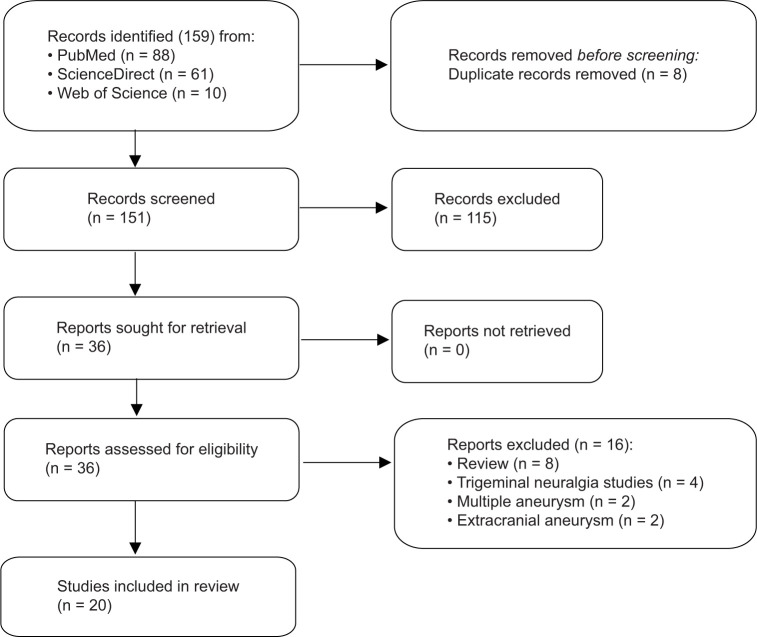
Methods: PubMed, ScienceDirect and Web of Science were searched according to the Preferred Reporting Items for Systematic Reviews and Meta-Analyses guidelines. Data extraction and quality assessment were performed according to preestablished guidelines.
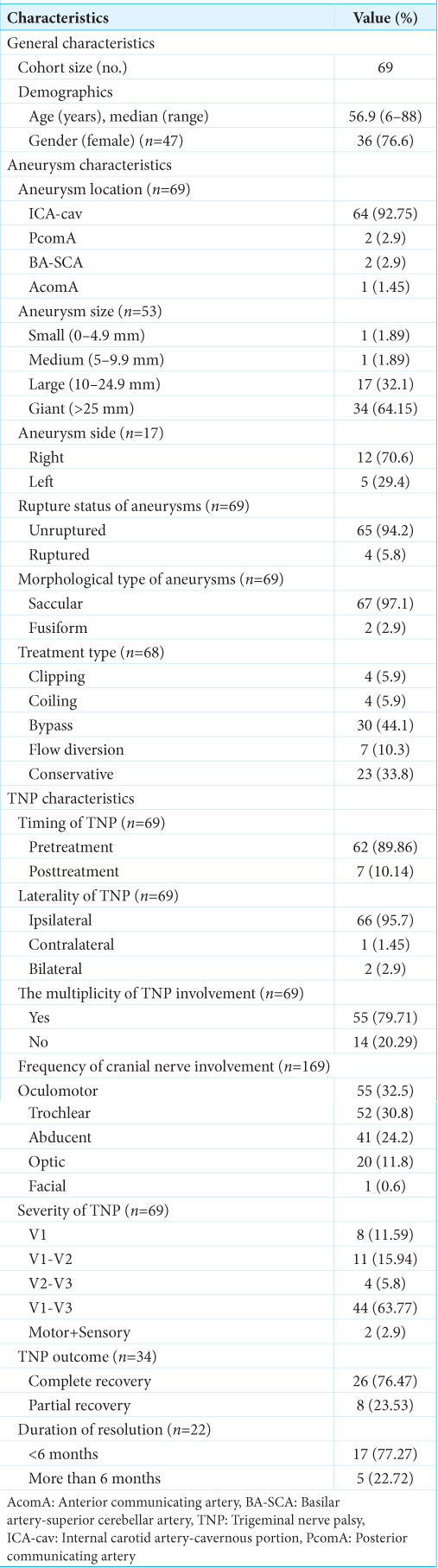
Results: Twenty studies were included, yielding 69 patients with TNP and IAs. The mean age was 56.9 years and females accounted for 76%. Among the total cases, a cavernous internal carotid artery aneurysm was found in the vast majority (93%), followed by 7% of aneurysms in the basilar artery-superior cerebellar artery, posterior communicating artery, and anterior communicating artery. 96% of the aneurysms were classified as large to giant-sized. Out of the total number of cases, the majority (90%) exhibited trigeminal palsy at the time of their initial presentation. Only a small proportion (n = 7, 10%) developed fifth nerve palsy subsequent to the treatment of their aneurysms. Concurrent versus isolated TNP were exhibited in 79.7% and 20.3% of the cases, respectively. Finally, in terms of outcome, complete recovery from trigeminal palsy was achieved in 76.7% (26/34), with a duration of resolution of <6 months in 77.3% (17/22).
Conclusion: Trigeminal nerve palsies are correlated with IAs, and this correlation depends mainly on the location and size of the aneurysms.
背景:颅内动脉瘤(IAs)患者的三叉神经麻痹(TNP)与病程或治疗有关。我们系统地回顾了IAs患者三叉神经麻痹的文献。方法:根据系统评价和meta分析指南的首选报告项目检索PubMed、ScienceDirect和Web of Science。根据预先制定的指南进行数据提取和质量评估。结果:纳入20项研究,共69例TNP和IAs患者。平均年龄56.9岁,女性占76%。在所有病例中,海绵状颈内动脉动脉瘤占绝大多数(93%),其次是基底动脉-小脑上动脉、后交通动脉和前交通动脉,占7%。96%的动脉瘤被分类为大到巨。在所有病例中,大多数(90%)在初次出现时表现为三叉神经麻痹。只有一小部分患者(n = 7.10%)在动脉瘤治疗后出现第五神经麻痹。并发性TNP和孤立性TNP分别占79.7%和20.3%。最后,在预后方面,76.7%(26/34)的三叉神经麻痹患者完全康复,持续时间为:结论:三叉神经麻痹与IAs相关,这种相关性主要取决于动脉瘤的位置和大小。




 京公网安备 11010802042870号
京ICP备2023020795号-1
京公网安备 11010802042870号
京ICP备2023020795号-1

 分享
分享

 求助内容:
求助内容: 应助结果提醒方式:
 扫码关注我们
