{"title":"Bow-Hunter Syndrome Due to Tandem Lesions; A Case Report.","authors":"Shigeomi Yokoya, Jun Nakauchi, Hidesato Takezawa","doi":"10.1055/s-0044-1792160","DOIUrl":null,"url":null,"abstract":"<p><p>Bow-Hunter syndrome (BHS) includes a form of stroke caused by dynamic factors affecting the extracranial vertebral artery (VA), such as rotation-induced flow disturbance at the atlantoaxial level. BHS is a rare condition that can result from a variety of factors, including abnormal bone compression and vertebral instability. So far, there have been no reports in which both vertebral instability and osteophytes compress the VA at different sites, leading to stroke. Herein, we present a rare case of stroke attributed to BHS involving thrombosis formation due to osteophyte compression at C3/4 and VA occlusion due to vertebral instability at the C4/5 overlapped. A 72-year-old male presented with rotational vertigo and vomiting associated with a cerebellar infarction. Digital subtraction angiography revealed severe stenosis of the left VA with an intra-arterial thrombus. Percutaneous transluminal angioplasty improved the stenosis; however, intravascular ultrasound revealed compression of the VA by osteophytes at C3/4. Additionally, left VA occlusion at C4/5 was confirmed because of vertebral instability. The osteophyte was removed via the anterolateral approach, and the VA was decompressed. The patient's postoperative course was uneventful, with no recurrence for more than 2 years. BHS can occur in the lower cervical spine when vertebral instability coincides with intimal arterial damage caused by osteophytes at other sites.</p>","PeriodicalId":94300,"journal":{"name":"Asian journal of neurosurgery","volume":"20 1","pages":"174-178"},"PeriodicalIF":0.0000,"publicationDate":"2024-11-04","publicationTypes":"Journal Article","fieldsOfStudy":null,"isOpenAccess":false,"openAccessPdf":"https://www.ncbi.nlm.nih.gov/pmc/articles/PMC11875694/pdf/","citationCount":"0","resultStr":null,"platform":"Semanticscholar","paperid":null,"PeriodicalName":"Asian journal of neurosurgery","FirstCategoryId":"1085","ListUrlMain":"https://doi.org/10.1055/s-0044-1792160","RegionNum":0,"RegionCategory":null,"ArticlePicture":[],"TitleCN":null,"AbstractTextCN":null,"PMCID":null,"EPubDate":"2025/3/1 0:00:00","PubModel":"eCollection","JCR":"","JCRName":"","Score":null,"Total":0}
引用次数: 0
Abstract
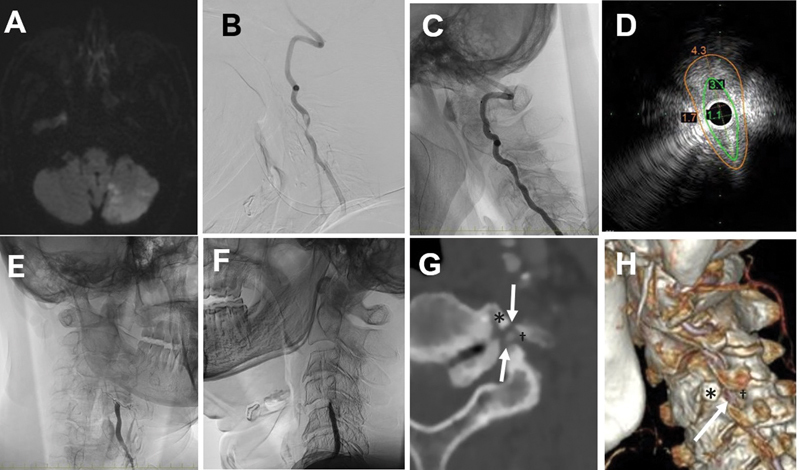
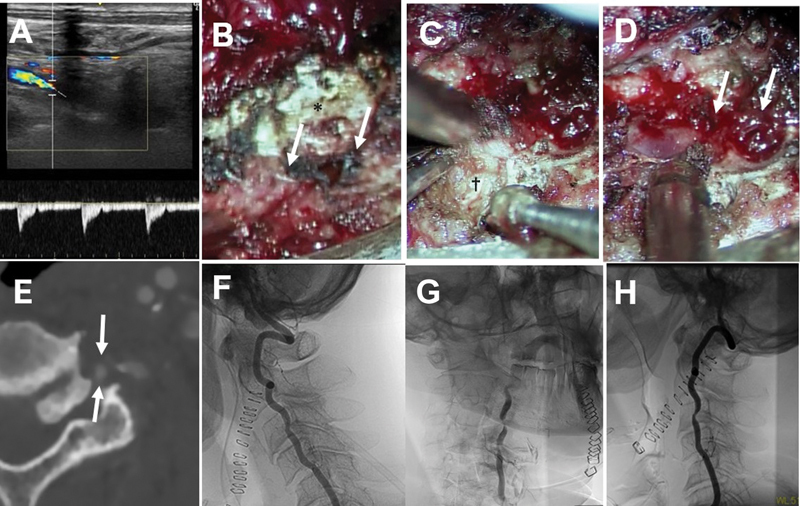
Bow-Hunter syndrome (BHS) includes a form of stroke caused by dynamic factors affecting the extracranial vertebral artery (VA), such as rotation-induced flow disturbance at the atlantoaxial level. BHS is a rare condition that can result from a variety of factors, including abnormal bone compression and vertebral instability. So far, there have been no reports in which both vertebral instability and osteophytes compress the VA at different sites, leading to stroke. Herein, we present a rare case of stroke attributed to BHS involving thrombosis formation due to osteophyte compression at C3/4 and VA occlusion due to vertebral instability at the C4/5 overlapped. A 72-year-old male presented with rotational vertigo and vomiting associated with a cerebellar infarction. Digital subtraction angiography revealed severe stenosis of the left VA with an intra-arterial thrombus. Percutaneous transluminal angioplasty improved the stenosis; however, intravascular ultrasound revealed compression of the VA by osteophytes at C3/4. Additionally, left VA occlusion at C4/5 was confirmed because of vertebral instability. The osteophyte was removed via the anterolateral approach, and the VA was decompressed. The patient's postoperative course was uneventful, with no recurrence for more than 2 years. BHS can occur in the lower cervical spine when vertebral instability coincides with intimal arterial damage caused by osteophytes at other sites.



 京公网安备 11010802042870号
京ICP备2023020795号-1
京公网安备 11010802042870号
京ICP备2023020795号-1

 分享
分享

 求助内容:
求助内容: 应助结果提醒方式:
 扫码关注我们
