B. Almohammed, D. Barba, E. Haddad, R. Nechache, F. Rosei, F. Vetrone
{"title":"Luminescent Erbium-Based Nanoparticles Synthesized by Pulsed Laser Ablation in Liquid","authors":"B. Almohammed, D. Barba, E. Haddad, R. Nechache, F. Rosei, F. Vetrone","doi":"10.1021/acs.jpcc.4c07101","DOIUrl":null,"url":null,"abstract":"Erbium and erbium oxide nanoparticles (Er-NPs) have been synthesized in deionized (DI) water using the green and environmentally friendly technique of pulsed laser ablation in liquid (PLAL), with laser fluence ranging from 2.5 to 20.9 J/cm<sup>2</sup>. Owing to the careful examination of the nanoparticle morphology, crystal structure, and chemical composition, the occurrence of various growth regimes is evidenced. The size of the Er-NPs is found to increase with the laser fluence, and the formed nanoparticles are surrounded by a thin hydroxide layer of a few nanometers thickness, originating from water and chemical residues. The activation of 4f–4f optical transitions associated with trivalent Er<sup>3+</sup> ions is promoted by the formation of erbium oxide. The Er-NPs having diameters lower than 100 nm are made of Er<sub>2</sub>O<sub>3</sub>, whereas Er-NPs of larger dimensions are made of an oxidized erbium oxide matrix containing a large amount of excess Er, the concentration of which increases gradually inside the Er-NPs. The formation of this graded Er/Er<sub>2</sub>O<sub>3</sub> core–shell structure gives rise to a decrease in the Er visible photoluminescence emission. These findings shed light on the influence of the PLAL laser fluence on both the geometry and the composition of Er-NPs, as well as its consequence on their photoemission capacity, making them relevant for easy implementation with tunable properties in advanced photonics devices.","PeriodicalId":61,"journal":{"name":"The Journal of Physical Chemistry C","volume":"11 1","pages":""},"PeriodicalIF":3.2000,"publicationDate":"2025-03-06","publicationTypes":"Journal Article","fieldsOfStudy":null,"isOpenAccess":false,"openAccessPdf":"","citationCount":"0","resultStr":null,"platform":"Semanticscholar","paperid":null,"PeriodicalName":"The Journal of Physical Chemistry C","FirstCategoryId":"1","ListUrlMain":"https://doi.org/10.1021/acs.jpcc.4c07101","RegionNum":3,"RegionCategory":"化学","ArticlePicture":[],"TitleCN":null,"AbstractTextCN":null,"PMCID":null,"EPubDate":"","PubModel":"","JCR":"Q2","JCRName":"CHEMISTRY, PHYSICAL","Score":null,"Total":0}
引用次数: 0
Abstract
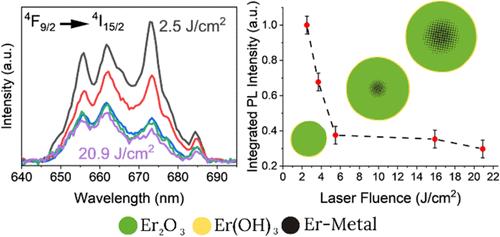
Erbium and erbium oxide nanoparticles (Er-NPs) have been synthesized in deionized (DI) water using the green and environmentally friendly technique of pulsed laser ablation in liquid (PLAL), with laser fluence ranging from 2.5 to 20.9 J/cm2. Owing to the careful examination of the nanoparticle morphology, crystal structure, and chemical composition, the occurrence of various growth regimes is evidenced. The size of the Er-NPs is found to increase with the laser fluence, and the formed nanoparticles are surrounded by a thin hydroxide layer of a few nanometers thickness, originating from water and chemical residues. The activation of 4f–4f optical transitions associated with trivalent Er3+ ions is promoted by the formation of erbium oxide. The Er-NPs having diameters lower than 100 nm are made of Er2O3, whereas Er-NPs of larger dimensions are made of an oxidized erbium oxide matrix containing a large amount of excess Er, the concentration of which increases gradually inside the Er-NPs. The formation of this graded Er/Er2O3 core–shell structure gives rise to a decrease in the Er visible photoluminescence emission. These findings shed light on the influence of the PLAL laser fluence on both the geometry and the composition of Er-NPs, as well as its consequence on their photoemission capacity, making them relevant for easy implementation with tunable properties in advanced photonics devices.
期刊介绍:
The Journal of Physical Chemistry A/B/C is devoted to reporting new and original experimental and theoretical basic research of interest to physical chemists, biophysical chemists, and chemical physicists.



 京公网安备 11010802042870号
京ICP备2023020795号-1
京公网安备 11010802042870号
京ICP备2023020795号-1

 分享
分享
 求助内容:
求助内容: 应助结果提醒方式:
 扫码关注我们
