Mathias Bal, Wouter Van Hoey, Robine Cleirbaut, Filip Lemière, Sabine Van Doorslaer, Pegie Cool, Bert U. W. Maes
{"title":"Visible Light-Photoinduced and Cu-Catalyzed Reduction of Nitrobenzenes into Anilines","authors":"Mathias Bal, Wouter Van Hoey, Robine Cleirbaut, Filip Lemière, Sabine Van Doorslaer, Pegie Cool, Bert U. W. Maes","doi":"10.1021/acscatal.4c07841","DOIUrl":null,"url":null,"abstract":"A visible light-photoinduced and Cu-catalyzed reduction of nitrobenzenes using <i>i</i>PrOH as a green and renewable hydrogen source in aqueous HCl/<i>i</i>PrOH at room temperature has been developed. The reduction of nitrobenzenes into anilines proceeds through nitrosobenzene and <i>N</i>-phenylhydroxylamine intermediates. While visible light and <i>i</i>PrOH allow the reduction of nitrobenzenes and nitrosobenzenes via photoexcitation and hydrogen atom abstraction from <i>i</i>PrOH, a Cu salt is a crucial additive to transform <i>N</i>-phenylhydroxylamines into the target anilines. Mechanistic studies revealed that Cu(I)X is required to reduce <i>N</i>-phenylhydroxylamines into anilines. Moreover, it avoids undesired arene chlorination, delivering chloroanilines. The reduction step does not require light irradiation and is accelerated by aq. HCl. The concomitantly produced Cu(II)X<sub>2</sub> is then reduced to Cu(I)X by oxidizing <i>N</i>-phenylhydroxylamines into nitrosobenzenes. Hereby, a Cu(I)–Cu(II) catalytic cycle is obtained.","PeriodicalId":9,"journal":{"name":"ACS Catalysis ","volume":"8 1","pages":""},"PeriodicalIF":13.1000,"publicationDate":"2025-03-06","publicationTypes":"Journal Article","fieldsOfStudy":null,"isOpenAccess":false,"openAccessPdf":"","citationCount":"0","resultStr":null,"platform":"Semanticscholar","paperid":null,"PeriodicalName":"ACS Catalysis ","FirstCategoryId":"92","ListUrlMain":"https://doi.org/10.1021/acscatal.4c07841","RegionNum":1,"RegionCategory":"化学","ArticlePicture":[],"TitleCN":null,"AbstractTextCN":null,"PMCID":null,"EPubDate":"","PubModel":"","JCR":"Q1","JCRName":"CHEMISTRY, PHYSICAL","Score":null,"Total":0}
引用次数: 0
Abstract
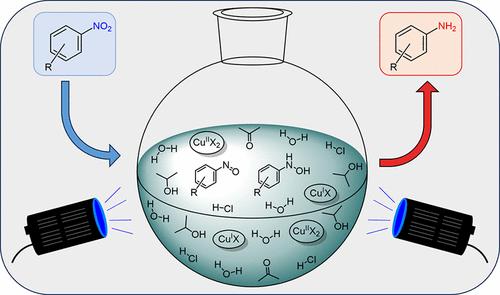
A visible light-photoinduced and Cu-catalyzed reduction of nitrobenzenes using iPrOH as a green and renewable hydrogen source in aqueous HCl/iPrOH at room temperature has been developed. The reduction of nitrobenzenes into anilines proceeds through nitrosobenzene and N-phenylhydroxylamine intermediates. While visible light and iPrOH allow the reduction of nitrobenzenes and nitrosobenzenes via photoexcitation and hydrogen atom abstraction from iPrOH, a Cu salt is a crucial additive to transform N-phenylhydroxylamines into the target anilines. Mechanistic studies revealed that Cu(I)X is required to reduce N-phenylhydroxylamines into anilines. Moreover, it avoids undesired arene chlorination, delivering chloroanilines. The reduction step does not require light irradiation and is accelerated by aq. HCl. The concomitantly produced Cu(II)X2 is then reduced to Cu(I)X by oxidizing N-phenylhydroxylamines into nitrosobenzenes. Hereby, a Cu(I)–Cu(II) catalytic cycle is obtained.
期刊介绍:
ACS Catalysis is an esteemed journal that publishes original research in the fields of heterogeneous catalysis, molecular catalysis, and biocatalysis. It offers broad coverage across diverse areas such as life sciences, organometallics and synthesis, photochemistry and electrochemistry, drug discovery and synthesis, materials science, environmental protection, polymer discovery and synthesis, and energy and fuels.
The scope of the journal is to showcase innovative work in various aspects of catalysis. This includes new reactions and novel synthetic approaches utilizing known catalysts, the discovery or modification of new catalysts, elucidation of catalytic mechanisms through cutting-edge investigations, practical enhancements of existing processes, as well as conceptual advances in the field. Contributions to ACS Catalysis can encompass both experimental and theoretical research focused on catalytic molecules, macromolecules, and materials that exhibit catalytic turnover.



 京公网安备 11010802042870号
京ICP备2023020795号-1
京公网安备 11010802042870号
京ICP备2023020795号-1

 分享
分享
 求助内容:
求助内容: 应助结果提醒方式:
 扫码关注我们
