Xingyong Huang, Mingjie Wan, Qilong Cao, Hai-Zhi Song and Ming Yang
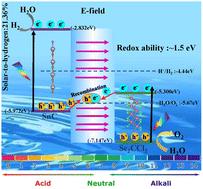
{"title":"Z-Scheme heterostructures of 2D SnC/Sc2CCl2 for overall water splitting with strong redox potential under visible light†","authors":"Xingyong Huang, Mingjie Wan, Qilong Cao, Hai-Zhi Song and Ming Yang","doi":"10.1039/D5CP00143A","DOIUrl":null,"url":null,"abstract":"<p >The two-dimensional (2D) Z-scheme system is an effective approach for hydrogen production <em>via</em> photocatalytic water splitting (PWS). This study established a 2D van der Waals (vdW) SnC/Sc<small><sub>2</sub></small>CCl<small><sub>2</sub></small> heterojunction for PWS. The electronic and optical properties of the designed heterojunction were determined using first-principles methods, showing that the heterojunction, acting as a Z-scheme photocatalyst (ZSP), formed an induced internal electric field to achieve effective electron–hole separation. The strong redox ability (∼1.5 eV) and moderate energy barrier of the SnC/Sc<small><sub>2</sub></small>CCl<small><sub>2</sub></small> heterojunction further enabled efficient PWS. Moreover, the PWS process benefited from the heterojunction's favorable absorption coefficient (10<small><sup>5</sup></small> cm<small><sup>−1</sup></small>) and solar-to-hydrogen conversion efficiency (21.36%) under visible light. The proposed Z-scheme SnC/Sc<small><sub>2</sub></small>CCl<small><sub>2</sub></small> heterojunction is a promising candidate for photocatalytic overall water splitting (POWS) across a pH range of 0–14.</p>","PeriodicalId":99,"journal":{"name":"Physical Chemistry Chemical Physics","volume":" 14","pages":" 6976-6983"},"PeriodicalIF":2.9000,"publicationDate":"2025-03-06","publicationTypes":"Journal Article","fieldsOfStudy":null,"isOpenAccess":false,"openAccessPdf":"","citationCount":"0","resultStr":null,"platform":"Semanticscholar","paperid":null,"PeriodicalName":"Physical Chemistry Chemical Physics","FirstCategoryId":"92","ListUrlMain":"https://pubs.rsc.org/en/content/articlelanding/2025/cp/d5cp00143a","RegionNum":3,"RegionCategory":"化学","ArticlePicture":[],"TitleCN":null,"AbstractTextCN":null,"PMCID":null,"EPubDate":"","PubModel":"","JCR":"Q3","JCRName":"CHEMISTRY, PHYSICAL","Score":null,"Total":0}
引用次数: 0
Abstract
The two-dimensional (2D) Z-scheme system is an effective approach for hydrogen production via photocatalytic water splitting (PWS). This study established a 2D van der Waals (vdW) SnC/Sc2CCl2 heterojunction for PWS. The electronic and optical properties of the designed heterojunction were determined using first-principles methods, showing that the heterojunction, acting as a Z-scheme photocatalyst (ZSP), formed an induced internal electric field to achieve effective electron–hole separation. The strong redox ability (∼1.5 eV) and moderate energy barrier of the SnC/Sc2CCl2 heterojunction further enabled efficient PWS. Moreover, the PWS process benefited from the heterojunction's favorable absorption coefficient (105 cm−1) and solar-to-hydrogen conversion efficiency (21.36%) under visible light. The proposed Z-scheme SnC/Sc2CCl2 heterojunction is a promising candidate for photocatalytic overall water splitting (POWS) across a pH range of 0–14.
期刊介绍:
Physical Chemistry Chemical Physics (PCCP) is an international journal co-owned by 19 physical chemistry and physics societies from around the world. This journal publishes original, cutting-edge research in physical chemistry, chemical physics and biophysical chemistry. To be suitable for publication in PCCP, articles must include significant innovation and/or insight into physical chemistry; this is the most important criterion that reviewers and Editors will judge against when evaluating submissions.
The journal has a broad scope and welcomes contributions spanning experiment, theory, computation and data science. Topical coverage includes spectroscopy, dynamics, kinetics, statistical mechanics, thermodynamics, electrochemistry, catalysis, surface science, quantum mechanics, quantum computing and machine learning. Interdisciplinary research areas such as polymers and soft matter, materials, nanoscience, energy, surfaces/interfaces, and biophysical chemistry are welcomed if they demonstrate significant innovation and/or insight into physical chemistry. Joined experimental/theoretical studies are particularly appreciated when complementary and based on up-to-date approaches.




 京公网安备 11010802042870号
京ICP备2023020795号-1
京公网安备 11010802042870号
京ICP备2023020795号-1

 分享
分享
 求助内容:
求助内容: 应助结果提醒方式:
 扫码关注我们
