Suo-Shu Zhang, Guang-Liang Wu, Zhao-Ting Yang, Shu-Yu Wang, Xun Ma, Yan-Ting Chen, Yuan-Yuan Guo, Lin Du, Qi-Hua Zhao
{"title":"High Proton Conductivity Enhancement Obtained by a Covalent Postsynthesis Modification Approach for Two Metal–Organic Frameworks","authors":"Suo-Shu Zhang, Guang-Liang Wu, Zhao-Ting Yang, Shu-Yu Wang, Xun Ma, Yan-Ting Chen, Yuan-Yuan Guo, Lin Du, Qi-Hua Zhao","doi":"10.1021/acs.inorgchem.4c04469","DOIUrl":null,"url":null,"abstract":"This study demonstrates an effective strategy to enhance proton conductivity by synthesizing 2 three-dimensional metal–organic frameworks (MOFs), [Zn(DTD22)]<sub><i>n</i></sub> (MOF 1) and [Cd<sub>2</sub>(DTD22)<sub>2</sub>]<sub><i>n</i></sub> (MOF 2), (DTD22 = 4,4″-diamino-[1,1′:4′,1″-terphenyl]-2,2″-dicarboxylic acid). The DTD22 ligand used formed a continuous hydrogen-bonding network in the structure, constructing excellent hydrophilic channels. MOF 1 and MOF 2 were further postsynthesized and modified (PSM) by Schiff base reaction, and 4-chloro-3-formylbenzenesulfonic acid ligands containing −SO<sub>3</sub>H and −Cl were successfully introduced into the framework to form PSM-MOF 1 and PSM-MOF 2. Experiments showed that this modification significantly enhanced the proton conductivity of the materials, especially at 90 °C and 98% RH: PSM-MOF 1 (2.38 × 10<sup>–1</sup> S·cm<sup>–1</sup>) and PSM-MOF 2 (3.50 × 10<sup>–1</sup> S·cm<sup>–1</sup>). In comparison, the conductivities of unmodified MOF 1 and MOF 2 were 8.55 × 10<sup>–2</sup> S·cm<sup>–1</sup> and 9.50 × 10<sup>–5</sup> S·cm<sup>–1</sup>, respectively. The present study demonstrates that the proton conductivity of MOFs can be effectively enhanced by the covalent postmodification method, which provides a new idea for the application of MOFs.","PeriodicalId":40,"journal":{"name":"Inorganic Chemistry","volume":"15 1","pages":""},"PeriodicalIF":4.6000,"publicationDate":"2025-03-06","publicationTypes":"Journal Article","fieldsOfStudy":null,"isOpenAccess":false,"openAccessPdf":"","citationCount":"0","resultStr":null,"platform":"Semanticscholar","paperid":null,"PeriodicalName":"Inorganic Chemistry","FirstCategoryId":"92","ListUrlMain":"https://doi.org/10.1021/acs.inorgchem.4c04469","RegionNum":2,"RegionCategory":"化学","ArticlePicture":[],"TitleCN":null,"AbstractTextCN":null,"PMCID":null,"EPubDate":"","PubModel":"","JCR":"Q1","JCRName":"CHEMISTRY, INORGANIC & NUCLEAR","Score":null,"Total":0}
引用次数: 0
Abstract
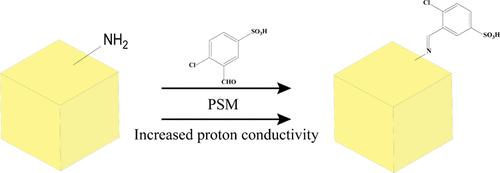
This study demonstrates an effective strategy to enhance proton conductivity by synthesizing 2 three-dimensional metal–organic frameworks (MOFs), [Zn(DTD22)]n (MOF 1) and [Cd2(DTD22)2]n (MOF 2), (DTD22 = 4,4″-diamino-[1,1′:4′,1″-terphenyl]-2,2″-dicarboxylic acid). The DTD22 ligand used formed a continuous hydrogen-bonding network in the structure, constructing excellent hydrophilic channels. MOF 1 and MOF 2 were further postsynthesized and modified (PSM) by Schiff base reaction, and 4-chloro-3-formylbenzenesulfonic acid ligands containing −SO3H and −Cl were successfully introduced into the framework to form PSM-MOF 1 and PSM-MOF 2. Experiments showed that this modification significantly enhanced the proton conductivity of the materials, especially at 90 °C and 98% RH: PSM-MOF 1 (2.38 × 10⁻¹ S·cm–1) and PSM-MOF 2 (3.50 × 10⁻¹ S·cm–1). In comparison, the conductivities of unmodified MOF 1 and MOF 2 were 8.55 × 10⁻² S·cm–1 and 9.50 × 10⁻⁵ S·cm–1, respectively. The present study demonstrates that the proton conductivity of MOFs can be effectively enhanced by the covalent postmodification method, which provides a new idea for the application of MOFs.
期刊介绍:
Inorganic Chemistry publishes fundamental studies in all phases of inorganic chemistry. Coverage includes experimental and theoretical reports on quantitative studies of structure and thermodynamics, kinetics, mechanisms of inorganic reactions, bioinorganic chemistry, and relevant aspects of organometallic chemistry, solid-state phenomena, and chemical bonding theory. Emphasis is placed on the synthesis, structure, thermodynamics, reactivity, spectroscopy, and bonding properties of significant new and known compounds.




 京公网安备 11010802042870号
京ICP备2023020795号-1
京公网安备 11010802042870号
京ICP备2023020795号-1

 分享
分享
 求助内容:
求助内容: 应助结果提醒方式:
 扫码关注我们
