Jannis Fidelius, Kai Schwedtmann, Sebastian Schellhammer, Rongjuan Huang, Felix Hennersdorf, Moritz Fink, Jan Haberstroh, Antonio Bauzá, Antonio Frontera, Sebastian Reineke and Jan J. Weigand
{"title":"1,3-Dipolar cycloaddition reactions of triflatophosphanes to afford functionalized azaphospholium salts and azaphospholes†","authors":"Jannis Fidelius, Kai Schwedtmann, Sebastian Schellhammer, Rongjuan Huang, Felix Hennersdorf, Moritz Fink, Jan Haberstroh, Antonio Bauzá, Antonio Frontera, Sebastian Reineke and Jan J. Weigand","doi":"10.1039/D5QI00427F","DOIUrl":null,"url":null,"abstract":"<p >The advent of 1,3-dipolar cycloadditions in organic chemistry has introduced a powerful tool for constructing novel ring systems. However, methods for synthesizing inorganic, phosphorus-containing rings <em>via</em> 1,3-dipolar cycloadditions have remained scarce and are largely limited to the functionalization of phosphaalkynes. In this contribution, we describe the synthesis of 1,3-dipolar triflatophosphanes, demonstrating their ability to engage in (3 + 2)-cycloadditions with a variety of dipolarophiles. In addition to nitriles, (thio)-cyanates, iso-(thio)-cyanates, and (thio)-ketones, phosphaalkenes also exhibit reactivity, yielding a wide range of heteroatom-functionalized di- and triazaphospholium compounds. Density Functional Theory (DFT) calculations provide insight into the likely stepwise mechanism. Furthermore, the reduction of synthesized diazaphospholium salts affords neutral diazaphospholes, offering a novel route to this class of compounds. Importantly, we explored the photophysical properties of selected diazaphospholes that exhibit strong fluorescence with photoluminescence quantum yields of up to 37%, making them attractive candidates for applications in optoelectronics.</p>","PeriodicalId":79,"journal":{"name":"Inorganic Chemistry Frontiers","volume":" 8","pages":" 3324-3333"},"PeriodicalIF":6.4000,"publicationDate":"2025-03-05","publicationTypes":"Journal Article","fieldsOfStudy":null,"isOpenAccess":false,"openAccessPdf":"https://pubs.rsc.org/en/content/articlepdf/2025/qi/d5qi00427f?page=search","citationCount":"0","resultStr":null,"platform":"Semanticscholar","paperid":null,"PeriodicalName":"Inorganic Chemistry Frontiers","FirstCategoryId":"92","ListUrlMain":"https://pubs.rsc.org/en/content/articlelanding/2025/qi/d5qi00427f","RegionNum":1,"RegionCategory":"化学","ArticlePicture":[],"TitleCN":null,"AbstractTextCN":null,"PMCID":null,"EPubDate":"","PubModel":"","JCR":"Q1","JCRName":"CHEMISTRY, INORGANIC & NUCLEAR","Score":null,"Total":0}
引用次数: 0
Abstract
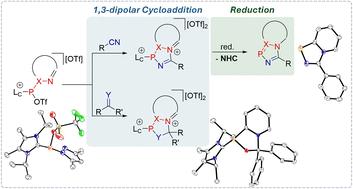
The advent of 1,3-dipolar cycloadditions in organic chemistry has introduced a powerful tool for constructing novel ring systems. However, methods for synthesizing inorganic, phosphorus-containing rings via 1,3-dipolar cycloadditions have remained scarce and are largely limited to the functionalization of phosphaalkynes. In this contribution, we describe the synthesis of 1,3-dipolar triflatophosphanes, demonstrating their ability to engage in (3 + 2)-cycloadditions with a variety of dipolarophiles. In addition to nitriles, (thio)-cyanates, iso-(thio)-cyanates, and (thio)-ketones, phosphaalkenes also exhibit reactivity, yielding a wide range of heteroatom-functionalized di- and triazaphospholium compounds. Density Functional Theory (DFT) calculations provide insight into the likely stepwise mechanism. Furthermore, the reduction of synthesized diazaphospholium salts affords neutral diazaphospholes, offering a novel route to this class of compounds. Importantly, we explored the photophysical properties of selected diazaphospholes that exhibit strong fluorescence with photoluminescence quantum yields of up to 37%, making them attractive candidates for applications in optoelectronics.




 京公网安备 11010802042870号
京ICP备2023020795号-1
京公网安备 11010802042870号
京ICP备2023020795号-1

 分享
分享
 求助内容:
求助内容: 应助结果提醒方式:
 扫码关注我们
