Tianyi Zhou , Xingfang Yu , Yuanfang Li , Yuanping Jiang , Zuojia Li , Yingcai Wang , Yayu Dong , Zhibin Zhang , Yunhai Liu
{"title":"Boosting photocatalytic reduction of uranium by sulfur-doped zinc ferrate nanoparticles: Impacts of shallow energy levels and light intensity","authors":"Tianyi Zhou , Xingfang Yu , Yuanfang Li , Yuanping Jiang , Zuojia Li , Yingcai Wang , Yayu Dong , Zhibin Zhang , Yunhai Liu","doi":"10.1016/j.jssc.2025.125290","DOIUrl":null,"url":null,"abstract":"<div><div>A critical aspect of the design of photocatalytic materials is the prevention of recombination of photogenerated carriers to maximize the photocatalytic efficiency for the removal of U(VI). Herein, the sulfur successfully integrated into co-precipitated zinc ferrate nanoparticles (ZFO) and nitrogen-doped zinc ferrate nanoparticles (N-ZFO) through a hydrothermal method, which exhibit exceptional photocatalytic activity under various lighting conditions. Compared to conventional ZFO, the bandgap energy of sulfur-doped ZFO was found to be narrower, and the charge carrier separation and transfer rates were higher, which are beneficial for the reduction of U(VI) by photoelectrons. Among these, the co-precipitated ZnFe<sub>2</sub>O<sub>4</sub> demonstrated a U(VI) reduction efficiency that was four times that of N-ZFO, and the reduction effect of S<sub>6</sub>-ZFO on U(VI) was 1.21 times and 1.08 times that of ZFO and S<sub>15</sub>–N-ZFO, respectively. The photocatalytic activity of S<sub>6</sub>-ZFO under natural light conditions exhibits diverse behaviors: 418.49 μmol/(g·h) on sunny days, 198.95 μmol/(g·h) on cloudy days, and 40.55 μmol/(g·h) on rainy days. Remarkably, it retains good photocatalytic activity even under a light intensity of 1000 Lux, offering a valuable strategy for the development of high-performance low-light photocatalysts. This breakthrough work offers a unique interfacial engineering approach capable of enhancing the removal of U(VI).</div></div>","PeriodicalId":378,"journal":{"name":"Journal of Solid State Chemistry","volume":"347 ","pages":"Article 125290"},"PeriodicalIF":3.5000,"publicationDate":"2025-02-28","publicationTypes":"Journal Article","fieldsOfStudy":null,"isOpenAccess":false,"openAccessPdf":"","citationCount":"0","resultStr":null,"platform":"Semanticscholar","paperid":null,"PeriodicalName":"Journal of Solid State Chemistry","FirstCategoryId":"92","ListUrlMain":"https://www.sciencedirect.com/science/article/pii/S0022459625001136","RegionNum":3,"RegionCategory":"化学","ArticlePicture":[],"TitleCN":null,"AbstractTextCN":null,"PMCID":null,"EPubDate":"","PubModel":"","JCR":"Q2","JCRName":"CHEMISTRY, INORGANIC & NUCLEAR","Score":null,"Total":0}
引用次数: 0
Abstract
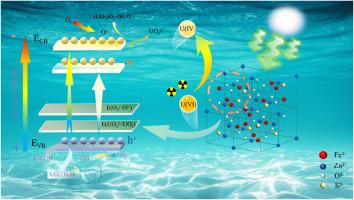
A critical aspect of the design of photocatalytic materials is the prevention of recombination of photogenerated carriers to maximize the photocatalytic efficiency for the removal of U(VI). Herein, the sulfur successfully integrated into co-precipitated zinc ferrate nanoparticles (ZFO) and nitrogen-doped zinc ferrate nanoparticles (N-ZFO) through a hydrothermal method, which exhibit exceptional photocatalytic activity under various lighting conditions. Compared to conventional ZFO, the bandgap energy of sulfur-doped ZFO was found to be narrower, and the charge carrier separation and transfer rates were higher, which are beneficial for the reduction of U(VI) by photoelectrons. Among these, the co-precipitated ZnFe2O4 demonstrated a U(VI) reduction efficiency that was four times that of N-ZFO, and the reduction effect of S6-ZFO on U(VI) was 1.21 times and 1.08 times that of ZFO and S15–N-ZFO, respectively. The photocatalytic activity of S6-ZFO under natural light conditions exhibits diverse behaviors: 418.49 μmol/(g·h) on sunny days, 198.95 μmol/(g·h) on cloudy days, and 40.55 μmol/(g·h) on rainy days. Remarkably, it retains good photocatalytic activity even under a light intensity of 1000 Lux, offering a valuable strategy for the development of high-performance low-light photocatalysts. This breakthrough work offers a unique interfacial engineering approach capable of enhancing the removal of U(VI).
期刊介绍:
Covering major developments in the field of solid state chemistry and related areas such as ceramics and amorphous materials, the Journal of Solid State Chemistry features studies of chemical, structural, thermodynamic, electronic, magnetic, and optical properties and processes in solids.



 京公网安备 11010802042870号
京ICP备2023020795号-1
京公网安备 11010802042870号
京ICP备2023020795号-1

 分享
分享
 求助内容:
求助内容: 应助结果提醒方式:
 扫码关注我们
