{"title":"A review of the effect of biofertilizers on productivity and aflatoxin production in groundnuts (Arachis hypogaea)","authors":"Tariro Munyari , Nancy Nleya , Kudakwashe Chitindingu , Melody Ndemera","doi":"10.1016/j.jafr.2025.101773","DOIUrl":null,"url":null,"abstract":"<div><div>Groundnuts (<em>Arachis hypogaea</em>) are an important crop globally but face a dual challenge of low productivity and aflatoxin contamination, threatening food security, farmer livelihoods, and public health. Conventional mitigation methods have proven inadequate, triggering the need for more efficient and sustainable methods. The review aimed to examine the effects of biofertilizer application on aflatoxin production levels in groundnuts and to assess its impact on groundnut yield and overall productivity. A structured search was conducted across several databases like Google Scholar, PubMed, Scopus, and Connected Papers, using keywords such as ‘biofertilizers,’ ‘aflatoxin,’ ‘groundnut productivity,’ and ‘sustainable agriculture’ and Boolean operators (AND, OR, NOT) to refine the search results. Studies were included if they provided quantitative data on the impact of biofertilizers on groundnut yield or aflatoxin reduction, addressing the dual challenge of improving crop productivity while reducing aflatoxin contamination. Reviewed studies indicated productivity gains ranging from 2.69 t/ha to 7.42 t/ha, alongside aflatoxin reductions of 56 %–100 % following biofertilizer application. The findings highlight that biofertilizers present a sustainable solution, simultaneously boosting crop productivity, enhancing soil health, and reducing aflatoxin contamination contributing to improved food security and safety.</div></div>","PeriodicalId":34393,"journal":{"name":"Journal of Agriculture and Food Research","volume":"20 ","pages":"Article 101773"},"PeriodicalIF":6.2000,"publicationDate":"2025-04-01","publicationTypes":"Journal Article","fieldsOfStudy":null,"isOpenAccess":false,"openAccessPdf":"","citationCount":"0","resultStr":null,"platform":"Semanticscholar","paperid":null,"PeriodicalName":"Journal of Agriculture and Food Research","FirstCategoryId":"1085","ListUrlMain":"https://www.sciencedirect.com/science/article/pii/S2666154325001449","RegionNum":0,"RegionCategory":null,"ArticlePicture":[],"TitleCN":null,"AbstractTextCN":null,"PMCID":null,"EPubDate":"2025/2/24 0:00:00","PubModel":"Epub","JCR":"Q1","JCRName":"AGRICULTURE, MULTIDISCIPLINARY","Score":null,"Total":0}
引用次数: 0
Abstract
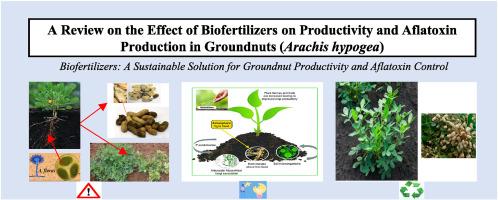
Groundnuts (Arachis hypogaea) are an important crop globally but face a dual challenge of low productivity and aflatoxin contamination, threatening food security, farmer livelihoods, and public health. Conventional mitigation methods have proven inadequate, triggering the need for more efficient and sustainable methods. The review aimed to examine the effects of biofertilizer application on aflatoxin production levels in groundnuts and to assess its impact on groundnut yield and overall productivity. A structured search was conducted across several databases like Google Scholar, PubMed, Scopus, and Connected Papers, using keywords such as ‘biofertilizers,’ ‘aflatoxin,’ ‘groundnut productivity,’ and ‘sustainable agriculture’ and Boolean operators (AND, OR, NOT) to refine the search results. Studies were included if they provided quantitative data on the impact of biofertilizers on groundnut yield or aflatoxin reduction, addressing the dual challenge of improving crop productivity while reducing aflatoxin contamination. Reviewed studies indicated productivity gains ranging from 2.69 t/ha to 7.42 t/ha, alongside aflatoxin reductions of 56 %–100 % following biofertilizer application. The findings highlight that biofertilizers present a sustainable solution, simultaneously boosting crop productivity, enhancing soil health, and reducing aflatoxin contamination contributing to improved food security and safety.




 京公网安备 11010802042870号
京ICP备2023020795号-1
京公网安备 11010802042870号
京ICP备2023020795号-1

 分享
分享
 求助内容:
求助内容: 应助结果提醒方式:
 扫码关注我们
