{"title":"Space-confined growth of halide perovskite nanocrystals for enhanced photocatalytic hydrogen evolution","authors":"Xue Li, Miaomiao Gao, Yaqiang Wu, Hui Fu, Qianqian Zhang, Jinghang Chen, Zeyan Wang, Zhaoke Zheng, Hefeng Cheng, Yuanyuan Liu, Baibiao Huang, Peng Wang","doi":"10.1016/j.mcat.2025.114981","DOIUrl":null,"url":null,"abstract":"<div><div>Halide perovskites, as emerging semiconductor materials, exhibit great potential in photocatalytic hydrogen evolution. However, perovskite powders prepared through the conventional co-precipitation method typically form large-sized particles with diameters of several tens of micrometers, resulting in low specific surface area and limited active sites, which seriously compromise their catalytic efficiency. Herein, a spatially confined growth method is developed to grow small-sized mixed halide perovskite FAPbBr<sub>3-x</sub>I<sub>x</sub> (FA = CH(NH<sub>2</sub>)<sub>2</sub><sup>+</sup>) nanocrystals within MCM-41 molecular sieve for photocatalytic hydroiodic acid splitting. This developed method significantly increases the specific surface area, provides more reaction sites, and promotes the separation of carriers for the perovskite nanocrystal. When loading with Pt as the cocatalyst, 40 % MCM-41@FAPbBr<sub>3-x</sub>I<sub>x</sub> composite demonstrates excellent photocatalytic H<sub>2</sub> evolution activity of 2260 μmol h<sup>−1</sup>. This work presents an inspiring advancement in confined growth tactics for perovskite nanocrystals to achieve efficient photocatalytic hydrogen evolution.</div></div>","PeriodicalId":393,"journal":{"name":"Molecular Catalysis","volume":"578 ","pages":"Article 114981"},"PeriodicalIF":4.9000,"publicationDate":"2025-05-01","publicationTypes":"Journal Article","fieldsOfStudy":null,"isOpenAccess":false,"openAccessPdf":"","citationCount":"0","resultStr":null,"platform":"Semanticscholar","paperid":null,"PeriodicalName":"Molecular Catalysis","FirstCategoryId":"92","ListUrlMain":"https://www.sciencedirect.com/science/article/pii/S2468823125001671","RegionNum":2,"RegionCategory":"化学","ArticlePicture":[],"TitleCN":null,"AbstractTextCN":null,"PMCID":null,"EPubDate":"2025/3/6 0:00:00","PubModel":"Epub","JCR":"Q2","JCRName":"CHEMISTRY, PHYSICAL","Score":null,"Total":0}
引用次数: 0
Abstract
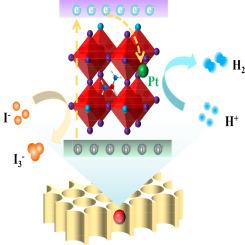
Halide perovskites, as emerging semiconductor materials, exhibit great potential in photocatalytic hydrogen evolution. However, perovskite powders prepared through the conventional co-precipitation method typically form large-sized particles with diameters of several tens of micrometers, resulting in low specific surface area and limited active sites, which seriously compromise their catalytic efficiency. Herein, a spatially confined growth method is developed to grow small-sized mixed halide perovskite FAPbBr3-xIx (FA = CH(NH2)2+) nanocrystals within MCM-41 molecular sieve for photocatalytic hydroiodic acid splitting. This developed method significantly increases the specific surface area, provides more reaction sites, and promotes the separation of carriers for the perovskite nanocrystal. When loading with Pt as the cocatalyst, 40 % MCM-41@FAPbBr3-xIx composite demonstrates excellent photocatalytic H2 evolution activity of 2260 μmol h−1. This work presents an inspiring advancement in confined growth tactics for perovskite nanocrystals to achieve efficient photocatalytic hydrogen evolution.
期刊介绍:
Molecular Catalysis publishes full papers that are original, rigorous, and scholarly contributions examining the molecular and atomic aspects of catalytic activation and reaction mechanisms. The fields covered are:
Heterogeneous catalysis including immobilized molecular catalysts
Homogeneous catalysis including organocatalysis, organometallic catalysis and biocatalysis
Photo- and electrochemistry
Theoretical aspects of catalysis analyzed by computational methods



 京公网安备 11010802042870号
京ICP备2023020795号-1
京公网安备 11010802042870号
京ICP备2023020795号-1

 分享
分享
 求助内容:
求助内容: 应助结果提醒方式:
 扫码关注我们
