Construction of photothermal hybrid with surface-polarized carbon nanotube twined oxygen-vacancy engineered cuprous oxide for improved PMS activation and water purification
Yarao Gao , Hongyao Zhao , Mengting Liu , Yanyun Wang , Yangping Zhang , Linzhi Zhai , Xiang Liu , Feng Zeng , Jianming Pan , Danhong Shang , Fu Yang
{"title":"Construction of photothermal hybrid with surface-polarized carbon nanotube twined oxygen-vacancy engineered cuprous oxide for improved PMS activation and water purification","authors":"Yarao Gao , Hongyao Zhao , Mengting Liu , Yanyun Wang , Yangping Zhang , Linzhi Zhai , Xiang Liu , Feng Zeng , Jianming Pan , Danhong Shang , Fu Yang","doi":"10.1016/j.mcat.2025.114994","DOIUrl":null,"url":null,"abstract":"<div><div>Photothermal hybrids composed of nanocarbon and metal species are promising in solar-driven photothermal conversion and later application of water purification. Herein, the photothermal hybrid with surface-polarized carbon nanotube (CNT) twined oxygen vacancy-engineered cuprous oxides was constructed. The surface polar oxygen and nitrogen moieties were introduced onto the CNT, enriching the surface polarity of the nanocarbon, which further twined the in-situ generated oxygen vacancy-engineered cuprous oxides. The constructed catalyst was endowed with abundant Cu(I) reactive sites and oxygen vacancy, providing the efficient trapping effect and enough exposed active sites to trigger improved peroxymonosulfate (PMS) activation. In addition, the obtained catalyst affords superior photothermal conversion efficiency, thereby showcasing the great potential in solar-driven water purification. Therefore, the catalyst shows excellent bisphenol A (BPA) degradation performance with a reaction rate constant of 0.47 min<sup>-1</sup>, and activation energy (Ea=9.38 kJ<strong>·</strong>mol<sup>-1</sup>).. The reaction mechanism study indicates the main contribution of singlet oxygen and superoxide radicals in the BPA degradation. More importantly, the obtained catalyst affords the excellent total organic carbon (TOC) removal ability for mixed contaminants, higher than that of single contaminant removal, which shows great potential for practical complicated wastewater purification. Finally, the obtained photothermal hybrids were anchored onto the tailored sponge through a hydrogel tethering strategy, which acts as a monolith evaporator to enable cleanwater regeneration and contaminant degradation.</div></div>","PeriodicalId":393,"journal":{"name":"Molecular Catalysis","volume":"578 ","pages":"Article 114994"},"PeriodicalIF":4.9000,"publicationDate":"2025-05-01","publicationTypes":"Journal Article","fieldsOfStudy":null,"isOpenAccess":false,"openAccessPdf":"","citationCount":"0","resultStr":null,"platform":"Semanticscholar","paperid":null,"PeriodicalName":"Molecular Catalysis","FirstCategoryId":"92","ListUrlMain":"https://www.sciencedirect.com/science/article/pii/S2468823125001804","RegionNum":2,"RegionCategory":"化学","ArticlePicture":[],"TitleCN":null,"AbstractTextCN":null,"PMCID":null,"EPubDate":"2025/3/6 0:00:00","PubModel":"Epub","JCR":"Q2","JCRName":"CHEMISTRY, PHYSICAL","Score":null,"Total":0}
引用次数: 0
Abstract
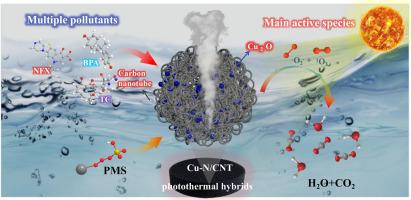
Photothermal hybrids composed of nanocarbon and metal species are promising in solar-driven photothermal conversion and later application of water purification. Herein, the photothermal hybrid with surface-polarized carbon nanotube (CNT) twined oxygen vacancy-engineered cuprous oxides was constructed. The surface polar oxygen and nitrogen moieties were introduced onto the CNT, enriching the surface polarity of the nanocarbon, which further twined the in-situ generated oxygen vacancy-engineered cuprous oxides. The constructed catalyst was endowed with abundant Cu(I) reactive sites and oxygen vacancy, providing the efficient trapping effect and enough exposed active sites to trigger improved peroxymonosulfate (PMS) activation. In addition, the obtained catalyst affords superior photothermal conversion efficiency, thereby showcasing the great potential in solar-driven water purification. Therefore, the catalyst shows excellent bisphenol A (BPA) degradation performance with a reaction rate constant of 0.47 min-1, and activation energy (Ea=9.38 kJ·mol-1).. The reaction mechanism study indicates the main contribution of singlet oxygen and superoxide radicals in the BPA degradation. More importantly, the obtained catalyst affords the excellent total organic carbon (TOC) removal ability for mixed contaminants, higher than that of single contaminant removal, which shows great potential for practical complicated wastewater purification. Finally, the obtained photothermal hybrids were anchored onto the tailored sponge through a hydrogel tethering strategy, which acts as a monolith evaporator to enable cleanwater regeneration and contaminant degradation.
期刊介绍:
Molecular Catalysis publishes full papers that are original, rigorous, and scholarly contributions examining the molecular and atomic aspects of catalytic activation and reaction mechanisms. The fields covered are:
Heterogeneous catalysis including immobilized molecular catalysts
Homogeneous catalysis including organocatalysis, organometallic catalysis and biocatalysis
Photo- and electrochemistry
Theoretical aspects of catalysis analyzed by computational methods



 京公网安备 11010802042870号
京ICP备2023020795号-1
京公网安备 11010802042870号
京ICP备2023020795号-1

 分享
分享
 求助内容:
求助内容: 应助结果提醒方式:
 扫码关注我们
