Mengling Liu , Qiuping Zhao , Lei Wang , Luyun Chen , Na Shang , Xueliang Wang , Haibin Wang , Chunlei Li , Junying Tian
{"title":"RuNi nanoparticles encased within a carbon layer for the enhancement of alkaline hydrogen oxidation reaction","authors":"Mengling Liu , Qiuping Zhao , Lei Wang , Luyun Chen , Na Shang , Xueliang Wang , Haibin Wang , Chunlei Li , Junying Tian","doi":"10.1016/j.jelechem.2025.119065","DOIUrl":null,"url":null,"abstract":"<div><div>Strong binding affinity for H, CO, and oxygen-containing species of Ru often hinder its electrocatalytic efficiency in hydrogen oxidation reaction (HOR) within alkaline exchange membrane fuel cells (AEMFCs). To address this, a RuNi alloy encased within a carbon shell (Ru<sub>0.55</sub>Ni<sub>0.45</sub>@C) is prepared through interchain cross-linking, freeze-drying and carbonization processes. The Ru<sub>0.55</sub>Ni<sub>0.45</sub>@C electrcatalyst demonstrates remarkable HOR activity of 526 A g<sub>Ru</sub><sup>−1</sup>, surpassing the Pt/C by 2.0 times. Most notably, the electrocatalyst exhibits high tolerance CO. Experimental data indicate that electron transfer from Ni and carbon layer to Ru leads to a decrease in the d-band center of Ru, which in turn reduces both the H and CO binding energy. Additionally, the Ru<sub>0.55</sub>Ni<sub>0.45</sub>@C electrocatalyst shows an unusual surge in activity at potentials exceeding 0.375 V vs. RHE. Quasi in situ X-ray photoelectron spectroscopy (XPS) analysis reveals this surge in activity is due to electron enrichment of the Ru component.</div></div>","PeriodicalId":355,"journal":{"name":"Journal of Electroanalytical Chemistry","volume":"984 ","pages":"Article 119065"},"PeriodicalIF":4.1000,"publicationDate":"2025-05-01","publicationTypes":"Journal Article","fieldsOfStudy":null,"isOpenAccess":false,"openAccessPdf":"","citationCount":"0","resultStr":null,"platform":"Semanticscholar","paperid":null,"PeriodicalName":"Journal of Electroanalytical Chemistry","FirstCategoryId":"92","ListUrlMain":"https://www.sciencedirect.com/science/article/pii/S1572665725001390","RegionNum":3,"RegionCategory":"化学","ArticlePicture":[],"TitleCN":null,"AbstractTextCN":null,"PMCID":null,"EPubDate":"2025/3/4 0:00:00","PubModel":"Epub","JCR":"Q1","JCRName":"CHEMISTRY, ANALYTICAL","Score":null,"Total":0}
引用次数: 0
Abstract
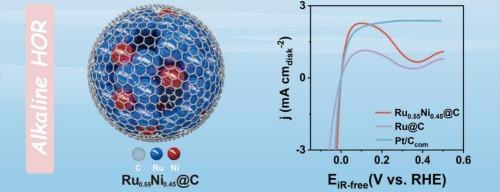
Strong binding affinity for H, CO, and oxygen-containing species of Ru often hinder its electrocatalytic efficiency in hydrogen oxidation reaction (HOR) within alkaline exchange membrane fuel cells (AEMFCs). To address this, a RuNi alloy encased within a carbon shell (Ru0.55Ni0.45@C) is prepared through interchain cross-linking, freeze-drying and carbonization processes. The Ru0.55Ni0.45@C electrcatalyst demonstrates remarkable HOR activity of 526 A gRu−1, surpassing the Pt/C by 2.0 times. Most notably, the electrocatalyst exhibits high tolerance CO. Experimental data indicate that electron transfer from Ni and carbon layer to Ru leads to a decrease in the d-band center of Ru, which in turn reduces both the H and CO binding energy. Additionally, the Ru0.55Ni0.45@C electrocatalyst shows an unusual surge in activity at potentials exceeding 0.375 V vs. RHE. Quasi in situ X-ray photoelectron spectroscopy (XPS) analysis reveals this surge in activity is due to electron enrichment of the Ru component.
在碱性交换膜燃料电池(aemfc)中,钌对H、CO和含氧物质的强结合亲和性往往会阻碍其在氢氧化反应(HOR)中的电催化效率。为了解决这个问题,通过链间交联、冷冻干燥和碳化工艺制备了一种包裹在碳壳内的RuNi合金(Ru0.55Ni0.45@C)。Ru0.55Ni0.45@C电催化剂的HOR活性为526 A gRu−1,是Pt/C的2.0倍。实验数据表明,电子从Ni和碳层转移到Ru,导致Ru的d带中心减小,从而降低了H和CO的结合能。此外,与RHE相比,Ru0.55Ni0.45@C电催化剂在电位超过0.375 V时表现出异常的活性激增。准原位x射线光电子能谱(XPS)分析表明,这种活性的激增是由于Ru成分的电子富集。
期刊介绍:
The Journal of Electroanalytical Chemistry is the foremost international journal devoted to the interdisciplinary subject of electrochemistry in all its aspects, theoretical as well as applied.
Electrochemistry is a wide ranging area that is in a state of continuous evolution. Rather than compiling a long list of topics covered by the Journal, the editors would like to draw particular attention to the key issues of novelty, topicality and quality. Papers should present new and interesting electrochemical science in a way that is accessible to the reader. The presentation and discussion should be at a level that is consistent with the international status of the Journal. Reports describing the application of well-established techniques to problems that are essentially technical will not be accepted. Similarly, papers that report observations but fail to provide adequate interpretation will be rejected by the Editors. Papers dealing with technical electrochemistry should be submitted to other specialist journals unless the authors can show that their work provides substantially new insights into electrochemical processes.



 京公网安备 11010802042870号
京ICP备2023020795号-1
京公网安备 11010802042870号
京ICP备2023020795号-1

 分享
分享
 求助内容:
求助内容: 应助结果提醒方式:
 扫码关注我们
