Maxwell Ampomah-Wireko , Ye Qu , Daran Li , Yuequan Wu , Ruirui Li , Yuanbo Li , Hongtao Kong , Zhi-Hao Li , Ya-Na Wang , En Zhang
{"title":"Design, synthesis and antibacterial evaluation of oxazolidinone derivatives containing N-methylglycyl or quaternary ammonium salts","authors":"Maxwell Ampomah-Wireko , Ye Qu , Daran Li , Yuequan Wu , Ruirui Li , Yuanbo Li , Hongtao Kong , Zhi-Hao Li , Ya-Na Wang , En Zhang","doi":"10.1016/j.bmc.2025.118144","DOIUrl":null,"url":null,"abstract":"<div><div>The continuous evolution of multidrug-resistant (MDR) bacteria to existing antibiotic treatment regimens poses a serious threat to human health, so the discovery of new and potent antimicrobial drugs that are less likely to develop resistance is of great clinical significance. As a result, oxazolidinone antibiotics have emerged as a significant class of bacterial protein synthesis inhibitors, with particular success in the treatment of MDR Gram-positive infections. Herein, a series of novel C-ring modified oxazolidinone derivatives with the introduction of <em>N</em>-methylglycyl groups or quaternary ammonium salts were synthesized and evaluated for their antibacterial efficacy, among which most of the <em>N</em>-methylglycyl derivatives showed significant activity against <em>E. faecalis</em>. Notably, compounds <strong>11g–11i</strong> showed good activity against <em>E. faecalis</em> and <em>S. aureus</em> with MICs of 2–8 μg/mL. The selected compound <strong>11g</strong> exhibited rapid bactericidal properties, good biofilm disruption capacity, low tendency to induce bacterial resistance, and low cytotoxicity against mammalian cells (HeLa). Furthermore, compound <strong>11g</strong> showed relatively good stability in mammalian body fluids and exhibited a longer post-antibiotic effect (PAE). Mechanistic studies showed that compound <strong>11g</strong> exerted its antibacterial effect by inhibiting glutathione (GSH) activity and inducing reactive oxygen species (ROS) accumulation, leading to bacterial death. These findings suggest that <strong>11g</strong> is a promising candidate for the exploitation of <em>N</em>-methylglycyl oxazolidinones as novel antibacterial agents.</div></div>","PeriodicalId":255,"journal":{"name":"Bioorganic & Medicinal Chemistry","volume":"122 ","pages":"Article 118144"},"PeriodicalIF":3.0000,"publicationDate":"2025-05-01","publicationTypes":"Journal Article","fieldsOfStudy":null,"isOpenAccess":false,"openAccessPdf":"","citationCount":"0","resultStr":null,"platform":"Semanticscholar","paperid":null,"PeriodicalName":"Bioorganic & Medicinal Chemistry","FirstCategoryId":"3","ListUrlMain":"https://www.sciencedirect.com/science/article/pii/S0968089625000859","RegionNum":3,"RegionCategory":"医学","ArticlePicture":[],"TitleCN":null,"AbstractTextCN":null,"PMCID":null,"EPubDate":"2025/3/2 0:00:00","PubModel":"Epub","JCR":"Q2","JCRName":"BIOCHEMISTRY & MOLECULAR BIOLOGY","Score":null,"Total":0}
引用次数: 0
Abstract
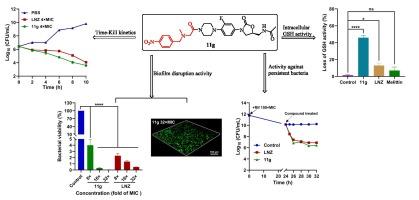
The continuous evolution of multidrug-resistant (MDR) bacteria to existing antibiotic treatment regimens poses a serious threat to human health, so the discovery of new and potent antimicrobial drugs that are less likely to develop resistance is of great clinical significance. As a result, oxazolidinone antibiotics have emerged as a significant class of bacterial protein synthesis inhibitors, with particular success in the treatment of MDR Gram-positive infections. Herein, a series of novel C-ring modified oxazolidinone derivatives with the introduction of N-methylglycyl groups or quaternary ammonium salts were synthesized and evaluated for their antibacterial efficacy, among which most of the N-methylglycyl derivatives showed significant activity against E. faecalis. Notably, compounds 11g–11i showed good activity against E. faecalis and S. aureus with MICs of 2–8 μg/mL. The selected compound 11g exhibited rapid bactericidal properties, good biofilm disruption capacity, low tendency to induce bacterial resistance, and low cytotoxicity against mammalian cells (HeLa). Furthermore, compound 11g showed relatively good stability in mammalian body fluids and exhibited a longer post-antibiotic effect (PAE). Mechanistic studies showed that compound 11g exerted its antibacterial effect by inhibiting glutathione (GSH) activity and inducing reactive oxygen species (ROS) accumulation, leading to bacterial death. These findings suggest that 11g is a promising candidate for the exploitation of N-methylglycyl oxazolidinones as novel antibacterial agents.
期刊介绍:
Bioorganic & Medicinal Chemistry provides an international forum for the publication of full original research papers and critical reviews on molecular interactions in key biological targets such as receptors, channels, enzymes, nucleotides, lipids and saccharides.
The aim of the journal is to promote a better understanding at the molecular level of life processes, and living organisms, as well as the interaction of these with chemical agents. A special feature will be that colour illustrations will be reproduced at no charge to the author, provided that the Editor agrees that colour is essential to the information content of the illustration in question.



 京公网安备 11010802042870号
京ICP备2023020795号-1
京公网安备 11010802042870号
京ICP备2023020795号-1

 分享
分享
 求助内容:
求助内容: 应助结果提醒方式:
 扫码关注我们
