{"title":"Machine learning-guided malate dehydrogenase engineering for improved production of L-malic acid in Aspergillus niger","authors":"Zihan Zhang , Yuanyuan Zheng , Chi Zhang, Qing Xu, Feng Xue","doi":"10.1016/j.mcat.2025.114990","DOIUrl":null,"url":null,"abstract":"<div><div>L-malic acid (MA) is an important four-carbon platform compound, with wide applications in food, pharmaceuticals, and cosmetics. Malate dehydrogenase (MDH), which also catalyzes the reduction of oxaloacetate (OAA) as the reaction is reversible, is the key enzyme for microbial production of L-MA. Here, machine-learning-guided protein engineering was applied to <em>An</em>MDH from <em>Aspergillus niger</em>, resulting in the best variant G212A/G234 V with a remarkable 11-fold improvement of enzyme activity. Then, the efficient L-MA-producing strain <em>A. niger</em> RG020 was constructed by introducing <em>An</em>MDH<sup>G212A/G234V</sup> into <em>A. niger</em> RG018. Shake-flask and bioreactor studies showed that <em>A. niger</em> RG020 had an increased L-MA production rate and yield compared to the parental strain RG018. In a 5-L batch bioreactor, the fermentation period was shortened from 146 to 104 h, with the productivity of MA increasing from 0.93 to 1.42 g/L/h. Our work provides practical guidance for improving the productivity of industrial strains.</div></div>","PeriodicalId":393,"journal":{"name":"Molecular Catalysis","volume":"578 ","pages":"Article 114990"},"PeriodicalIF":4.9000,"publicationDate":"2025-03-06","publicationTypes":"Journal Article","fieldsOfStudy":null,"isOpenAccess":false,"openAccessPdf":"","citationCount":"0","resultStr":null,"platform":"Semanticscholar","paperid":null,"PeriodicalName":"Molecular Catalysis","FirstCategoryId":"92","ListUrlMain":"https://www.sciencedirect.com/science/article/pii/S2468823125001762","RegionNum":2,"RegionCategory":"化学","ArticlePicture":[],"TitleCN":null,"AbstractTextCN":null,"PMCID":null,"EPubDate":"","PubModel":"","JCR":"Q2","JCRName":"CHEMISTRY, PHYSICAL","Score":null,"Total":0}
引用次数: 0
Abstract
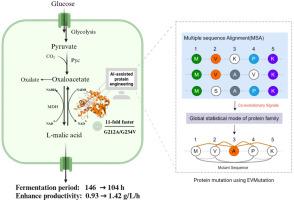
L-malic acid (MA) is an important four-carbon platform compound, with wide applications in food, pharmaceuticals, and cosmetics. Malate dehydrogenase (MDH), which also catalyzes the reduction of oxaloacetate (OAA) as the reaction is reversible, is the key enzyme for microbial production of L-MA. Here, machine-learning-guided protein engineering was applied to AnMDH from Aspergillus niger, resulting in the best variant G212A/G234 V with a remarkable 11-fold improvement of enzyme activity. Then, the efficient L-MA-producing strain A. niger RG020 was constructed by introducing AnMDHG212A/G234V into A. niger RG018. Shake-flask and bioreactor studies showed that A. niger RG020 had an increased L-MA production rate and yield compared to the parental strain RG018. In a 5-L batch bioreactor, the fermentation period was shortened from 146 to 104 h, with the productivity of MA increasing from 0.93 to 1.42 g/L/h. Our work provides practical guidance for improving the productivity of industrial strains.
期刊介绍:
Molecular Catalysis publishes full papers that are original, rigorous, and scholarly contributions examining the molecular and atomic aspects of catalytic activation and reaction mechanisms. The fields covered are:
Heterogeneous catalysis including immobilized molecular catalysts
Homogeneous catalysis including organocatalysis, organometallic catalysis and biocatalysis
Photo- and electrochemistry
Theoretical aspects of catalysis analyzed by computational methods



 京公网安备 11010802042870号
京ICP备2023020795号-1
京公网安备 11010802042870号
京ICP备2023020795号-1

 分享
分享
 求助内容:
求助内容: 应助结果提醒方式:
 扫码关注我们
