Katherine Bovis, Martha Davies-Branch, Philip J R Day
{"title":"Dysregulated Neurotransmission and the Role of Viruses in Alzheimer's Disease.","authors":"Katherine Bovis, Martha Davies-Branch, Philip J R Day","doi":"10.1021/acschemneuro.4c00763","DOIUrl":null,"url":null,"abstract":"<p><p>The causes of neurodegeneration remain elusive. There is growing evidence linking viral infection to dysregulated neurotransmission as a causative factor in Alzheimer's disease. Studies suggest that viral infection may result in dysregulated glutamatergic and l-arginine/NO neurotransmission that can initiate neurodegeneration and neuroinflammation within AD. This involves viral infection (HIV-1/HSV-1) altering glutamate biosynthesis and receptor activation resulting in excessive influxes of glutamate and subsequent dysregulation of Ca<sup>2+</sup> influx that all contribute to reduced dendrite growth and tau phosphorylation. For l-arginine/NO neurotransmission, the mechanism derives from the \"protective\" antiviral mechanisms of NO that correlate with pathologies such as β-amyloid peptide accumulation and functional degeneration of hippocampal neurons, respectively. More research is required to underpin the direct mechanisms that viruses might impact to induce specific pathologies.</p>","PeriodicalId":13,"journal":{"name":"ACS Chemical Neuroscience","volume":" ","pages":"982-987"},"PeriodicalIF":3.9000,"publicationDate":"2025-03-19","publicationTypes":"Journal Article","fieldsOfStudy":null,"isOpenAccess":false,"openAccessPdf":"https://www.ncbi.nlm.nih.gov/pmc/articles/PMC11926781/pdf/","citationCount":"0","resultStr":null,"platform":"Semanticscholar","paperid":null,"PeriodicalName":"ACS Chemical Neuroscience","FirstCategoryId":"3","ListUrlMain":"https://doi.org/10.1021/acschemneuro.4c00763","RegionNum":3,"RegionCategory":"医学","ArticlePicture":[],"TitleCN":null,"AbstractTextCN":null,"PMCID":null,"EPubDate":"2025/3/5 0:00:00","PubModel":"Epub","JCR":"Q2","JCRName":"BIOCHEMISTRY & MOLECULAR BIOLOGY","Score":null,"Total":0}
引用次数: 0
Abstract
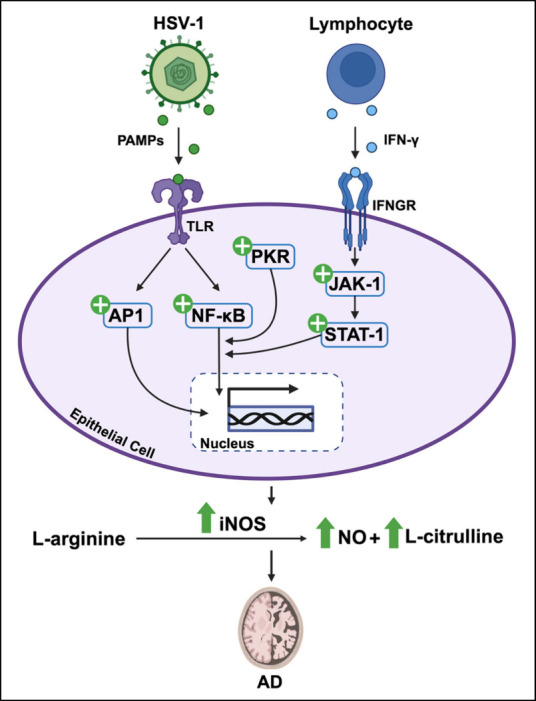
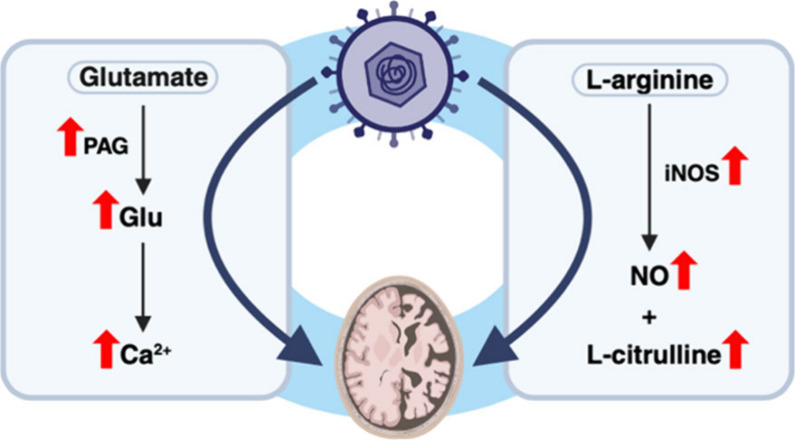
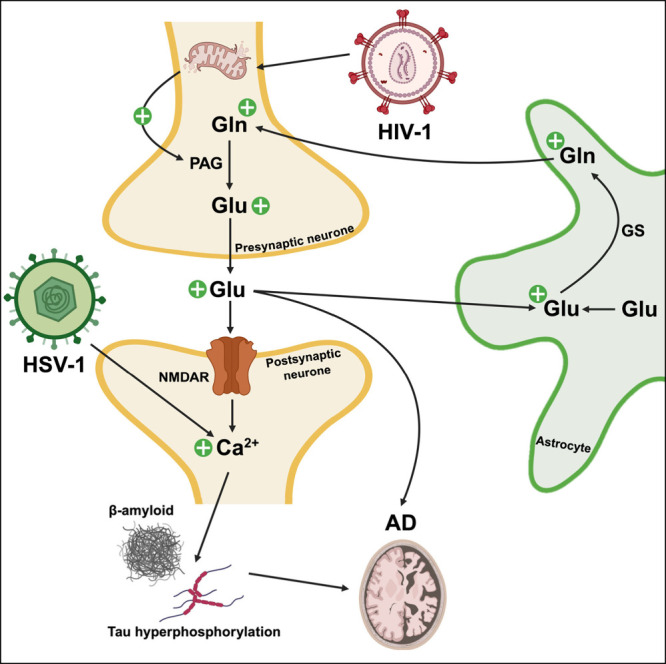
The causes of neurodegeneration remain elusive. There is growing evidence linking viral infection to dysregulated neurotransmission as a causative factor in Alzheimer's disease. Studies suggest that viral infection may result in dysregulated glutamatergic and l-arginine/NO neurotransmission that can initiate neurodegeneration and neuroinflammation within AD. This involves viral infection (HIV-1/HSV-1) altering glutamate biosynthesis and receptor activation resulting in excessive influxes of glutamate and subsequent dysregulation of Ca2+ influx that all contribute to reduced dendrite growth and tau phosphorylation. For l-arginine/NO neurotransmission, the mechanism derives from the "protective" antiviral mechanisms of NO that correlate with pathologies such as β-amyloid peptide accumulation and functional degeneration of hippocampal neurons, respectively. More research is required to underpin the direct mechanisms that viruses might impact to induce specific pathologies.
期刊介绍:
ACS Chemical Neuroscience publishes high-quality research articles and reviews that showcase chemical, quantitative biological, biophysical and bioengineering approaches to the understanding of the nervous system and to the development of new treatments for neurological disorders. Research in the journal focuses on aspects of chemical neurobiology and bio-neurochemistry such as the following:
Neurotransmitters and receptors
Neuropharmaceuticals and therapeutics
Neural development—Plasticity, and degeneration
Chemical, physical, and computational methods in neuroscience
Neuronal diseases—basis, detection, and treatment
Mechanism of aging, learning, memory and behavior
Pain and sensory processing
Neurotoxins
Neuroscience-inspired bioengineering
Development of methods in chemical neurobiology
Neuroimaging agents and technologies
Animal models for central nervous system diseases
Behavioral research



 京公网安备 11010802042870号
京ICP备2023020795号-1
京公网安备 11010802042870号
京ICP备2023020795号-1

 分享
分享
 求助内容:
求助内容: 应助结果提醒方式:
 扫码关注我们
