Sofia C. Aparício, João V. M. Resende, Bernardo D. Ribeiro, Isabel M. Marrucho
{"title":"Dissolution-Precipitation of Plastic Waste: Current Position and Potential as Green Recycling Technique","authors":"Sofia C. Aparício, João V. M. Resende, Bernardo D. Ribeiro, Isabel M. Marrucho","doi":"10.1002/cssc.202500018","DOIUrl":null,"url":null,"abstract":"<p>Plastic waste management is a major global concern as the production of these materials continues to increase without proportional advancements in recycling technologies. Dissolution-precipitation is a promising emerging technology, offering a simple yet effective process to manage complex materials that often go unrecycled, while also recovering high-quality polymers. The success of this technology largely depends on the careful design and selection of solvents. This perspective discusses the most used methods used to screen and select these solvents prior to experimental tests, and provides an overview of the solvents tested in dissolution and precipitation steps of common polymers. Recent advances improved the accuracy and applicability of common and novel solvent screening methods, namely Hansen Solubility Parameters, COSMO-RS, and Machine Learning models. Additionally, the compilation of all solvents reported for dissolution-precipitation of common polymers clearly highlighted the scarcity of studies using alternative green solvents and the need to deeper understand the dissolution-precipitation processes as a whole. This should lead to the development of more sustainable circular polymer recycling processes, which should be regarding Life Cycle Analysis (LCA) and economic assessments.</p>","PeriodicalId":149,"journal":{"name":"ChemSusChem","volume":"18 11","pages":""},"PeriodicalIF":6.6000,"publicationDate":"2025-03-06","publicationTypes":"Journal Article","fieldsOfStudy":null,"isOpenAccess":false,"openAccessPdf":"","citationCount":"0","resultStr":null,"platform":"Semanticscholar","paperid":null,"PeriodicalName":"ChemSusChem","FirstCategoryId":"92","ListUrlMain":"https://chemistry-europe.onlinelibrary.wiley.com/doi/10.1002/cssc.202500018","RegionNum":2,"RegionCategory":"化学","ArticlePicture":[],"TitleCN":null,"AbstractTextCN":null,"PMCID":null,"EPubDate":"","PubModel":"","JCR":"Q1","JCRName":"CHEMISTRY, MULTIDISCIPLINARY","Score":null,"Total":0}
引用次数: 0
Abstract
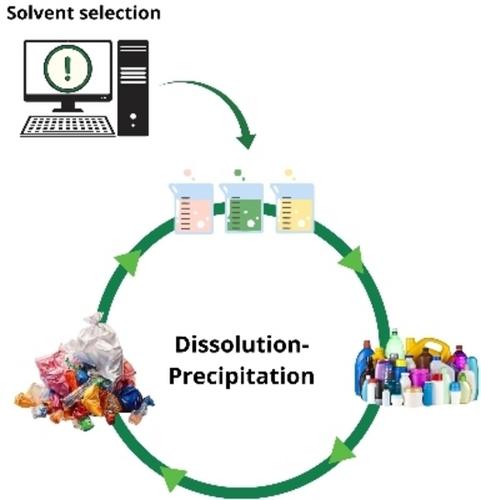
Plastic waste management is a major global concern as the production of these materials continues to increase without proportional advancements in recycling technologies. Dissolution-precipitation is a promising emerging technology, offering a simple yet effective process to manage complex materials that often go unrecycled, while also recovering high-quality polymers. The success of this technology largely depends on the careful design and selection of solvents. This perspective discusses the most used methods used to screen and select these solvents prior to experimental tests, and provides an overview of the solvents tested in dissolution and precipitation steps of common polymers. Recent advances improved the accuracy and applicability of common and novel solvent screening methods, namely Hansen Solubility Parameters, COSMO-RS, and Machine Learning models. Additionally, the compilation of all solvents reported for dissolution-precipitation of common polymers clearly highlighted the scarcity of studies using alternative green solvents and the need to deeper understand the dissolution-precipitation processes as a whole. This should lead to the development of more sustainable circular polymer recycling processes, which should be regarding Life Cycle Analysis (LCA) and economic assessments.
期刊介绍:
ChemSusChem
Impact Factor (2016): 7.226
Scope:
Interdisciplinary journal
Focuses on research at the interface of chemistry and sustainability
Features the best research on sustainability and energy
Areas Covered:
Chemistry
Materials Science
Chemical Engineering
Biotechnology





 京公网安备 11010802042870号
京ICP备2023020795号-1
京公网安备 11010802042870号
京ICP备2023020795号-1

 分享
分享
 求助内容:
求助内容: 应助结果提醒方式:
 扫码关注我们
