Josefine Windfeld-Mathiasen MD , Morten Tulstrup MD, PhD , Ida M. Heerfordt MD, PhD , Kim P. Dalhoff MD, DMSc , Jon T. Andersen MD, PhD , Henrik Horwitz MD, PhD
{"title":"Injury and Poisoning Profile in Anabolic Steroid Users","authors":"Josefine Windfeld-Mathiasen MD , Morten Tulstrup MD, PhD , Ida M. Heerfordt MD, PhD , Kim P. Dalhoff MD, DMSc , Jon T. Andersen MD, PhD , Henrik Horwitz MD, PhD","doi":"10.1016/j.annemergmed.2025.02.001","DOIUrl":null,"url":null,"abstract":"<div><h3>Study objective</h3><div>This study investigated the 1-year risk of injuries and poisonings among anabolic androgenic steroid users compared with controls from the general population.</div></div><div><h3>Methods</h3><div>In a cohort study conducted in Denmark, 1,189 anabolic androgenic steroid users were identified through a national antidoping program and matched with 59,450 controls. Participants were followed for 1 year. Data on hospital contacts, educational length, and occupational status were retrieved from nationwide registries. The primary outcomes were the incidence of injuries and poisonings. The secondary outcomes differentiated between fracture and nonfracture injuries, and medicinal versus nonmedicinal causes of poisonings, and described specific causes of injury-related hospital contacts.</div></div><div><h3>Results</h3><div>Anabolic androgenic steroid users had significantly higher incidences of injuries and poisonings compared with controls. The risk difference for any injury was 7.8% (95% confidence interval [CI] 5.5 to 10.2) and the adjusted hazard ratio (aHR) was 1.46 (95% CI 1.29 to 1.66). Specifically, the risk of fractures was more than doubled among anabolic androgenic steroid users (aHR of 2.23, 95% CI 1.72 to 2.89), with head injuries being particularly prevalent. The risk difference for any poisoning was 1.2% (95% CI 0.5 to 1.9) and the aHR was 2.98 (95% CI 1.82 to 4.90). Medicinal poisoning was the most common poisoning among anabolic androgenic steroid users, with an aHR of 3.53 (95% CI 1.94 to 6.41).</div></div><div><h3>Conclusion</h3><div>Anabolic androgenic steroid use is associated with an increased risk of both injuries and poisonings, thereby quantifying a substantial risk of external harm among users.</div></div>","PeriodicalId":8236,"journal":{"name":"Annals of emergency medicine","volume":"85 6","pages":"Pages 505-511"},"PeriodicalIF":5.0000,"publicationDate":"2025-03-05","publicationTypes":"Journal Article","fieldsOfStudy":null,"isOpenAccess":false,"openAccessPdf":"","citationCount":"0","resultStr":null,"platform":"Semanticscholar","paperid":null,"PeriodicalName":"Annals of emergency medicine","FirstCategoryId":"3","ListUrlMain":"https://www.sciencedirect.com/science/article/pii/S0196064425000629","RegionNum":1,"RegionCategory":"医学","ArticlePicture":[],"TitleCN":null,"AbstractTextCN":null,"PMCID":null,"EPubDate":"","PubModel":"","JCR":"Q1","JCRName":"EMERGENCY MEDICINE","Score":null,"Total":0}
引用次数: 0
Abstract
Study objective
This study investigated the 1-year risk of injuries and poisonings among anabolic androgenic steroid users compared with controls from the general population.
Methods
In a cohort study conducted in Denmark, 1,189 anabolic androgenic steroid users were identified through a national antidoping program and matched with 59,450 controls. Participants were followed for 1 year. Data on hospital contacts, educational length, and occupational status were retrieved from nationwide registries. The primary outcomes were the incidence of injuries and poisonings. The secondary outcomes differentiated between fracture and nonfracture injuries, and medicinal versus nonmedicinal causes of poisonings, and described specific causes of injury-related hospital contacts.
Results
Anabolic androgenic steroid users had significantly higher incidences of injuries and poisonings compared with controls. The risk difference for any injury was 7.8% (95% confidence interval [CI] 5.5 to 10.2) and the adjusted hazard ratio (aHR) was 1.46 (95% CI 1.29 to 1.66). Specifically, the risk of fractures was more than doubled among anabolic androgenic steroid users (aHR of 2.23, 95% CI 1.72 to 2.89), with head injuries being particularly prevalent. The risk difference for any poisoning was 1.2% (95% CI 0.5 to 1.9) and the aHR was 2.98 (95% CI 1.82 to 4.90). Medicinal poisoning was the most common poisoning among anabolic androgenic steroid users, with an aHR of 3.53 (95% CI 1.94 to 6.41).
Conclusion
Anabolic androgenic steroid use is associated with an increased risk of both injuries and poisonings, thereby quantifying a substantial risk of external harm among users.
研究目的:本研究调查了合成代谢雄激素类固醇使用者1年内受伤和中毒的风险,并与普通人群的对照组进行了比较。方法:在丹麦进行的一项队列研究中,通过国家反兴奋剂计划确定了1189名合成代谢雄激素类固醇使用者,并与59,450名对照者进行了匹配。参与者被跟踪了1年。有关医院联系人、教育年限和职业状况的数据从全国登记中检索。主要结局是损伤和中毒的发生率。次要结果区分了骨折和非骨折损伤,药物和非药物中毒原因,并描述了与伤害相关的医院接触的具体原因。结果:与对照组相比,合成代谢雄激素类固醇使用者的受伤和中毒发生率明显更高。任何损伤的风险差异为7.8%(95%可信区间[CI] 5.5至10.2),校正风险比(aHR)为1.46 (95% CI 1.29至1.66)。具体来说,在合成代谢雄激素类固醇使用者中,骨折的风险增加了一倍多(aHR为2.23,95% CI为1.72至2.89),头部损伤尤其普遍。任何中毒的风险差异为1.2% (95% CI 0.5至1.9),aHR为2.98 (95% CI 1.82至4.90)。药物中毒是合成代谢雄激素类固醇使用者中最常见的中毒,aHR为3.53 (95% CI 1.94 ~ 6.41)。结论:合成代谢雄激素类固醇的使用与伤害和中毒风险的增加有关,从而量化了使用者遭受外部伤害的重大风险。
期刊介绍:
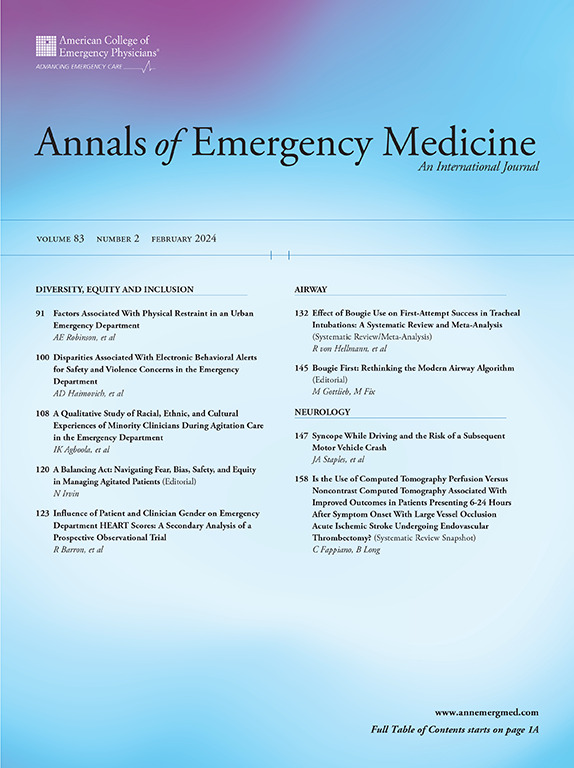
Annals of Emergency Medicine, the official journal of the American College of Emergency Physicians, is an international, peer-reviewed journal dedicated to improving the quality of care by publishing the highest quality science for emergency medicine and related medical specialties. Annals publishes original research, clinical reports, opinion, and educational information related to the practice, teaching, and research of emergency medicine. In addition to general emergency medicine topics, Annals regularly publishes articles on out-of-hospital emergency medical services, pediatric emergency medicine, injury and disease prevention, health policy and ethics, disaster management, toxicology, and related topics.



 京公网安备 11010802042870号
京ICP备2023020795号-1
京公网安备 11010802042870号
京ICP备2023020795号-1

 分享
分享
 求助内容:
求助内容: 应助结果提醒方式:
 扫码关注我们
