{"title":"Is clinical complete response as accurate as pathological complete response in patients with mid-low locally advanced rectal cancer?","authors":"Niyaz Shadmanov, Vusal Aliyev, Guglielmo Niccolò Piozzi, Barıs Bakır, Suha Goksel, Oktar Asoglu","doi":"10.3393/ac.2024.00339.0048","DOIUrl":null,"url":null,"abstract":"<p><strong>Purpose: </strong>The standard treatment for locally advanced rectal cancer involves neoadjuvant chemoradiation followed by total mesorectal excision surgery. A subset of patients achieves pathologic complete response (pCR), representing the optimal treatment outcome. This study compares the long-term oncological outcomes of patients who achieved pCR with those who attained clinical complete response (cCR) after total neoadjuvant therapy, managed using a watch-and-wait approach.</p><p><strong>Methods: </strong>This study retrospectively evaluated patients with mid-low locally advanced rectal cancer who underwent neoadjuvant treatment from January 1, 2005, to May 1, 2023. The pCR and cCR groups were compared based on demographic, clinical, histopathological, and long-term survival outcomes.</p><p><strong>Results: </strong>The median follow-up times were 54 months (range, 7-83 months) for the cCR group (n=73), 96 months (range, 7-215 months) for the pCR group (n=63), and 72 months (range, 4-212 months) for the pathological incomplete clinical response (pICR) group (n=627). In the cCR group, 15 patients (20.5%) experienced local regrowth, and 5 (6.8%) developed distant metastasis (DM). The pCR group had no cases of local recurrence, but 3 patients (4.8%) developed DM. Among the pICR patients, 58 (9.2%) experienced local recurrence, and 92 (14.6%) had DM. Five-year disease-free survival rates were 90.0% for cCR, 92.0% for pCR, and 69.5% for pICR (P=0.022). Five-year overall survival rates were 93.1% for cCR, 92.0% for pCR, and 78.1% for pICR. There were no significant differences in outcomes between the cCR and pCR groups (P=0.810); however, the pICR group exhibited poorer outcomes (P=0.002).</p><p><strong>Conclusions: </strong>This study shows no significant long-term oncological differences between patients who exhibited cCR and those who experienced pCR.</p>","PeriodicalId":8267,"journal":{"name":"Annals of Coloproctology","volume":"41 1","pages":"57-67"},"PeriodicalIF":2.1000,"publicationDate":"2025-02-01","publicationTypes":"Journal Article","fieldsOfStudy":null,"isOpenAccess":false,"openAccessPdf":"https://www.ncbi.nlm.nih.gov/pmc/articles/PMC11894943/pdf/","citationCount":"0","resultStr":null,"platform":"Semanticscholar","paperid":null,"PeriodicalName":"Annals of Coloproctology","FirstCategoryId":"1085","ListUrlMain":"https://doi.org/10.3393/ac.2024.00339.0048","RegionNum":0,"RegionCategory":null,"ArticlePicture":[],"TitleCN":null,"AbstractTextCN":null,"PMCID":null,"EPubDate":"2025/2/28 0:00:00","PubModel":"Epub","JCR":"Q2","JCRName":"GASTROENTEROLOGY & HEPATOLOGY","Score":null,"Total":0}
引用次数: 0
Abstract
Purpose: The standard treatment for locally advanced rectal cancer involves neoadjuvant chemoradiation followed by total mesorectal excision surgery. A subset of patients achieves pathologic complete response (pCR), representing the optimal treatment outcome. This study compares the long-term oncological outcomes of patients who achieved pCR with those who attained clinical complete response (cCR) after total neoadjuvant therapy, managed using a watch-and-wait approach.
Methods: This study retrospectively evaluated patients with mid-low locally advanced rectal cancer who underwent neoadjuvant treatment from January 1, 2005, to May 1, 2023. The pCR and cCR groups were compared based on demographic, clinical, histopathological, and long-term survival outcomes.
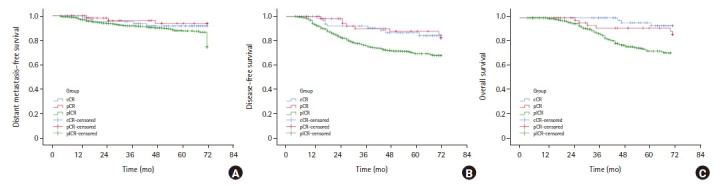
Results: The median follow-up times were 54 months (range, 7-83 months) for the cCR group (n=73), 96 months (range, 7-215 months) for the pCR group (n=63), and 72 months (range, 4-212 months) for the pathological incomplete clinical response (pICR) group (n=627). In the cCR group, 15 patients (20.5%) experienced local regrowth, and 5 (6.8%) developed distant metastasis (DM). The pCR group had no cases of local recurrence, but 3 patients (4.8%) developed DM. Among the pICR patients, 58 (9.2%) experienced local recurrence, and 92 (14.6%) had DM. Five-year disease-free survival rates were 90.0% for cCR, 92.0% for pCR, and 69.5% for pICR (P=0.022). Five-year overall survival rates were 93.1% for cCR, 92.0% for pCR, and 78.1% for pICR. There were no significant differences in outcomes between the cCR and pCR groups (P=0.810); however, the pICR group exhibited poorer outcomes (P=0.002).
Conclusions: This study shows no significant long-term oncological differences between patients who exhibited cCR and those who experienced pCR.





 京公网安备 11010802042870号
京ICP备2023020795号-1
京公网安备 11010802042870号
京ICP备2023020795号-1

 分享
分享
 求助内容:
求助内容: 应助结果提醒方式:
 扫码关注我们
