Ping Qing, Sheng Zhao, Xingtong Zhou, Juan Du, Liang Zou, Fujian Duan, Haibo Chen, Xianqiang Wang, Shengshou Hu
{"title":"A Predictive Marker for Right Heart Failure After Left Ventricular Assist Device Implantation: The Direct Bilirubin to Total Bilirubin Ratio.","authors":"Ping Qing, Sheng Zhao, Xingtong Zhou, Juan Du, Liang Zou, Fujian Duan, Haibo Chen, Xianqiang Wang, Shengshou Hu","doi":"10.1097/MAT.0000000000002398","DOIUrl":null,"url":null,"abstract":"<p><p>Early right heart failure (RHF) after left ventricular assist device (LVAD) implantation poses significant morbidity and mortality risks. Existing RHF prediction scores are complex, typically requiring multiple indicators and evaluation steps. This research aimed to explore a more feasible predictor for initial screening of early RHF. This multicenter, retrospective analysis included 83 consecutively enrolled patients undergoing continuous-flow LVAD implantation. Multivariable logistic regression identified independent predictors of early RHF, whereas receiver operating characteristic (ROC) curve analysis assessed predictive value. Among the 83 patients, 21 (25.3%) experienced early RHF. Logistic regression analyses revealed that the direct bilirubin to total bilirubin (DBIL/TBIL) ratio on admission was significantly correlated with early RHF (adjusted odds ratio [OR]: 2.41, 95% confidence interval [CI]: 1.35-4.31, p = 0.003). The DBIL/TBIL ratio on admission exhibited the highest area under the receiver operating characteristic curve (AUC) (0.767, 95% CI: 0.661-0.852). Internal validation using bootstrap techniques resulted in a mean AUC of 0.767 (95% CI: 0.640-0.879), whereas external validation in a cohort of 31 patients demonstrated an AUC of 0.682 (95% CI: 0.491-0.837). An optimal DBIL/TBIL ratio threshold of 0.52 yielded 76.19% sensitivity and 79.03% specificity for early RHF prediction. In subgroups with different TBIL levels, sensitivity and specificity were 70.0% and 86.67% for TBIL greater than or equal to 2 mg/dl, and 81.82% and 76.60% for TBIL less than 2 mg/dl, respectively. The DBIL/TBIL ratio upon admission is a viable predictor of early RHF following LVAD implantation, demonstrating acceptable predictive efficacy.</p>","PeriodicalId":8844,"journal":{"name":"ASAIO Journal","volume":" ","pages":"472-481"},"PeriodicalIF":2.3000,"publicationDate":"2025-06-01","publicationTypes":"Journal Article","fieldsOfStudy":null,"isOpenAccess":false,"openAccessPdf":"https://www.ncbi.nlm.nih.gov/pmc/articles/PMC12122093/pdf/","citationCount":"0","resultStr":null,"platform":"Semanticscholar","paperid":null,"PeriodicalName":"ASAIO Journal","FirstCategoryId":"5","ListUrlMain":"https://doi.org/10.1097/MAT.0000000000002398","RegionNum":3,"RegionCategory":"医学","ArticlePicture":[],"TitleCN":null,"AbstractTextCN":null,"PMCID":null,"EPubDate":"2025/3/6 0:00:00","PubModel":"Epub","JCR":"Q2","JCRName":"ENGINEERING, BIOMEDICAL","Score":null,"Total":0}
引用次数: 0
Abstract
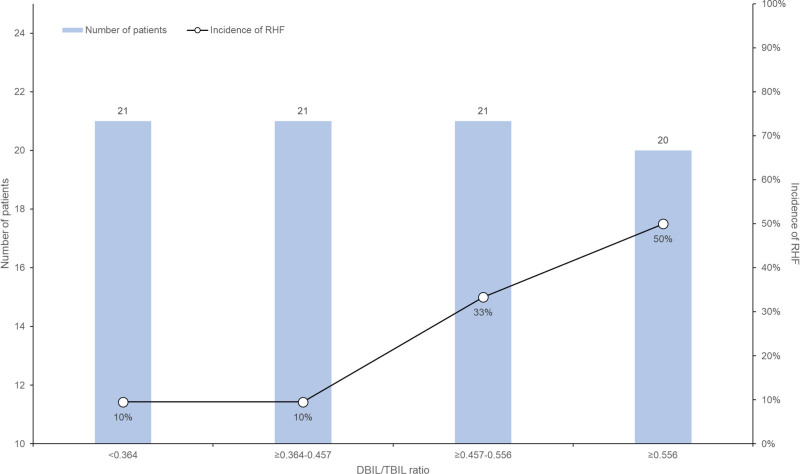
Early right heart failure (RHF) after left ventricular assist device (LVAD) implantation poses significant morbidity and mortality risks. Existing RHF prediction scores are complex, typically requiring multiple indicators and evaluation steps. This research aimed to explore a more feasible predictor for initial screening of early RHF. This multicenter, retrospective analysis included 83 consecutively enrolled patients undergoing continuous-flow LVAD implantation. Multivariable logistic regression identified independent predictors of early RHF, whereas receiver operating characteristic (ROC) curve analysis assessed predictive value. Among the 83 patients, 21 (25.3%) experienced early RHF. Logistic regression analyses revealed that the direct bilirubin to total bilirubin (DBIL/TBIL) ratio on admission was significantly correlated with early RHF (adjusted odds ratio [OR]: 2.41, 95% confidence interval [CI]: 1.35-4.31, p = 0.003). The DBIL/TBIL ratio on admission exhibited the highest area under the receiver operating characteristic curve (AUC) (0.767, 95% CI: 0.661-0.852). Internal validation using bootstrap techniques resulted in a mean AUC of 0.767 (95% CI: 0.640-0.879), whereas external validation in a cohort of 31 patients demonstrated an AUC of 0.682 (95% CI: 0.491-0.837). An optimal DBIL/TBIL ratio threshold of 0.52 yielded 76.19% sensitivity and 79.03% specificity for early RHF prediction. In subgroups with different TBIL levels, sensitivity and specificity were 70.0% and 86.67% for TBIL greater than or equal to 2 mg/dl, and 81.82% and 76.60% for TBIL less than 2 mg/dl, respectively. The DBIL/TBIL ratio upon admission is a viable predictor of early RHF following LVAD implantation, demonstrating acceptable predictive efficacy.
期刊介绍:
ASAIO Journal is in the forefront of artificial organ research and development. On the cutting edge of innovative technology, it features peer-reviewed articles of the highest quality that describe research, development, the most recent advances in the design of artificial organ devices and findings from initial testing. Bimonthly, the ASAIO Journal features state-of-the-art investigations, laboratory and clinical trials, and discussions and opinions from experts around the world.
The official publication of the American Society for Artificial Internal Organs.





 京公网安备 11010802042870号
京ICP备2023020795号-1
京公网安备 11010802042870号
京ICP备2023020795号-1

 分享
分享
 求助内容:
求助内容: 应助结果提醒方式:
 扫码关注我们
