Atherogenic index of plasma, high sensitivity C-reactive protein and incident diabetes among middle-aged and elderly adults in China: a national cohort study.
{"title":"Atherogenic index of plasma, high sensitivity C-reactive protein and incident diabetes among middle-aged and elderly adults in China: a national cohort study.","authors":"Tongshuai Wang, Mengru Zhang, Wenxing Shi, Yongzhen Li, Tiantian Zhang, Wenming Shi","doi":"10.1186/s12933-025-02653-4","DOIUrl":null,"url":null,"abstract":"<p><strong>Background: </strong>The atherogenic index of plasma (AIP) and systematic inflammation, as measured by high-sensitivity C-reactive protein (hsCRP), are predictors of diabetes, but their combined impacts on incident diabetes are poorly understood. Using a nationally representative cohort in China, we aimed to investigate the association of AIP and hsCRP with incident diabetes among middle-aged and elderly adults.</p><p><strong>Methods: </strong>This cohort comprised 9,112 participants aged at least 45 years from 125 cities in the China Health and Retirement Longitudinal Study who were free of diabetes at baseline in 2011. Of these, 5,048 participants were followed up until 2015. The AIP was calculated as Log10[TG (mg/dL)/HDL-C(mg/dL)]. Multivariate logistic regression and linear mixed-effect (LME) models were performed to evaluate the associations of AIP, hsCRP, and incident diabetes as well as glycemic biomarkers. Receiver operating characteristic (ROC) curves were used to evaluate their diagnostic values. We conducted a mediation analysis to assess the direct and indirect associations between AIP and hsCRP with diabetes.</p><p><strong>Results: </strong>489 (9.7%) cases developed diabetes during four years. Higher levels of AIP and hsCRP were independently associated with diabetes. Compared to the lowest quartile of AIP or hsCRP, the highest quartile of AIP (adjusted odds ratio, aOR 2.53, 95% CI: 1.90-3.38) and hsCRP (aOR 2.38, 1.79-3.16) was significantly associated with incident diabetes. The joint effects showed that participants with higher levels of AIP and hsCRP had significantly higher aOR of 2.76 (2.13-3.57). The LME models showed AIP and hsCRP were related to an increased level of fasting blood glucose and glycated hemoglobin. The combination of AIP and hsCRP has better predictive efficacy (area under the curve, AUC: 0.628, 0.601-0.654) for incident diabetes than alone. Mediation analyses showed that high AIP significantly mediated 25.4% of the association between hsCRP and diabetes, and hsCRP simultaneously mediated 5.7% of the association between AIP and diabetes.</p><p><strong>Conclusions: </strong>This cohort suggests combined effects and mutual mediation between the AIP and hsCRP on incident diabetes in China. Our findings provide clinical implications for monitoring and managing AIP and hsCRP levels to mitigate the development of diabetes.</p>","PeriodicalId":9374,"journal":{"name":"Cardiovascular Diabetology","volume":"24 1","pages":"103"},"PeriodicalIF":10.6000,"publicationDate":"2025-03-05","publicationTypes":"Journal Article","fieldsOfStudy":null,"isOpenAccess":false,"openAccessPdf":"https://www.ncbi.nlm.nih.gov/pmc/articles/PMC11883954/pdf/","citationCount":"0","resultStr":null,"platform":"Semanticscholar","paperid":null,"PeriodicalName":"Cardiovascular Diabetology","FirstCategoryId":"3","ListUrlMain":"https://doi.org/10.1186/s12933-025-02653-4","RegionNum":1,"RegionCategory":"医学","ArticlePicture":[],"TitleCN":null,"AbstractTextCN":null,"PMCID":null,"EPubDate":"","PubModel":"","JCR":"Q1","JCRName":"CARDIAC & CARDIOVASCULAR SYSTEMS","Score":null,"Total":0}
引用次数: 0
Abstract
Background: The atherogenic index of plasma (AIP) and systematic inflammation, as measured by high-sensitivity C-reactive protein (hsCRP), are predictors of diabetes, but their combined impacts on incident diabetes are poorly understood. Using a nationally representative cohort in China, we aimed to investigate the association of AIP and hsCRP with incident diabetes among middle-aged and elderly adults.
Methods: This cohort comprised 9,112 participants aged at least 45 years from 125 cities in the China Health and Retirement Longitudinal Study who were free of diabetes at baseline in 2011. Of these, 5,048 participants were followed up until 2015. The AIP was calculated as Log10[TG (mg/dL)/HDL-C(mg/dL)]. Multivariate logistic regression and linear mixed-effect (LME) models were performed to evaluate the associations of AIP, hsCRP, and incident diabetes as well as glycemic biomarkers. Receiver operating characteristic (ROC) curves were used to evaluate their diagnostic values. We conducted a mediation analysis to assess the direct and indirect associations between AIP and hsCRP with diabetes.
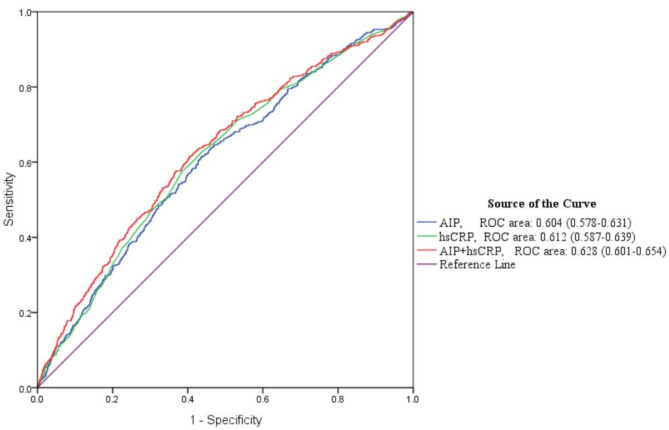
Results: 489 (9.7%) cases developed diabetes during four years. Higher levels of AIP and hsCRP were independently associated with diabetes. Compared to the lowest quartile of AIP or hsCRP, the highest quartile of AIP (adjusted odds ratio, aOR 2.53, 95% CI: 1.90-3.38) and hsCRP (aOR 2.38, 1.79-3.16) was significantly associated with incident diabetes. The joint effects showed that participants with higher levels of AIP and hsCRP had significantly higher aOR of 2.76 (2.13-3.57). The LME models showed AIP and hsCRP were related to an increased level of fasting blood glucose and glycated hemoglobin. The combination of AIP and hsCRP has better predictive efficacy (area under the curve, AUC: 0.628, 0.601-0.654) for incident diabetes than alone. Mediation analyses showed that high AIP significantly mediated 25.4% of the association between hsCRP and diabetes, and hsCRP simultaneously mediated 5.7% of the association between AIP and diabetes.
Conclusions: This cohort suggests combined effects and mutual mediation between the AIP and hsCRP on incident diabetes in China. Our findings provide clinical implications for monitoring and managing AIP and hsCRP levels to mitigate the development of diabetes.
期刊介绍:
Cardiovascular Diabetology is a journal that welcomes manuscripts exploring various aspects of the relationship between diabetes, cardiovascular health, and the metabolic syndrome. We invite submissions related to clinical studies, genetic investigations, experimental research, pharmacological studies, epidemiological analyses, and molecular biology research in this field.





 京公网安备 11010802042870号
京ICP备2023020795号-1
京公网安备 11010802042870号
京ICP备2023020795号-1

 分享
分享
 求助内容:
求助内容: 应助结果提醒方式:
 扫码关注我们
