Marija Ćapin Vilaj, Monika Trupinić, Ante Jug, Dinko Hauptman, Zoran Zimak, Željko Kaštelan, Davor Ježek
{"title":"Testicular tissue bank: ten years of testicular tissue cryopreservation in Croatia.","authors":"Marija Ćapin Vilaj, Monika Trupinić, Ante Jug, Dinko Hauptman, Zoran Zimak, Željko Kaštelan, Davor Ježek","doi":"","DOIUrl":null,"url":null,"abstract":"<p><p>The Testicular Tissue Bank has been operating at the University Hospital Center (UHC) Zagreb since 2013. It aims to cryopreserve testicular tissue from patients with azoospermia. If spermatozoa are found in the collected tissue, a combined procedure known as testicular sperm extraction (TESE)/intracytoplasmic sperm injection (ICSI) is performed. During the last 10 years, our bank has deposited samples from 443 patients collected either by conventional TESE or microsurgical TESE procedure. Among them, 9% were from oncological patients whose samples were stored to preserve fertility. According to pathohistological analysis, 17% of patients were diagnosed with complete spermatogenesis or hypospermatogenesis, 11% with spermatogenic arrest, 48% with mixed atrophy of seminiferous tubules, and 24% with Sertoli cell-only phenotype or tubular fibrosis. Overall, the presence of testicular spermatozoa was found in 58% of patients, which makes them suitable for the ICSI procedure. In 21 out of 59 patients (36%) who underwent a salvage TESE, the outcome was different than that of the first spermatozoa retrieval attempt. Considering that the male factor is one of the leading causes of infertility, the results of Testicular Tissue Bank activity confirm its important role in improving the demographic picture of Croatia.</p>","PeriodicalId":10796,"journal":{"name":"Croatian Medical Journal","volume":"66 1","pages":"71-76"},"PeriodicalIF":2.3000,"publicationDate":"2025-02-28","publicationTypes":"Journal Article","fieldsOfStudy":null,"isOpenAccess":false,"openAccessPdf":"https://www.ncbi.nlm.nih.gov/pmc/articles/PMC11947978/pdf/","citationCount":"0","resultStr":null,"platform":"Semanticscholar","paperid":null,"PeriodicalName":"Croatian Medical Journal","FirstCategoryId":"3","ListUrlMain":"","RegionNum":4,"RegionCategory":"医学","ArticlePicture":[],"TitleCN":null,"AbstractTextCN":null,"PMCID":null,"EPubDate":"","PubModel":"","JCR":"Q2","JCRName":"MEDICINE, GENERAL & INTERNAL","Score":null,"Total":0}
引用次数: 0
Abstract
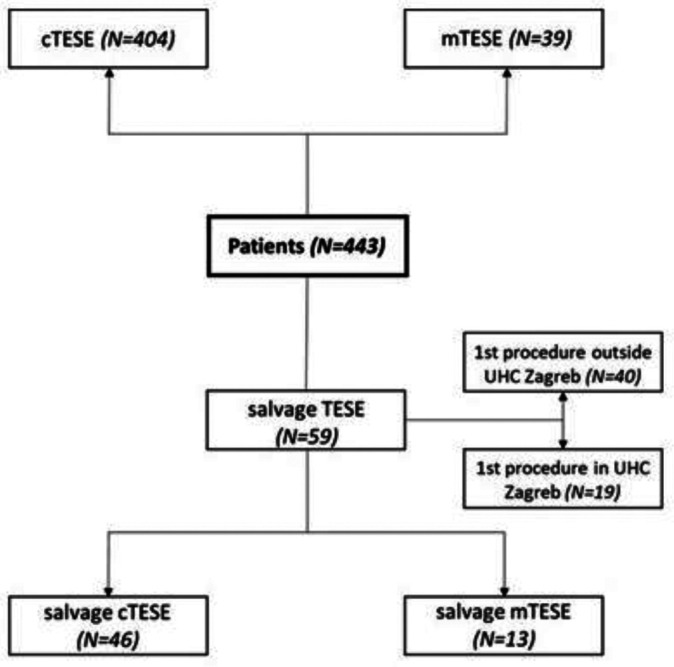
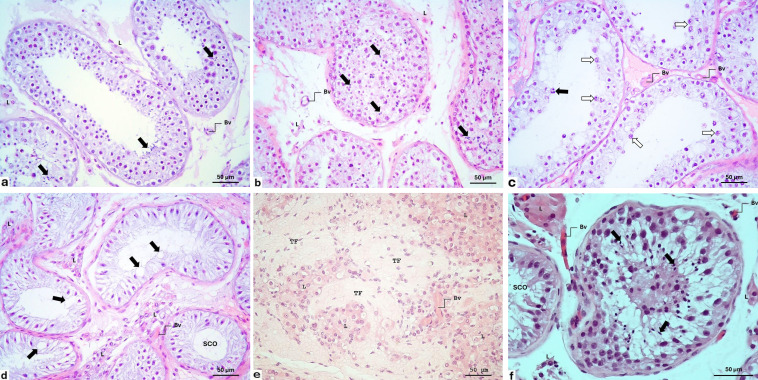
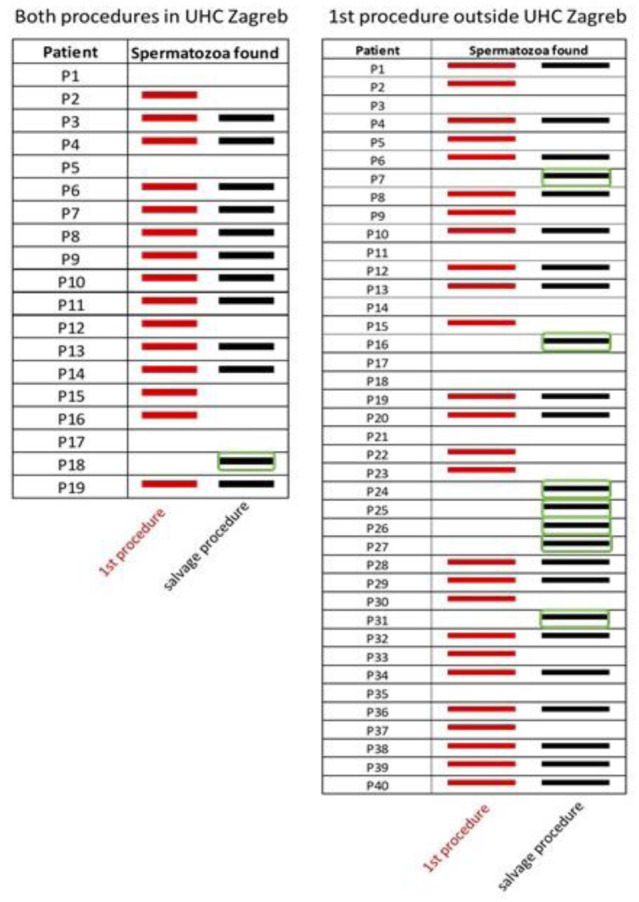
The Testicular Tissue Bank has been operating at the University Hospital Center (UHC) Zagreb since 2013. It aims to cryopreserve testicular tissue from patients with azoospermia. If spermatozoa are found in the collected tissue, a combined procedure known as testicular sperm extraction (TESE)/intracytoplasmic sperm injection (ICSI) is performed. During the last 10 years, our bank has deposited samples from 443 patients collected either by conventional TESE or microsurgical TESE procedure. Among them, 9% were from oncological patients whose samples were stored to preserve fertility. According to pathohistological analysis, 17% of patients were diagnosed with complete spermatogenesis or hypospermatogenesis, 11% with spermatogenic arrest, 48% with mixed atrophy of seminiferous tubules, and 24% with Sertoli cell-only phenotype or tubular fibrosis. Overall, the presence of testicular spermatozoa was found in 58% of patients, which makes them suitable for the ICSI procedure. In 21 out of 59 patients (36%) who underwent a salvage TESE, the outcome was different than that of the first spermatozoa retrieval attempt. Considering that the male factor is one of the leading causes of infertility, the results of Testicular Tissue Bank activity confirm its important role in improving the demographic picture of Croatia.
期刊介绍:
Croatian Medical Journal (CMJ) is an international peer reviewed journal open to scientists from all fields of biomedicine and health related research.
Although CMJ welcomes all contributions that increase and expand on medical knowledge, the two areas are of the special interest: topics globally relevant for biomedicine and health and medicine in developing and emerging countries.
 分享
分享



 京公网安备 11010802042870号
京ICP备2023020795号-1
京公网安备 11010802042870号
京ICP备2023020795号-1

 求助内容:
求助内容: 应助结果提醒方式:
 扫码关注我们
