Majid Eslami, Ramtin Naderian, Ariyan Ahmadpour, Ali Shushtari, Sahar Maleki, Parham Mohammadian, Arvin Amiri, Maryam Janbazi, Mohammad Memarian, Bahman Yousefi
{"title":"Microbiome structure in healthy and pregnant women and importance of vaginal dysbiosis in spontaneous abortion.","authors":"Majid Eslami, Ramtin Naderian, Ariyan Ahmadpour, Ali Shushtari, Sahar Maleki, Parham Mohammadian, Arvin Amiri, Maryam Janbazi, Mohammad Memarian, Bahman Yousefi","doi":"10.3389/fcimb.2024.1401610","DOIUrl":null,"url":null,"abstract":"<p><p>The vaginal microbiome of healthy women is dominated by <i>Lactobacillus</i> spp. A variety of illnesses, such as vaginosis, sexually transmitted infections (STIs), failed implantation, premature birth (PTB), and preterm pre-labor membrane rupture, are brought on by an unbalanced microbiota. Pregnancy is associated with a decrease in the metabolic capacity of the vaginal resident microbiome, which is consistent with a change to a less complex <i>Lactobacillus</i>-dominated microbiome. Age, race, sexual intercourse, smoking, IUD, contraception, lifestyle, and diet all affect the makeup of the vaginal microbiome. Moreover, physiological events including menarche, the menstrual cycle, pregnancy, menopause, and other hormonal changes have an impact on the vaginal microbiome. The vaginal microbiome is significantly disrupted by the menstrual cycle, with significant changes toward a more varied microbiota occurring around menstruation. Several major factors maintain or disrupt the vaginal microbiome including ethnic group, menstruation cycle, and pregnancy which are discussed in this section. In the index pregnancy, the vaginal microbiota of women who had already given birth, or had just experienced an induced or spontaneous abortion, was qualitatively and quantitatively different from that of women who were having their first child. Early pregnancy vaginal microbiome depletion is a risk factor for early pregnancy miscarriage. Although, early pregnancy miscarriage is not always caused by a high bacterial diversity and quantity of <i>lactobacilli</i>. <i>Lactobacillus</i> protects against pathogens through the production of antibacterial compounds such as lactic acid and bacteriocins.</p>","PeriodicalId":12458,"journal":{"name":"Frontiers in Cellular and Infection Microbiology","volume":"14 ","pages":"1401610"},"PeriodicalIF":4.8000,"publicationDate":"2025-02-17","publicationTypes":"Journal Article","fieldsOfStudy":null,"isOpenAccess":false,"openAccessPdf":"https://www.ncbi.nlm.nih.gov/pmc/articles/PMC11881085/pdf/","citationCount":"0","resultStr":null,"platform":"Semanticscholar","paperid":null,"PeriodicalName":"Frontiers in Cellular and Infection Microbiology","FirstCategoryId":"3","ListUrlMain":"https://doi.org/10.3389/fcimb.2024.1401610","RegionNum":2,"RegionCategory":"医学","ArticlePicture":[],"TitleCN":null,"AbstractTextCN":null,"PMCID":null,"EPubDate":"2024/1/1 0:00:00","PubModel":"eCollection","JCR":"Q2","JCRName":"IMMUNOLOGY","Score":null,"Total":0}
引用次数: 0
Abstract
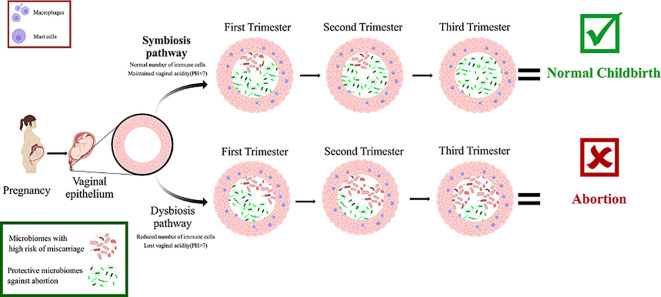
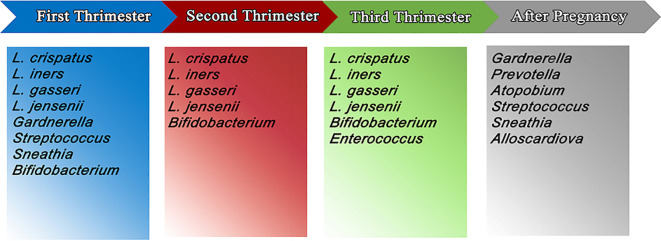
The vaginal microbiome of healthy women is dominated by Lactobacillus spp. A variety of illnesses, such as vaginosis, sexually transmitted infections (STIs), failed implantation, premature birth (PTB), and preterm pre-labor membrane rupture, are brought on by an unbalanced microbiota. Pregnancy is associated with a decrease in the metabolic capacity of the vaginal resident microbiome, which is consistent with a change to a less complex Lactobacillus-dominated microbiome. Age, race, sexual intercourse, smoking, IUD, contraception, lifestyle, and diet all affect the makeup of the vaginal microbiome. Moreover, physiological events including menarche, the menstrual cycle, pregnancy, menopause, and other hormonal changes have an impact on the vaginal microbiome. The vaginal microbiome is significantly disrupted by the menstrual cycle, with significant changes toward a more varied microbiota occurring around menstruation. Several major factors maintain or disrupt the vaginal microbiome including ethnic group, menstruation cycle, and pregnancy which are discussed in this section. In the index pregnancy, the vaginal microbiota of women who had already given birth, or had just experienced an induced or spontaneous abortion, was qualitatively and quantitatively different from that of women who were having their first child. Early pregnancy vaginal microbiome depletion is a risk factor for early pregnancy miscarriage. Although, early pregnancy miscarriage is not always caused by a high bacterial diversity and quantity of lactobacilli. Lactobacillus protects against pathogens through the production of antibacterial compounds such as lactic acid and bacteriocins.
期刊介绍:
Frontiers in Cellular and Infection Microbiology is a leading specialty journal, publishing rigorously peer-reviewed research across all pathogenic microorganisms and their interaction with their hosts. Chief Editor Yousef Abu Kwaik, University of Louisville is supported by an outstanding Editorial Board of international experts. This multidisciplinary open-access journal is at the forefront of disseminating and communicating scientific knowledge and impactful discoveries to researchers, academics, clinicians and the public worldwide.
Frontiers in Cellular and Infection Microbiology includes research on bacteria, fungi, parasites, viruses, endosymbionts, prions and all microbial pathogens as well as the microbiota and its effect on health and disease in various hosts. The research approaches include molecular microbiology, cellular microbiology, gene regulation, proteomics, signal transduction, pathogenic evolution, genomics, structural biology, and virulence factors as well as model hosts. Areas of research to counteract infectious agents by the host include the host innate and adaptive immune responses as well as metabolic restrictions to various pathogenic microorganisms, vaccine design and development against various pathogenic microorganisms, and the mechanisms of antibiotic resistance and its countermeasures.





 京公网安备 11010802042870号
京ICP备2023020795号-1
京公网安备 11010802042870号
京ICP备2023020795号-1

 分享
分享
 求助内容:
求助内容: 应助结果提醒方式:
 扫码关注我们
