Is late-life vulnerability to cardiovascular disease risk associated with longitudinal tau accumulation in older adults with mild cognitive impairment?
M A Dratva, J M Diaz, M L Thomas, Q Shen, A A Tsiknia, K A Rostowsky, E E Sundermann, S J Banks
{"title":"Is late-life vulnerability to cardiovascular disease risk associated with longitudinal tau accumulation in older adults with mild cognitive impairment?","authors":"M A Dratva, J M Diaz, M L Thomas, Q Shen, A A Tsiknia, K A Rostowsky, E E Sundermann, S J Banks","doi":"10.1016/j.jarlif.2025.100001","DOIUrl":null,"url":null,"abstract":"<p><strong>Background: </strong>Older females have higher Alzheimer's Disease (AD) risk and tau burden, especially in early disease stages, compared to males. Overlapping cardiovascular disease (CVD) and dementia risk factors, like the apolipoprotein (APOE)-ε4 allele, show mixed sex-specific results. We previously found that late-life CVD risk related more strongly to tau at a single timepoint in cognitively normal, older female APOE-ε4 carriers than in males.</p><p><strong>Objectives: </strong>Do composite and component CVD risk factors explain sex differences in tau accumulation in older adults with mild cognitive impairment (MCI) and underlying amyloid-beta (Aβ) pathology?</p><p><strong>Design: </strong>Longitudinal analysis in the Alzheimer's Disease Neuroimaging Initiative (ADNI) cohort.</p><p><strong>Setting: </strong>ADNI is a multi-site longitudinal study across the United States and Canada.</p><p><strong>Participants: </strong><i>n</i> = 52 older adults (aged 60-90), designated as both Aβ-positive and MCI.</p><p><strong>Measurements: </strong>CVD risk was measured by body mass index (BMI) and FRS, which includes age, systolic blood pressure (BP), high-density lipoprotein (HDL), total cholesterol, hypertension treatment, smoking, and diabetes. Regional standardized uptake value ratios (SUVRs) were extracted at each tau-PET timepoint. Composite SUVRs for Braak34 and Braak56 were calculated. Statistical models examined the separate and interactive effects of sex and APOE-ε4 on tau accumulation, and moderating effects of FRS, its components, or BMI, on tau accumulation.</p><p><strong>Results: </strong>Females accumulated more tau than males in bilateral Braak34 and right Braak56, while APOE-ε4 carriers trended toward more tau accumulation in left Braak56. FRS and its components did not relate to tau accumulation, nor influence sex effects, although they attenuated APOE-ε4 effects. In left Braak56, higher baseline BMI in males showed a trend toward greater tau accumulation.</p><p><strong>Conclusions: </strong>In MCI and Aβ-positive older adults, females accumulated more tau than males, and late-life vascular risk did not explain this relationship. Higher BMI related to more tau accumulation in males only, suggesting sex-specific vulnerability to BMI on brain health. Although replication in larger and more representative cohorts is needed, these findings corroborate accelerated tau progression in older females, independent of CVD risk, and suggest that vascular health has limited influence on tau progression once AD pathology is established in the brain.</p>","PeriodicalId":73537,"journal":{"name":"JAR life","volume":"14 ","pages":"100001"},"PeriodicalIF":0.0000,"publicationDate":"2025-02-18","publicationTypes":"Journal Article","fieldsOfStudy":null,"isOpenAccess":false,"openAccessPdf":"https://www.ncbi.nlm.nih.gov/pmc/articles/PMC11879684/pdf/","citationCount":"0","resultStr":null,"platform":"Semanticscholar","paperid":null,"PeriodicalName":"JAR life","FirstCategoryId":"1085","ListUrlMain":"https://doi.org/10.1016/j.jarlif.2025.100001","RegionNum":0,"RegionCategory":null,"ArticlePicture":[],"TitleCN":null,"AbstractTextCN":null,"PMCID":null,"EPubDate":"2025/1/1 0:00:00","PubModel":"eCollection","JCR":"","JCRName":"","Score":null,"Total":0}
引用次数: 0
Abstract
Background: Older females have higher Alzheimer's Disease (AD) risk and tau burden, especially in early disease stages, compared to males. Overlapping cardiovascular disease (CVD) and dementia risk factors, like the apolipoprotein (APOE)-ε4 allele, show mixed sex-specific results. We previously found that late-life CVD risk related more strongly to tau at a single timepoint in cognitively normal, older female APOE-ε4 carriers than in males.
Objectives: Do composite and component CVD risk factors explain sex differences in tau accumulation in older adults with mild cognitive impairment (MCI) and underlying amyloid-beta (Aβ) pathology?
Design: Longitudinal analysis in the Alzheimer's Disease Neuroimaging Initiative (ADNI) cohort.
Setting: ADNI is a multi-site longitudinal study across the United States and Canada.
Participants: n = 52 older adults (aged 60-90), designated as both Aβ-positive and MCI.
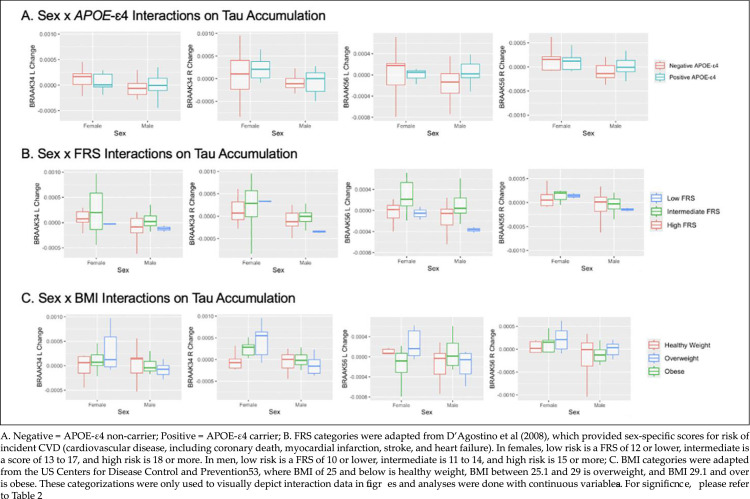
Measurements: CVD risk was measured by body mass index (BMI) and FRS, which includes age, systolic blood pressure (BP), high-density lipoprotein (HDL), total cholesterol, hypertension treatment, smoking, and diabetes. Regional standardized uptake value ratios (SUVRs) were extracted at each tau-PET timepoint. Composite SUVRs for Braak34 and Braak56 were calculated. Statistical models examined the separate and interactive effects of sex and APOE-ε4 on tau accumulation, and moderating effects of FRS, its components, or BMI, on tau accumulation.
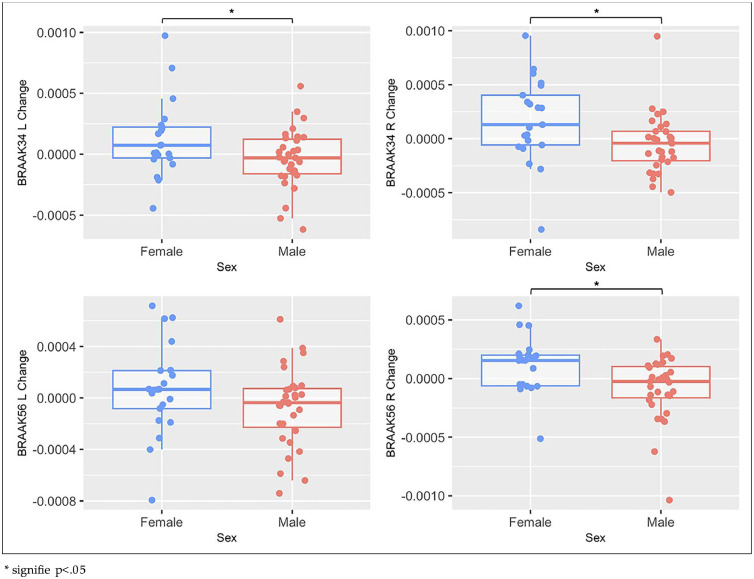
Results: Females accumulated more tau than males in bilateral Braak34 and right Braak56, while APOE-ε4 carriers trended toward more tau accumulation in left Braak56. FRS and its components did not relate to tau accumulation, nor influence sex effects, although they attenuated APOE-ε4 effects. In left Braak56, higher baseline BMI in males showed a trend toward greater tau accumulation.
Conclusions: In MCI and Aβ-positive older adults, females accumulated more tau than males, and late-life vascular risk did not explain this relationship. Higher BMI related to more tau accumulation in males only, suggesting sex-specific vulnerability to BMI on brain health. Although replication in larger and more representative cohorts is needed, these findings corroborate accelerated tau progression in older females, independent of CVD risk, and suggest that vascular health has limited influence on tau progression once AD pathology is established in the brain.



 京公网安备 11010802042870号
京ICP备2023020795号-1
京公网安备 11010802042870号
京ICP备2023020795号-1

 分享
分享

 求助内容:
求助内容: 应助结果提醒方式:
 扫码关注我们
