Alina Pervez, Russell Seth Martins, Huzaifa Moiz, Abbas Raza Syed, Muneeb Khan, Nashia Ali Rizvi, Mohsin Ali Mustafa, Muhammad Taha Nasim, Alina Abdul Rehman, Shayan Khalid, Saif Ur Rehman, Sarah Nadeem, Adil H Haider, Shabbir Akhtar
{"title":"Development of clinical practice guidelines and primary care referral pathways for management of otorhinolaryngological conditions in Pakistan.","authors":"Alina Pervez, Russell Seth Martins, Huzaifa Moiz, Abbas Raza Syed, Muneeb Khan, Nashia Ali Rizvi, Mohsin Ali Mustafa, Muhammad Taha Nasim, Alina Abdul Rehman, Shayan Khalid, Saif Ur Rehman, Sarah Nadeem, Adil H Haider, Shabbir Akhtar","doi":"10.1186/s12875-025-02756-7","DOIUrl":null,"url":null,"abstract":"<p><strong>Background: </strong>Diseases of the ear, nose, and throat (ENT) account for a significant portion of a primary care physician's practice in Pakistan, a South Asian lower-middle income country. This increasing burden demands comprehensive clinical practice guidelines and primary care clinical referral algorithms to be devised so that general physicians can adequately provide standardized primary health care and prevent needless specialist ENT referrals.</p><p><strong>Methods: </strong>We selected eight guidelines regarding epistaxis, neck masses, hearing loss, Meniere's disease, dysphonia, allergic rhinitis, acute otitis externa, and rhinosinusitis from the American Academy of Otolaryngology-Head and Neck Surgery Foundation as the source guidelines and employed the GRADE-ADOLOPMENT approach to contextualize guidelines by adopting, adapting, or excluding recommendations from these guidelines. Clinical referral algorithms were created using recommendations from the created clinical practice guidelines, with additional recommendations being sought via a best evidence review process.</p><p><strong>Results: </strong>We successfully created local clinical practice guidelines for the eight ENT conditions using the GRADE-ADOLOPMENT process. While most recommendations were adopted in the local clinical practice guidelines, one recommendation for acute otitis externa, hearing loss, and epistaxis and two for allergic rhinitis were adopted with minor changes to provide supporting information. Six recommendations were excluded mostly due to the unavailability of services in Pakistan. Eight clinical referral algorithms were also created which incorporated 17 additional recommendations to fill gaps in clinical practice including four additional recommendations to the epistaxis algorithm, three for neck lumps/mass, rhinosinusitis, and allergic rhinitis, two for acute otitis externa, and one for Meniere's disease and dysphonia algorithms.</p><p><strong>Conclusion: </strong>The newly created clinical practice guidelines will help in the provision of standardized, high-quality care at the primary care level. Concomitantly, the clinical referral pathways can assist the general physicians in the management of patients as well as guide appropriate timely referrals to ENT specialists.</p>","PeriodicalId":72428,"journal":{"name":"BMC primary care","volume":"26 1","pages":"64"},"PeriodicalIF":2.6000,"publicationDate":"2025-03-05","publicationTypes":"Journal Article","fieldsOfStudy":null,"isOpenAccess":false,"openAccessPdf":"https://www.ncbi.nlm.nih.gov/pmc/articles/PMC11881372/pdf/","citationCount":"0","resultStr":null,"platform":"Semanticscholar","paperid":null,"PeriodicalName":"BMC primary care","FirstCategoryId":"1085","ListUrlMain":"https://doi.org/10.1186/s12875-025-02756-7","RegionNum":0,"RegionCategory":null,"ArticlePicture":[],"TitleCN":null,"AbstractTextCN":null,"PMCID":null,"EPubDate":"","PubModel":"","JCR":"Q2","JCRName":"MEDICINE, GENERAL & INTERNAL","Score":null,"Total":0}
引用次数: 0
Abstract
Background: Diseases of the ear, nose, and throat (ENT) account for a significant portion of a primary care physician's practice in Pakistan, a South Asian lower-middle income country. This increasing burden demands comprehensive clinical practice guidelines and primary care clinical referral algorithms to be devised so that general physicians can adequately provide standardized primary health care and prevent needless specialist ENT referrals.
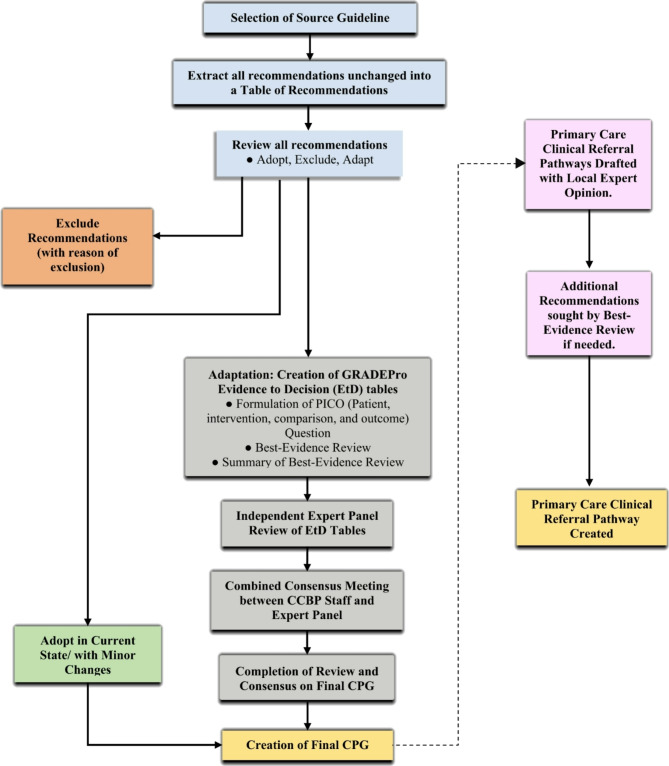
Methods: We selected eight guidelines regarding epistaxis, neck masses, hearing loss, Meniere's disease, dysphonia, allergic rhinitis, acute otitis externa, and rhinosinusitis from the American Academy of Otolaryngology-Head and Neck Surgery Foundation as the source guidelines and employed the GRADE-ADOLOPMENT approach to contextualize guidelines by adopting, adapting, or excluding recommendations from these guidelines. Clinical referral algorithms were created using recommendations from the created clinical practice guidelines, with additional recommendations being sought via a best evidence review process.
Results: We successfully created local clinical practice guidelines for the eight ENT conditions using the GRADE-ADOLOPMENT process. While most recommendations were adopted in the local clinical practice guidelines, one recommendation for acute otitis externa, hearing loss, and epistaxis and two for allergic rhinitis were adopted with minor changes to provide supporting information. Six recommendations were excluded mostly due to the unavailability of services in Pakistan. Eight clinical referral algorithms were also created which incorporated 17 additional recommendations to fill gaps in clinical practice including four additional recommendations to the epistaxis algorithm, three for neck lumps/mass, rhinosinusitis, and allergic rhinitis, two for acute otitis externa, and one for Meniere's disease and dysphonia algorithms.
Conclusion: The newly created clinical practice guidelines will help in the provision of standardized, high-quality care at the primary care level. Concomitantly, the clinical referral pathways can assist the general physicians in the management of patients as well as guide appropriate timely referrals to ENT specialists.




 京公网安备 11010802042870号
京ICP备2023020795号-1
京公网安备 11010802042870号
京ICP备2023020795号-1

 分享
分享

 求助内容:
求助内容: 应助结果提醒方式:
 扫码关注我们
