Wenchao Li, Zhenhua Zhang, Saumya Kumar, Javier Botey-Bataller, Martijn Zoodsma, Ali Ehsani, Qiuyao Zhan, Ahmed Alaswad, Liang Zhou, Inge Grondman, Valerie Koeken, Jian Yang, Gang Wang, Sonja Volland, Tania O. Crişan, Leo A. B. Joosten, Thomas Illig, Cheng-Jian Xu, Mihai G. Netea, Yang Li
{"title":"Single-cell immune aging clocks reveal inter-individual heterogeneity during infection and vaccination","authors":"Wenchao Li, Zhenhua Zhang, Saumya Kumar, Javier Botey-Bataller, Martijn Zoodsma, Ali Ehsani, Qiuyao Zhan, Ahmed Alaswad, Liang Zhou, Inge Grondman, Valerie Koeken, Jian Yang, Gang Wang, Sonja Volland, Tania O. Crişan, Leo A. B. Joosten, Thomas Illig, Cheng-Jian Xu, Mihai G. Netea, Yang Li","doi":"10.1038/s43587-025-00819-z","DOIUrl":null,"url":null,"abstract":"Aging affects human immune system functionality, increasing susceptibility to immune-mediated diseases. While gene expression programs accurately reflect immune function, their relationship with biological immune aging and health status remains unclear. Here we developed robust, cell-type-specific aging clocks (sc-ImmuAging) for the myeloid and lymphoid immune cell populations in circulation within peripheral blood mononuclear cells, using single-cell RNA-sequencing data from 1,081 healthy individuals aged from 18 to 97 years. Application of sc-ImmuAging to transcriptome data of patients with COVID-19 revealed notable age acceleration in monocytes, which decreased during recovery. Furthermore, inter-individual variations in immune aging induced by vaccination were identified, with individuals exhibiting elevated baseline interferon response genes showing age rejuvenation in CD8+ T cells after BCG vaccination. sc-ImmuAging provides a powerful tool for decoding immune aging dynamics, offering insights into age-related immune alterations and potential interventions to promote healthy aging. Immune system function changes substantially with age. In this study, the authors present single-cell transcriptomic aging clocks revealing immune-cell-specific age acceleration that is shaped by infection and vaccination, as well as identifying pathways and regulators of immune system aging.","PeriodicalId":94150,"journal":{"name":"Nature aging","volume":"5 4","pages":"607-621"},"PeriodicalIF":19.4000,"publicationDate":"2025-03-05","publicationTypes":"Journal Article","fieldsOfStudy":null,"isOpenAccess":false,"openAccessPdf":"https://www.ncbi.nlm.nih.gov/pmc/articles/PMC12003178/pdf/","citationCount":"0","resultStr":null,"platform":"Semanticscholar","paperid":null,"PeriodicalName":"Nature aging","FirstCategoryId":"1085","ListUrlMain":"https://www.nature.com/articles/s43587-025-00819-z","RegionNum":0,"RegionCategory":null,"ArticlePicture":[],"TitleCN":null,"AbstractTextCN":null,"PMCID":null,"EPubDate":"","PubModel":"","JCR":"Q1","JCRName":"CELL BIOLOGY","Score":null,"Total":0}
引用次数: 0
Abstract
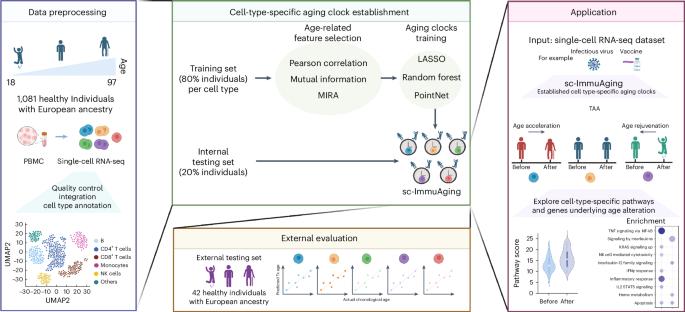
Aging affects human immune system functionality, increasing susceptibility to immune-mediated diseases. While gene expression programs accurately reflect immune function, their relationship with biological immune aging and health status remains unclear. Here we developed robust, cell-type-specific aging clocks (sc-ImmuAging) for the myeloid and lymphoid immune cell populations in circulation within peripheral blood mononuclear cells, using single-cell RNA-sequencing data from 1,081 healthy individuals aged from 18 to 97 years. Application of sc-ImmuAging to transcriptome data of patients with COVID-19 revealed notable age acceleration in monocytes, which decreased during recovery. Furthermore, inter-individual variations in immune aging induced by vaccination were identified, with individuals exhibiting elevated baseline interferon response genes showing age rejuvenation in CD8+ T cells after BCG vaccination. sc-ImmuAging provides a powerful tool for decoding immune aging dynamics, offering insights into age-related immune alterations and potential interventions to promote healthy aging. Immune system function changes substantially with age. In this study, the authors present single-cell transcriptomic aging clocks revealing immune-cell-specific age acceleration that is shaped by infection and vaccination, as well as identifying pathways and regulators of immune system aging.



 京公网安备 11010802042870号
京ICP备2023020795号-1
京公网安备 11010802042870号
京ICP备2023020795号-1

 分享
分享

 求助内容:
求助内容: 应助结果提醒方式:
 扫码关注我们
