Yushu Huang, Lijuan Da, Yue Dong, Zihan Li, Yuan Liu, Zilin Li, Xifeng Wu, Wenyuan Li
{"title":"Construction and validation of a DNN-based biological age and its influencing factors in the China Kadoorie Biobank","authors":"Yushu Huang, Lijuan Da, Yue Dong, Zihan Li, Yuan Liu, Zilin Li, Xifeng Wu, Wenyuan Li","doi":"10.1007/s11357-025-01577-x","DOIUrl":null,"url":null,"abstract":"<p>Biological age is an important measure of aging that reflects an individual’s physical health and is linked to various diseases. Current prediction models are still limited in precision, and the risk factors for accelerated aging remain underexplored. Therefore, we aimed to develop a precise biological age and assess the impact of socio-demographic and behavioral patterns on the aging process.We utilized Deep Neural Networks (DNN) to construct biological age from participants with physical examinations, blood samples, and questionnaires data from the China Kadoorie Biobank (CKB) between June 2004 and December 2016. △age, calculated as the residuals between biological age and chronological age, was used to investigate the associations of age acceleration with diseases. Socio-demographics (gender, education attainment, marital status, household income) and lifestyle characteristics (body mass index [BMI], smoking, drinking, physical activity, and sleep) were also assessed to explore their impact on age acceleration. 18,261 participants aged 57 ± 10 years were included in this study. The DNN-based biological age model has demonstrated accurate predictive performance, achieving a mean absolute error of 3.655 years. △age was associated with increased risks of various morbidity and mortality, with the highest associations found for circulatory and respiratory diseases, with hazard ratios of 1.033 (95% CI: 1.023, 1.042) and 1.078 (95% CI: 1.027, 1.130), respectively. Socio-demographics, including being female, lower education, widowed or divorced, and low household income, along with behavioral patterns, such as being underweight, insufficient physical activity, and poor sleep, were associated with accelerated aging. Our DNN model is capable of constructing a precise biological age using commonly collected data. Socio-demographics and lifestyle factors were associated with accelerated aging, highlighting that addressing modifiable risk factors can effectively slow age acceleration and reduce disease risk, providing valuable insights for interventions to promote healthy aging.</p>","PeriodicalId":12730,"journal":{"name":"GeroScience","volume":"85 1","pages":""},"PeriodicalIF":5.4000,"publicationDate":"2025-03-07","publicationTypes":"Journal Article","fieldsOfStudy":null,"isOpenAccess":false,"openAccessPdf":"","citationCount":"0","resultStr":null,"platform":"Semanticscholar","paperid":null,"PeriodicalName":"GeroScience","FirstCategoryId":"3","ListUrlMain":"https://doi.org/10.1007/s11357-025-01577-x","RegionNum":2,"RegionCategory":"医学","ArticlePicture":[],"TitleCN":null,"AbstractTextCN":null,"PMCID":null,"EPubDate":"","PubModel":"","JCR":"Q1","JCRName":"GERIATRICS & GERONTOLOGY","Score":null,"Total":0}
引用次数: 0
Abstract
Biological age is an important measure of aging that reflects an individual’s physical health and is linked to various diseases. Current prediction models are still limited in precision, and the risk factors for accelerated aging remain underexplored. Therefore, we aimed to develop a precise biological age and assess the impact of socio-demographic and behavioral patterns on the aging process.We utilized Deep Neural Networks (DNN) to construct biological age from participants with physical examinations, blood samples, and questionnaires data from the China Kadoorie Biobank (CKB) between June 2004 and December 2016. △age, calculated as the residuals between biological age and chronological age, was used to investigate the associations of age acceleration with diseases. Socio-demographics (gender, education attainment, marital status, household income) and lifestyle characteristics (body mass index [BMI], smoking, drinking, physical activity, and sleep) were also assessed to explore their impact on age acceleration. 18,261 participants aged 57 ± 10 years were included in this study. The DNN-based biological age model has demonstrated accurate predictive performance, achieving a mean absolute error of 3.655 years. △age was associated with increased risks of various morbidity and mortality, with the highest associations found for circulatory and respiratory diseases, with hazard ratios of 1.033 (95% CI: 1.023, 1.042) and 1.078 (95% CI: 1.027, 1.130), respectively. Socio-demographics, including being female, lower education, widowed or divorced, and low household income, along with behavioral patterns, such as being underweight, insufficient physical activity, and poor sleep, were associated with accelerated aging. Our DNN model is capable of constructing a precise biological age using commonly collected data. Socio-demographics and lifestyle factors were associated with accelerated aging, highlighting that addressing modifiable risk factors can effectively slow age acceleration and reduce disease risk, providing valuable insights for interventions to promote healthy aging.
GeroScienceMedicine-Complementary and Alternative Medicine
CiteScore
10.50
自引率
5.40%
发文量
182
期刊介绍:
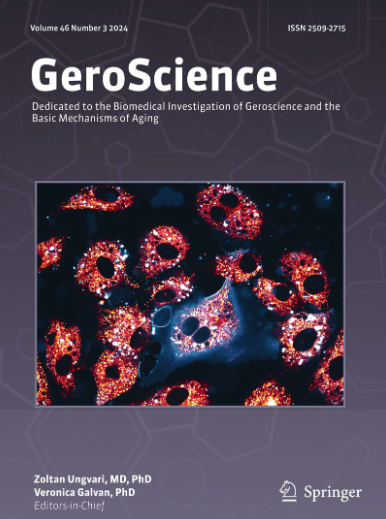
GeroScience is a bi-monthly, international, peer-reviewed journal that publishes articles related to research in the biology of aging and research on biomedical applications that impact aging. The scope of articles to be considered include evolutionary biology, biophysics, genetics, genomics, proteomics, molecular biology, cell biology, biochemistry, endocrinology, immunology, physiology, pharmacology, neuroscience, and psychology.



 京公网安备 11010802042870号
京ICP备2023020795号-1
京公网安备 11010802042870号
京ICP备2023020795号-1

 分享
分享
 求助内容:
求助内容: 应助结果提醒方式:
 扫码关注我们
