Jin Zhang, Haoyang Jiang, Xiaotong Zhao, Zhaoyang Liu, Le Li, Weiping Ding, Miao Zhong
{"title":"Energy Efficiency Limit in CO-to-Ethylene Electroreduction and the Method to Advance Toward","authors":"Jin Zhang, Haoyang Jiang, Xiaotong Zhao, Zhaoyang Liu, Le Li, Weiping Ding, Miao Zhong","doi":"10.1002/anie.202502690","DOIUrl":null,"url":null,"abstract":"<p>The electrified synthesis of high-demand feedstocks (C<sub>2</sub>H<sub>4</sub>) from CO and H<sub>2</sub>O through a CO electroreduction (COR) protocol is attractive for large-scale applications; however, a high reaction potential and modest Faradaic efficiencies (FEs) limit its practical energy efficiency (EE). In this study, a quantitative reaction–transport model was constructed to analyze the root causes of low performance in COR, which revealed low volumetric exchange current density and limited intermediate surface reaction as key factors, constraining CO-to-C<sub>2+</sub> and CO-to-C<sub>2</sub>H<sub>4</sub> conversion energetics and selectivities. Consequently, a robust, high active-site density electrode, featuring nanometer-scale interspacing between the active, Nafion-wrapped Cu<sup>+</sup>–Cu nanosheet catalysts, was designed. This design increases volumetric COR activity with an efficient intermediate surface reaction mechanism for C<sub>2</sub>H<sub>4</sub> production, substantially lowering the full-cell COR potential to 1.87 V at 4 A in a 25 cm<sup>2</sup> membrane electrode assembly, thereby achieving a record >50% C<sub>2+</sub> EE with a 90 ± 1% FE along with a >40% C<sub>2</sub>H<sub>4</sub> EE with a 71 ± 1% FE throughout stable >100 h operation. Similarly designed high-volumetric-activity Bi and Ag nanosheet catalysts enabled >60% and >55% EEs for the CO<sub>2</sub>-to-formate and CO<sub>2</sub>-to-CO electroreduction, demonstrating the broader applicability of our electrochemical activity and EE enhancement concept on a three-phase interface.</p>","PeriodicalId":125,"journal":{"name":"Angewandte Chemie International Edition","volume":"64 21","pages":""},"PeriodicalIF":16.9000,"publicationDate":"2025-03-07","publicationTypes":"Journal Article","fieldsOfStudy":null,"isOpenAccess":false,"openAccessPdf":"","citationCount":"0","resultStr":null,"platform":"Semanticscholar","paperid":null,"PeriodicalName":"Angewandte Chemie International Edition","FirstCategoryId":"92","ListUrlMain":"https://onlinelibrary.wiley.com/doi/10.1002/anie.202502690","RegionNum":1,"RegionCategory":"化学","ArticlePicture":[],"TitleCN":null,"AbstractTextCN":null,"PMCID":null,"EPubDate":"","PubModel":"","JCR":"Q1","JCRName":"CHEMISTRY, MULTIDISCIPLINARY","Score":null,"Total":0}
引用次数: 0
Abstract
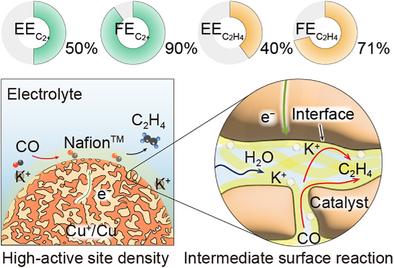
The electrified synthesis of high-demand feedstocks (C2H4) from CO and H2O through a CO electroreduction (COR) protocol is attractive for large-scale applications; however, a high reaction potential and modest Faradaic efficiencies (FEs) limit its practical energy efficiency (EE). In this study, a quantitative reaction–transport model was constructed to analyze the root causes of low performance in COR, which revealed low volumetric exchange current density and limited intermediate surface reaction as key factors, constraining CO-to-C2+ and CO-to-C2H4 conversion energetics and selectivities. Consequently, a robust, high active-site density electrode, featuring nanometer-scale interspacing between the active, Nafion-wrapped Cu+–Cu nanosheet catalysts, was designed. This design increases volumetric COR activity with an efficient intermediate surface reaction mechanism for C2H4 production, substantially lowering the full-cell COR potential to 1.87 V at 4 A in a 25 cm2 membrane electrode assembly, thereby achieving a record >50% C2+ EE with a 90 ± 1% FE along with a >40% C2H4 EE with a 71 ± 1% FE throughout stable >100 h operation. Similarly designed high-volumetric-activity Bi and Ag nanosheet catalysts enabled >60% and >55% EEs for the CO2-to-formate and CO2-to-CO electroreduction, demonstrating the broader applicability of our electrochemical activity and EE enhancement concept on a three-phase interface.
期刊介绍:
Angewandte Chemie, a journal of the German Chemical Society (GDCh), maintains a leading position among scholarly journals in general chemistry with an impressive Impact Factor of 16.6 (2022 Journal Citation Reports, Clarivate, 2023). Published weekly in a reader-friendly format, it features new articles almost every day. Established in 1887, Angewandte Chemie is a prominent chemistry journal, offering a dynamic blend of Review-type articles, Highlights, Communications, and Research Articles on a weekly basis, making it unique in the field.




 京公网安备 11010802042870号
京ICP备2023020795号-1
京公网安备 11010802042870号
京ICP备2023020795号-1

 分享
分享
 求助内容:
求助内容: 应助结果提醒方式:
 扫码关注我们
