{"title":"Long-lasting far-UVC persistent luminescence for solar-blind optical tagging†","authors":"Xihui Shan, Yi Zhang, Xulong Lv and Yanjie Liang","doi":"10.1039/D5QI00184F","DOIUrl":null,"url":null,"abstract":"<p >Far ultraviolet-C (far-UVC; 200–230 nm) luminescent materials have garnered significant interest in recent years, driven by the growing demands for applications such as disinfection and solar-blind imaging due to their distinct wavelength features. However, the research and development of far-UVC persistent phosphors are lacking. Here, we report the realization of far-UVC persistent luminescence in CaSO<small><sub>4</sub></small>:Pr<small><sup>3+</sup></small> and CaSO<small><sub>4</sub></small>:Pb<small><sup>2+</sup></small> phosphors, which show emissions peaking at 220 nm and 230 nm with a long persistence time of >24 h after ceasing X-ray excitation. This is by far the shortest UVC afterglow emission to the best of our knowledge. The far-UVC afterglow from the charged phosphors can be readily detected using a solar-blind UV camera in both indoor-lighting and outdoor environments owing to the absence of background noise from ambient light. The continuous photostimulation of indoor white LED light and outdoor sunlight has different impacts on the far-UVC afterglow performance of CaSO<small><sub>4</sub></small>:Pr<small><sup>3+</sup></small> and CaSO<small><sub>4</sub></small>:Pb<small><sup>2+</sup></small> phosphors, which is elucidated by the decay time-dependent thermoluminescence (TL) curves under different light conditions. This study expands the field of persistent luminescence to the far-UVC spectral region and will inspire the discovery of more excellent far-UVC persistent phosphors.</p>","PeriodicalId":79,"journal":{"name":"Inorganic Chemistry Frontiers","volume":" 8","pages":" 3118-3125"},"PeriodicalIF":6.4000,"publicationDate":"2025-03-07","publicationTypes":"Journal Article","fieldsOfStudy":null,"isOpenAccess":false,"openAccessPdf":"","citationCount":"0","resultStr":null,"platform":"Semanticscholar","paperid":null,"PeriodicalName":"Inorganic Chemistry Frontiers","FirstCategoryId":"92","ListUrlMain":"https://pubs.rsc.org/en/content/articlelanding/2025/qi/d5qi00184f","RegionNum":1,"RegionCategory":"化学","ArticlePicture":[],"TitleCN":null,"AbstractTextCN":null,"PMCID":null,"EPubDate":"","PubModel":"","JCR":"Q1","JCRName":"CHEMISTRY, INORGANIC & NUCLEAR","Score":null,"Total":0}
引用次数: 0
Abstract
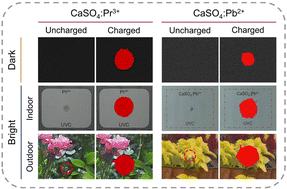
Far ultraviolet-C (far-UVC; 200–230 nm) luminescent materials have garnered significant interest in recent years, driven by the growing demands for applications such as disinfection and solar-blind imaging due to their distinct wavelength features. However, the research and development of far-UVC persistent phosphors are lacking. Here, we report the realization of far-UVC persistent luminescence in CaSO4:Pr3+ and CaSO4:Pb2+ phosphors, which show emissions peaking at 220 nm and 230 nm with a long persistence time of >24 h after ceasing X-ray excitation. This is by far the shortest UVC afterglow emission to the best of our knowledge. The far-UVC afterglow from the charged phosphors can be readily detected using a solar-blind UV camera in both indoor-lighting and outdoor environments owing to the absence of background noise from ambient light. The continuous photostimulation of indoor white LED light and outdoor sunlight has different impacts on the far-UVC afterglow performance of CaSO4:Pr3+ and CaSO4:Pb2+ phosphors, which is elucidated by the decay time-dependent thermoluminescence (TL) curves under different light conditions. This study expands the field of persistent luminescence to the far-UVC spectral region and will inspire the discovery of more excellent far-UVC persistent phosphors.



 京公网安备 11010802042870号
京ICP备2023020795号-1
京公网安备 11010802042870号
京ICP备2023020795号-1

 分享
分享
 求助内容:
求助内容: 应助结果提醒方式:
 扫码关注我们
