Vahid Khandan, Ryan C. Chiechi, Elisabeth Verpoorte and Klaus Mathwig
{"title":"Suppressing parasitic flow in membraneless diffusion-based microfluidic gradient generators†","authors":"Vahid Khandan, Ryan C. Chiechi, Elisabeth Verpoorte and Klaus Mathwig","doi":"10.1039/D4LC00956H","DOIUrl":null,"url":null,"abstract":"<p >Diffusion-based microfluidic gradient generators (DMGGs) are essential for various <em>in vitro</em> studies due to their ability to provide a convection-free concentration gradient. However, these systems, often referred to as membrane-based DMGGs, exhibit delayed gradient formation due to the incorporated flow-resistant membrane. This limitation substantially hinders their application in dynamic and time-sensitive studies. Here, we accelerate the gradient response in DMGGs by removing the membrane and implementing new geometrical configurations to compensate for the membrane's role in suppressing parasitic flows. We introduce these novel configurations into two microfluidic designs: the H-junction and the Y-junction. In the H-junction design, parasitic flow is redirected through a bypass channel following the gradient region. The Y-junction design features a shared discharge channel that allows converging discharge flow streams, preventing the buildup of parasitic pressure downstream of the gradient region. Using hydraulic circuit analysis and fluid dynamics simulations, we demonstrate the effectiveness of the H-junction and Y-junction designs in suppressing parasitic pressure flows. These computational results, supported by experimental data from particle image velocimetry, confirm the capability of our designs to generate a highly stable, accurate, and convection-free gradient with rapid formation. These advantages make the H-junction and Y-junction designs ideal experimental platforms for a wide range of <em>in vitro</em> studies, including drug testing, cell chemotaxis, and stem cell differentiation.</p>","PeriodicalId":85,"journal":{"name":"Lab on a Chip","volume":" 7","pages":" 1875-1887"},"PeriodicalIF":5.4000,"publicationDate":"2025-03-03","publicationTypes":"Journal Article","fieldsOfStudy":null,"isOpenAccess":false,"openAccessPdf":"","citationCount":"0","resultStr":null,"platform":"Semanticscholar","paperid":null,"PeriodicalName":"Lab on a Chip","FirstCategoryId":"5","ListUrlMain":"https://pubs.rsc.org/en/content/articlelanding/2025/lc/d4lc00956h","RegionNum":2,"RegionCategory":"工程技术","ArticlePicture":[],"TitleCN":null,"AbstractTextCN":null,"PMCID":null,"EPubDate":"","PubModel":"","JCR":"Q1","JCRName":"BIOCHEMICAL RESEARCH METHODS","Score":null,"Total":0}
引用次数: 0
Abstract
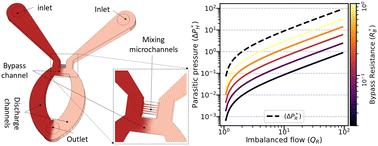
Diffusion-based microfluidic gradient generators (DMGGs) are essential for various in vitro studies due to their ability to provide a convection-free concentration gradient. However, these systems, often referred to as membrane-based DMGGs, exhibit delayed gradient formation due to the incorporated flow-resistant membrane. This limitation substantially hinders their application in dynamic and time-sensitive studies. Here, we accelerate the gradient response in DMGGs by removing the membrane and implementing new geometrical configurations to compensate for the membrane's role in suppressing parasitic flows. We introduce these novel configurations into two microfluidic designs: the H-junction and the Y-junction. In the H-junction design, parasitic flow is redirected through a bypass channel following the gradient region. The Y-junction design features a shared discharge channel that allows converging discharge flow streams, preventing the buildup of parasitic pressure downstream of the gradient region. Using hydraulic circuit analysis and fluid dynamics simulations, we demonstrate the effectiveness of the H-junction and Y-junction designs in suppressing parasitic pressure flows. These computational results, supported by experimental data from particle image velocimetry, confirm the capability of our designs to generate a highly stable, accurate, and convection-free gradient with rapid formation. These advantages make the H-junction and Y-junction designs ideal experimental platforms for a wide range of in vitro studies, including drug testing, cell chemotaxis, and stem cell differentiation.
期刊介绍:
Lab on a Chip is the premiere journal that publishes cutting-edge research in the field of miniaturization. By their very nature, microfluidic/nanofluidic/miniaturized systems are at the intersection of disciplines, spanning fundamental research to high-end application, which is reflected by the broad readership of the journal. Lab on a Chip publishes two types of papers on original research: full-length research papers and communications. Papers should demonstrate innovations, which can come from technical advancements or applications addressing pressing needs in globally important areas. The journal also publishes Comments, Reviews, and Perspectives.



 京公网安备 11010802042870号
京ICP备2023020795号-1
京公网安备 11010802042870号
京ICP备2023020795号-1

 分享
分享
 求助内容:
求助内容: 应助结果提醒方式:
 扫码关注我们
