{"title":"Is there an association between retinal vein occlusion and cerebrovascular accident? A systematic review and meta-analysis.","authors":"Kai-Yang Chen, Hoi-Chun Chan, Chi-Ming Chan","doi":"10.1186/s12886-025-03944-w","DOIUrl":null,"url":null,"abstract":"<p><strong>Background: </strong>Retinal vein occlusion (RVO) is a significant retinal vascular disorder that has been hypothesized to increase the risk of cerebrovascular accidents (CVA). Given the shared vascular pathology between the retina and cerebral circulation, understanding the association between RVO and stroke incidence is critical for early intervention and risk management. This systematic review and meta-analysis aim to evaluate the risk of CVA, including ischemic and hemorrhagic subtypes, in patients with RVO.</p><p><strong>Methods: </strong>This study followed the Preferred Reporting Items for Systematic Reviews and Meta-Analyses (PRISMA) guidelines and was registered in PROSPERO (CRD42024557820). A systematic search of PubMed, Cochrane Library, Scopus, Web of Science, and Embase was conducted from inception to February 2025. Studies assessing the incidence of CVA post-RVO in adult patients (≥ 18 years) were included. Two independent reviewers performed study selection, data extraction, and quality assessment using the Cochrane Risk of Bias tool for Non-Randomized studies (ROBINS-I) was used for observational cohort studies. Meta-analysis was conducted using Comprehensive Meta-Analysis (CMA) software version 3.7, applying a fixed-effects model for low heterogeneity. Subgroup and sensitivity analyses were performed based on RVO type (BRVO vs. CRVO) and stroke subtype (ischemic vs. hemorrhagic CVA). Publication bias was evaluated using Egger's test and funnel plots.</p><p><strong>Results: </strong>A total of 14 studies (n = 97,812 patients) were included. The pooled event rate for CVA post-RVO was 37.5% (95% CI: 37.3%-37.8%), with no significant heterogeneity (I<sup>2</sup> = 0%, p = 0.97). Subgroup analysis showed that both ischemic CVA (37.8%; 95% CI: 37.3%-38.3%) and hemorrhagic CVA (32.7%; 95% CI: 32.3%-33.1%) occurred at similar rates across branch retinal vein occlusion (BRVO) and central retinal vein occlusion (CRVO). The mortality rate post-CVA in RVO patients was 69.0% (95% CI: 68.4%-69.5%), highlighting the severity of stroke outcomes in this population. The incidence of ischemic cardiovascular events, including myocardial infarction, was 15.7% (95% CI: 15.4%-16.0%), reinforcing the need for cardiovascular monitoring in RVO patients. The incidence of deep vein thrombosis (DVT) was relatively low (0.05%) but still warrants clinical attention in high-risk populations. Publication bias was minimal, as confirmed by Egger's test (p > 0.24) and funnel plot symmetry. Sensitivity analyses confirmed the robustness of the pooled estimates.</p><p><strong>Conclusion: </strong>This meta-analysis provides strong evidence linking RVO to an increased risk of CVA and mortality. Given the high incidence of stroke (37.5%) and mortality post-CVA (69%), early cardiovascular risk assessment and intervention are crucial. Patients with RVO should undergo comprehensive vascular risk evaluation, including blood pressure control, lipid regulation, and anticoagulation therapy when indicated. The findings support a multidisciplinary approach involving ophthalmologists, neurologists, and cardiologists for proactive stroke prevention strategies in RVO patients. Future research should explore genetic predispositions, inflammatory markers, and AI-based predictive models to improve early risk stratification and intervention.</p>","PeriodicalId":9058,"journal":{"name":"BMC Ophthalmology","volume":"25 1","pages":"112"},"PeriodicalIF":1.7000,"publicationDate":"2025-03-06","publicationTypes":"Journal Article","fieldsOfStudy":null,"isOpenAccess":false,"openAccessPdf":"https://www.ncbi.nlm.nih.gov/pmc/articles/PMC11887117/pdf/","citationCount":"0","resultStr":null,"platform":"Semanticscholar","paperid":null,"PeriodicalName":"BMC Ophthalmology","FirstCategoryId":"3","ListUrlMain":"https://doi.org/10.1186/s12886-025-03944-w","RegionNum":4,"RegionCategory":"医学","ArticlePicture":[],"TitleCN":null,"AbstractTextCN":null,"PMCID":null,"EPubDate":"","PubModel":"","JCR":"Q3","JCRName":"OPHTHALMOLOGY","Score":null,"Total":0}
引用次数: 0
Abstract
Background: Retinal vein occlusion (RVO) is a significant retinal vascular disorder that has been hypothesized to increase the risk of cerebrovascular accidents (CVA). Given the shared vascular pathology between the retina and cerebral circulation, understanding the association between RVO and stroke incidence is critical for early intervention and risk management. This systematic review and meta-analysis aim to evaluate the risk of CVA, including ischemic and hemorrhagic subtypes, in patients with RVO.
Methods: This study followed the Preferred Reporting Items for Systematic Reviews and Meta-Analyses (PRISMA) guidelines and was registered in PROSPERO (CRD42024557820). A systematic search of PubMed, Cochrane Library, Scopus, Web of Science, and Embase was conducted from inception to February 2025. Studies assessing the incidence of CVA post-RVO in adult patients (≥ 18 years) were included. Two independent reviewers performed study selection, data extraction, and quality assessment using the Cochrane Risk of Bias tool for Non-Randomized studies (ROBINS-I) was used for observational cohort studies. Meta-analysis was conducted using Comprehensive Meta-Analysis (CMA) software version 3.7, applying a fixed-effects model for low heterogeneity. Subgroup and sensitivity analyses were performed based on RVO type (BRVO vs. CRVO) and stroke subtype (ischemic vs. hemorrhagic CVA). Publication bias was evaluated using Egger's test and funnel plots.
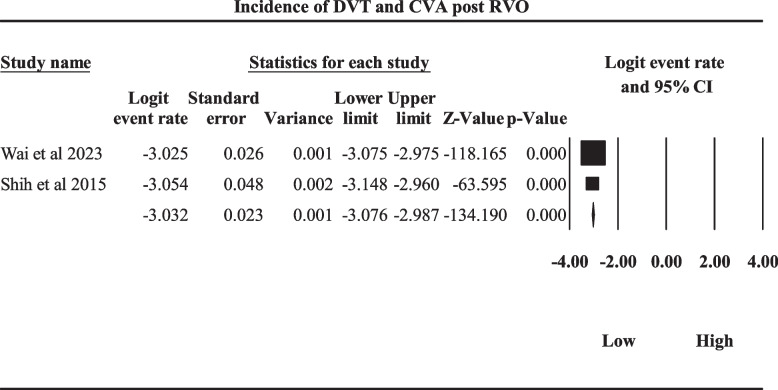
Results: A total of 14 studies (n = 97,812 patients) were included. The pooled event rate for CVA post-RVO was 37.5% (95% CI: 37.3%-37.8%), with no significant heterogeneity (I2 = 0%, p = 0.97). Subgroup analysis showed that both ischemic CVA (37.8%; 95% CI: 37.3%-38.3%) and hemorrhagic CVA (32.7%; 95% CI: 32.3%-33.1%) occurred at similar rates across branch retinal vein occlusion (BRVO) and central retinal vein occlusion (CRVO). The mortality rate post-CVA in RVO patients was 69.0% (95% CI: 68.4%-69.5%), highlighting the severity of stroke outcomes in this population. The incidence of ischemic cardiovascular events, including myocardial infarction, was 15.7% (95% CI: 15.4%-16.0%), reinforcing the need for cardiovascular monitoring in RVO patients. The incidence of deep vein thrombosis (DVT) was relatively low (0.05%) but still warrants clinical attention in high-risk populations. Publication bias was minimal, as confirmed by Egger's test (p > 0.24) and funnel plot symmetry. Sensitivity analyses confirmed the robustness of the pooled estimates.
Conclusion: This meta-analysis provides strong evidence linking RVO to an increased risk of CVA and mortality. Given the high incidence of stroke (37.5%) and mortality post-CVA (69%), early cardiovascular risk assessment and intervention are crucial. Patients with RVO should undergo comprehensive vascular risk evaluation, including blood pressure control, lipid regulation, and anticoagulation therapy when indicated. The findings support a multidisciplinary approach involving ophthalmologists, neurologists, and cardiologists for proactive stroke prevention strategies in RVO patients. Future research should explore genetic predispositions, inflammatory markers, and AI-based predictive models to improve early risk stratification and intervention.
期刊介绍:
BMC Ophthalmology is an open access, peer-reviewed journal that considers articles on all aspects of the prevention, diagnosis and management of eye disorders, as well as related molecular genetics, pathophysiology, and epidemiology.






 京公网安备 11010802042870号
京ICP备2023020795号-1
京公网安备 11010802042870号
京ICP备2023020795号-1

 分享
分享
 求助内容:
求助内容: 应助结果提醒方式:
 扫码关注我们
