Angelique Fan, Céline Lambert, Jeremie Sellam, Roland Chapurlat, Hubert Marotte, Bruno Pereira, Thierry Thomas, Anne Tournadre, Martin Soubrier, Sylvain Mathieu
{"title":"CADOR (Capsaicin in neuropathic-like pain in digital osteoarthritis) study protocol: a multicentre randomised parallel-group trial.","authors":"Angelique Fan, Céline Lambert, Jeremie Sellam, Roland Chapurlat, Hubert Marotte, Bruno Pereira, Thierry Thomas, Anne Tournadre, Martin Soubrier, Sylvain Mathieu","doi":"10.1136/bmjopen-2024-093409","DOIUrl":null,"url":null,"abstract":"<p><strong>Introduction: </strong>It is common for finger pain in hand osteoarthritis (HOA) to display a neuropathic component. Non-steroidal anti-inflammatory drugs (NSAIDs) and conventional analgesics are not very effective in relieving this neuropathic-like pain. Capsaicin, a compound extracted from chilli peppers, is approved for the management of localised neuropathic pain. However, the effectiveness of an 8% capsaicin transdermal patch has never been tested in HOA patients with neuropathic-like pain in a randomised setting. In this study, we aimed to compare the 60-day (D60) efficacy of a transdermal application of capsaicin 8% versus a control (very low-dose capsaicin at 0.04%) on hand pain in patients with painful digital osteoarthritis with a neuropathic-like pain component.</p><p><strong>Methods and analysis: </strong>CADOR (CApsaicin in neuropathic-like pain in Digital Osteoarthritis: a Randomised trial) is a multicentre, randomised, controlled, double-blind, two parallel group, phase 3 clinical trial. Eligible patients have HOA according to the American College of Rheumatology criteria and at least Kellgren-Lawrence grade≥2, with neuropathic-like pain ('Douleur neuropathique en 4 questions' (DN4) score≥4/10 and pain intensity≥40/100 mm). At Day 0, 120 patients will be randomised (1:1) to receive a single 30 min topical application of either capsaicin 8% transdermal patch (experimental group) or capsaicin 0.04% transdermal patch (control group). The primary outcome is pain intensity in the fingers over the past 48 hours at Day 60, measured with a Visual Analogue Scale (VAS) ranging from 0 to 100 mm. Secondary outcomes are functional disability, quality of life, anxiety and depression, the patient's global impression of improvement, use of analgesics and NSAIDs and the safety of capsaicin. At visit D60, patients who still have finger pain≥40/100 mm on the VAS will receive, if they wish a single 30 min topical application of capsaicin 8% transdermal patch (not blinded). The efficacy of two transdermal applications of capsaicin (either two applications of 8% patch in the experimental arm or one application of 0.04% and one application of 8% in the control arm) will be assessed on Day 120.</p><p><strong>Ethics and dissemination: </strong>Ethics approval was obtained from the French Health Authorities (Comité de protection des Personnes SUD EST V and Agence Nationale de Sécurité du Médicament) on 23 May 2024 in accordance with European Regulation n°536/2014 of 16 April 2014 (ref: 2024-511159-16-00) before participant enrolment.</p><p><strong>Trial registration number: </strong>ClinicalTrials.gov: NCT06444919.</p>","PeriodicalId":9158,"journal":{"name":"BMJ Open","volume":"15 3","pages":"e093409"},"PeriodicalIF":2.3000,"publicationDate":"2025-03-06","publicationTypes":"Journal Article","fieldsOfStudy":null,"isOpenAccess":false,"openAccessPdf":"https://www.ncbi.nlm.nih.gov/pmc/articles/PMC11887280/pdf/","citationCount":"0","resultStr":null,"platform":"Semanticscholar","paperid":null,"PeriodicalName":"BMJ Open","FirstCategoryId":"3","ListUrlMain":"https://doi.org/10.1136/bmjopen-2024-093409","RegionNum":3,"RegionCategory":"医学","ArticlePicture":[],"TitleCN":null,"AbstractTextCN":null,"PMCID":null,"EPubDate":"","PubModel":"","JCR":"Q1","JCRName":"MEDICINE, GENERAL & INTERNAL","Score":null,"Total":0}
引用次数: 0
Abstract
Introduction: It is common for finger pain in hand osteoarthritis (HOA) to display a neuropathic component. Non-steroidal anti-inflammatory drugs (NSAIDs) and conventional analgesics are not very effective in relieving this neuropathic-like pain. Capsaicin, a compound extracted from chilli peppers, is approved for the management of localised neuropathic pain. However, the effectiveness of an 8% capsaicin transdermal patch has never been tested in HOA patients with neuropathic-like pain in a randomised setting. In this study, we aimed to compare the 60-day (D60) efficacy of a transdermal application of capsaicin 8% versus a control (very low-dose capsaicin at 0.04%) on hand pain in patients with painful digital osteoarthritis with a neuropathic-like pain component.
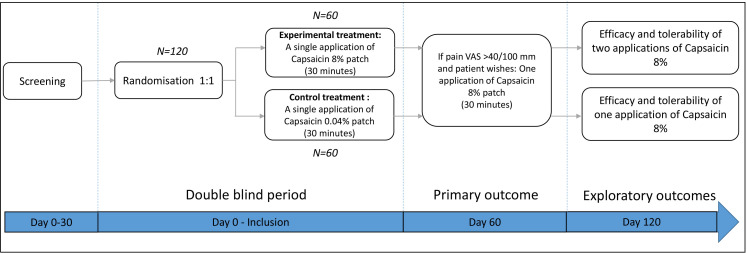
Methods and analysis: CADOR (CApsaicin in neuropathic-like pain in Digital Osteoarthritis: a Randomised trial) is a multicentre, randomised, controlled, double-blind, two parallel group, phase 3 clinical trial. Eligible patients have HOA according to the American College of Rheumatology criteria and at least Kellgren-Lawrence grade≥2, with neuropathic-like pain ('Douleur neuropathique en 4 questions' (DN4) score≥4/10 and pain intensity≥40/100 mm). At Day 0, 120 patients will be randomised (1:1) to receive a single 30 min topical application of either capsaicin 8% transdermal patch (experimental group) or capsaicin 0.04% transdermal patch (control group). The primary outcome is pain intensity in the fingers over the past 48 hours at Day 60, measured with a Visual Analogue Scale (VAS) ranging from 0 to 100 mm. Secondary outcomes are functional disability, quality of life, anxiety and depression, the patient's global impression of improvement, use of analgesics and NSAIDs and the safety of capsaicin. At visit D60, patients who still have finger pain≥40/100 mm on the VAS will receive, if they wish a single 30 min topical application of capsaicin 8% transdermal patch (not blinded). The efficacy of two transdermal applications of capsaicin (either two applications of 8% patch in the experimental arm or one application of 0.04% and one application of 8% in the control arm) will be assessed on Day 120.
Ethics and dissemination: Ethics approval was obtained from the French Health Authorities (Comité de protection des Personnes SUD EST V and Agence Nationale de Sécurité du Médicament) on 23 May 2024 in accordance with European Regulation n°536/2014 of 16 April 2014 (ref: 2024-511159-16-00) before participant enrolment.
期刊介绍:
BMJ Open is an online, open access journal, dedicated to publishing medical research from all disciplines and therapeutic areas. The journal publishes all research study types, from study protocols to phase I trials to meta-analyses, including small or specialist studies. Publishing procedures are built around fully open peer review and continuous publication, publishing research online as soon as the article is ready.



 京公网安备 11010802042870号
京ICP备2023020795号-1
京公网安备 11010802042870号
京ICP备2023020795号-1

 分享
分享
 求助内容:
求助内容: 应助结果提醒方式:
 扫码关注我们
