Dor Shpitzer, Yael C Cohen, Tamir Shragai, Ori Grossberger, Dana Amsterdam, Anat Reiner-Benaim, Irit Avivi
{"title":"Clinical outcomes in older adults treated outside clinical studies: highlighting the octogenarian experience.","authors":"Dor Shpitzer, Yael C Cohen, Tamir Shragai, Ori Grossberger, Dana Amsterdam, Anat Reiner-Benaim, Irit Avivi","doi":"10.1182/bloodadvances.2025015968","DOIUrl":null,"url":null,"abstract":"<p><strong>Abstract: </strong>With an aging population, multiple myeloma (MM) increasingly affects octogenarians (Octos; age of ≥80 years), yet data on their management and outcomes, particularly if treated outside clinical trials, remain limited. This retrospective study analyzed 652 patients aged ≥70 years, diagnosed with active MM between 2014 and 2023, identified in the Maccabi Healthcare Services medical records. Patient characteristics, treatment, time to next treatment (TTNT), overall survival (OS), and factors influencing outcomes, were compared between Octo and older adults (OL) aged 70 to <80 years. Octo patients (median age, 83 years) had more comorbidities and higher Charlson Comorbidity Index (CCI) scores than OL patients (≥6; 53% vs 23%), leading to lower rates of anti-MM therapy administration and reduced triplet/quadruplet regimen use. Over a median follow-up of 25 months, Octo patients had significantly shorter median OS; 25.9 vs 71.3 months, and 33 vs 76.9 months among treated patients only. TTNT was similar (17.8 vs 22.1 months). Multivariate analysis showed that triplet/quadruplet regimen was associated with improved TTNT (hazard ratio [HR], 0.61; P < .001) and OS (HR, 0.63; P < .001) compared with doublets, whereas higher CCI scores and age of ≥80 years predicted worse OS (HR, 1.5; P = .003; and HR, 2.27; P < .001; respectively). Daratumumab-based therapies enhanced TTNT in both age groups (HR, 0.54; P = .017). In conclusion, higher comorbidities in Octo patients adversely affected their management and survival. However, daratumumab positively influenced outcomes, underscoring the need for tailored approaches to optimize treatment in older patients with MM.</p>","PeriodicalId":9228,"journal":{"name":"Blood advances","volume":" ","pages":"2677-2685"},"PeriodicalIF":7.1000,"publicationDate":"2025-06-10","publicationTypes":"Journal Article","fieldsOfStudy":null,"isOpenAccess":false,"openAccessPdf":"https://www.ncbi.nlm.nih.gov/pmc/articles/PMC12155550/pdf/","citationCount":"0","resultStr":null,"platform":"Semanticscholar","paperid":null,"PeriodicalName":"Blood advances","FirstCategoryId":"3","ListUrlMain":"https://doi.org/10.1182/bloodadvances.2025015968","RegionNum":1,"RegionCategory":"医学","ArticlePicture":[],"TitleCN":null,"AbstractTextCN":null,"PMCID":null,"EPubDate":"","PubModel":"","JCR":"Q1","JCRName":"HEMATOLOGY","Score":null,"Total":0}
引用次数: 0
Abstract
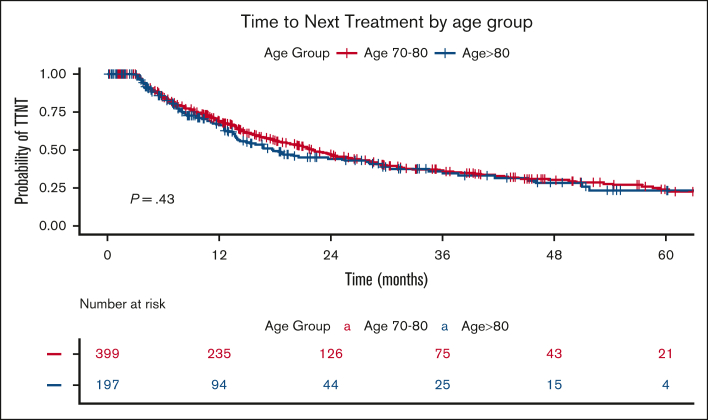
Abstract: With an aging population, multiple myeloma (MM) increasingly affects octogenarians (Octos; age of ≥80 years), yet data on their management and outcomes, particularly if treated outside clinical trials, remain limited. This retrospective study analyzed 652 patients aged ≥70 years, diagnosed with active MM between 2014 and 2023, identified in the Maccabi Healthcare Services medical records. Patient characteristics, treatment, time to next treatment (TTNT), overall survival (OS), and factors influencing outcomes, were compared between Octo and older adults (OL) aged 70 to <80 years. Octo patients (median age, 83 years) had more comorbidities and higher Charlson Comorbidity Index (CCI) scores than OL patients (≥6; 53% vs 23%), leading to lower rates of anti-MM therapy administration and reduced triplet/quadruplet regimen use. Over a median follow-up of 25 months, Octo patients had significantly shorter median OS; 25.9 vs 71.3 months, and 33 vs 76.9 months among treated patients only. TTNT was similar (17.8 vs 22.1 months). Multivariate analysis showed that triplet/quadruplet regimen was associated with improved TTNT (hazard ratio [HR], 0.61; P < .001) and OS (HR, 0.63; P < .001) compared with doublets, whereas higher CCI scores and age of ≥80 years predicted worse OS (HR, 1.5; P = .003; and HR, 2.27; P < .001; respectively). Daratumumab-based therapies enhanced TTNT in both age groups (HR, 0.54; P = .017). In conclusion, higher comorbidities in Octo patients adversely affected their management and survival. However, daratumumab positively influenced outcomes, underscoring the need for tailored approaches to optimize treatment in older patients with MM.
期刊介绍:
Blood Advances, a semimonthly medical journal published by the American Society of Hematology, marks the first addition to the Blood family in 70 years. This peer-reviewed, online-only, open-access journal was launched under the leadership of founding editor-in-chief Robert Negrin, MD, from Stanford University Medical Center in Stanford, CA, with its inaugural issue released on November 29, 2016.
Blood Advances serves as an international platform for original articles detailing basic laboratory, translational, and clinical investigations in hematology. The journal comprehensively covers all aspects of hematology, including disorders of leukocytes (both benign and malignant), erythrocytes, platelets, hemostatic mechanisms, vascular biology, immunology, and hematologic oncology. Each article undergoes a rigorous peer-review process, with selection based on the originality of the findings, the high quality of the work presented, and the clarity of the presentation.





 京公网安备 11010802042870号
京ICP备2023020795号-1
京公网安备 11010802042870号
京ICP备2023020795号-1

 分享
分享
 求助内容:
求助内容: 应助结果提醒方式:
 扫码关注我们
