Mehdi Farokhnia, John Tazare, Claire L Pince, Nicolaus Bruns, Joshua C Gray, Vincent Lo Re, David A Fiellin, Henry R Kranzler, George F Koob, Amy C Justice, Leandro F Vendruscolo, Christopher T Rentsch, Lorenzo Leggio
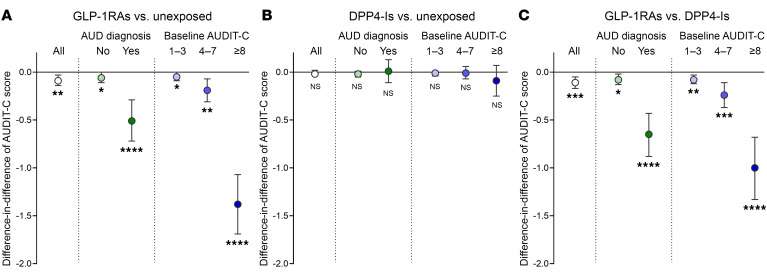
{"title":"Glucagon-like peptide-1 receptor agonists, but not dipeptidyl peptidase-4 inhibitors, reduce alcohol intake.","authors":"Mehdi Farokhnia, John Tazare, Claire L Pince, Nicolaus Bruns, Joshua C Gray, Vincent Lo Re, David A Fiellin, Henry R Kranzler, George F Koob, Amy C Justice, Leandro F Vendruscolo, Christopher T Rentsch, Lorenzo Leggio","doi":"10.1172/JCI188314","DOIUrl":null,"url":null,"abstract":"<p><p>BACKGROUNDDespite growing preclinical evidence that glucagon-like peptide1 receptor agonists (GLP-1RAs) could be repurposed to treat alcohol use disorder (AUD), clinical evidence is scarce. Additionally, the potential impact of dipeptidyl peptidase-4 inhibitors (DPP-4Is) on alcohol intake is largely unknown.METHODSWe conducted a large cohort study using 2008-2023 electronic health records data from the U.S. Department of Veterans Affairs. Changes in Alcohol Use Disorders Identification Test-Consumption (AUDIT-C) scores were compared between propensity-score-matched GLP-1RA recipients, DPP-4I recipients, and unexposed comparators. We further tested the effects of 2 DPP-4Is, linagliptin and omarigliptin, on binge-like alcohol drinking in mice and operant oral alcohol self administration in alcohol-dependent rats, models previously used to show a significant effect of the GLP-1RA semaglutide in reducing alcohol intake.RESULTSGLP-1RA recipients reported a greater reduction in AUDIT-C scores than unexposed individuals (difference-in-difference [DiD]: 0.09 [95% CI: 0.03, 0.14], P = 0.0025) and DPP-4I recipients (DiD: 0.11 [95% CI: 0.05,0.17], P = 0.0002). Reductions in drinking were more pronounced among individuals with baseline AUD (GLP-1RA versus unexposed: 0.51 [95% CI: 0.29,0.72], P < 0.0001; GLP-1RA versus DPP-4I: 0.65 [95% CI: 0.43,0.88], P < 0.0001) and baseline hazardous drinking (GLP-1RA versus unexposed: 1.38 [95% CI: 1.07,1.69], P < 0.0001; GLP-1RA versus DPP-4I: 1.00 [95% CI: 0.68,1.33], P < 0.0001). There were no differences between DPP-4I recipients and unexposed individuals. The latter results were confirmed via a reverse translational approach. Specifically, neither linagliptin nor omarigliptin reduced alcohol drinking in mice or rats. The rodent experiments also confirmed target engagemhent, as both DPP-4Is reduced blood glucose levels.CONCLUSIONConvergent findings across humans, mice, and rats indicated that GLP-1RAs, but not DPP-4Is, reduce alcohol consumption and may be efficacious in treating AUD.FUNDINGThis work was supported by the National Institutes of Health Intramural Research Program (ZIA DA000635, ZIA DA000644, ZIA DA000602), National Institute on Alcohol Abuse and Alcoholism extramural funding (R01 AA030041, P01 AA029545, U01 AA026224, U24 AA020794, U01 AA020790, U10 AA013566), the U.S. Department of Veterans Affairs (I01BX004820), and an Alkermes Pathways Research Award.</p>","PeriodicalId":15469,"journal":{"name":"Journal of Clinical Investigation","volume":" ","pages":""},"PeriodicalIF":13.6000,"publicationDate":"2025-03-06","publicationTypes":"Journal Article","fieldsOfStudy":null,"isOpenAccess":false,"openAccessPdf":"https://www.ncbi.nlm.nih.gov/pmc/articles/PMC12043080/pdf/","citationCount":"0","resultStr":null,"platform":"Semanticscholar","paperid":null,"PeriodicalName":"Journal of Clinical Investigation","FirstCategoryId":"3","ListUrlMain":"https://doi.org/10.1172/JCI188314","RegionNum":1,"RegionCategory":"医学","ArticlePicture":[],"TitleCN":null,"AbstractTextCN":null,"PMCID":null,"EPubDate":"2025/5/1 0:00:00","PubModel":"eCollection","JCR":"Q1","JCRName":"MEDICINE, RESEARCH & EXPERIMENTAL","Score":null,"Total":0}
引用次数: 0
Abstract
BACKGROUNDDespite growing preclinical evidence that glucagon-like peptide1 receptor agonists (GLP-1RAs) could be repurposed to treat alcohol use disorder (AUD), clinical evidence is scarce. Additionally, the potential impact of dipeptidyl peptidase-4 inhibitors (DPP-4Is) on alcohol intake is largely unknown.METHODSWe conducted a large cohort study using 2008-2023 electronic health records data from the U.S. Department of Veterans Affairs. Changes in Alcohol Use Disorders Identification Test-Consumption (AUDIT-C) scores were compared between propensity-score-matched GLP-1RA recipients, DPP-4I recipients, and unexposed comparators. We further tested the effects of 2 DPP-4Is, linagliptin and omarigliptin, on binge-like alcohol drinking in mice and operant oral alcohol self administration in alcohol-dependent rats, models previously used to show a significant effect of the GLP-1RA semaglutide in reducing alcohol intake.RESULTSGLP-1RA recipients reported a greater reduction in AUDIT-C scores than unexposed individuals (difference-in-difference [DiD]: 0.09 [95% CI: 0.03, 0.14], P = 0.0025) and DPP-4I recipients (DiD: 0.11 [95% CI: 0.05,0.17], P = 0.0002). Reductions in drinking were more pronounced among individuals with baseline AUD (GLP-1RA versus unexposed: 0.51 [95% CI: 0.29,0.72], P < 0.0001; GLP-1RA versus DPP-4I: 0.65 [95% CI: 0.43,0.88], P < 0.0001) and baseline hazardous drinking (GLP-1RA versus unexposed: 1.38 [95% CI: 1.07,1.69], P < 0.0001; GLP-1RA versus DPP-4I: 1.00 [95% CI: 0.68,1.33], P < 0.0001). There were no differences between DPP-4I recipients and unexposed individuals. The latter results were confirmed via a reverse translational approach. Specifically, neither linagliptin nor omarigliptin reduced alcohol drinking in mice or rats. The rodent experiments also confirmed target engagemhent, as both DPP-4Is reduced blood glucose levels.CONCLUSIONConvergent findings across humans, mice, and rats indicated that GLP-1RAs, but not DPP-4Is, reduce alcohol consumption and may be efficacious in treating AUD.FUNDINGThis work was supported by the National Institutes of Health Intramural Research Program (ZIA DA000635, ZIA DA000644, ZIA DA000602), National Institute on Alcohol Abuse and Alcoholism extramural funding (R01 AA030041, P01 AA029545, U01 AA026224, U24 AA020794, U01 AA020790, U10 AA013566), the U.S. Department of Veterans Affairs (I01BX004820), and an Alkermes Pathways Research Award.
期刊介绍:
The Journal of Clinical Investigation, established in 1924 by the ASCI, is a prestigious publication that focuses on breakthroughs in basic and clinical biomedical science, with the goal of advancing the field of medicine. With an impressive Impact Factor of 15.9 in 2022, it is recognized as one of the leading journals in the "Medicine, Research & Experimental" category of the Web of Science.
The journal attracts a diverse readership from various medical disciplines and sectors. It publishes a wide range of research articles encompassing all biomedical specialties, including Autoimmunity, Gastroenterology, Immunology, Metabolism, Nephrology, Neuroscience, Oncology, Pulmonology, Vascular Biology, and many others.
The Editorial Board consists of esteemed academic editors who possess extensive expertise in their respective fields. They are actively involved in research, ensuring the journal's high standards of publication and scientific rigor.





 京公网安备 11010802042870号
京ICP备2023020795号-1
京公网安备 11010802042870号
京ICP备2023020795号-1

 分享
分享
 求助内容:
求助内容: 应助结果提醒方式:
 扫码关注我们
