{"title":"Mechanisms of NMDA receptor inhibition by vortioxetine – Comparison with fluoxetine","authors":"Arseniy S. Zhigulin, Oleg I. Barygin","doi":"10.1016/j.ejphar.2025.177460","DOIUrl":null,"url":null,"abstract":"<div><div>N-methyl-D-aspartate receptors (NMDARs) are involved in the pathophysiology of depression and are inhibited by many antidepressants. In this work, we studied the action of the vortioxetine, a relatively new multitarget antidepressant, on native NMDARs in rat hippocampal CA1 pyramidal neurons and compared it to the action of structurally similar antidepressant fluoxetine. Vortioxetine inhibited these receptors with IC<sub>50</sub> value of 11 ± 1 μM at −80 mV holding voltage, being about three-fold more potent than fluoxetine in these conditions. The inhibition by both compounds was not competitive. Both vortioxetine and fluoxetine demonstrated complex voltage dependence with voltage-dependent and voltage-independent components. The voltage-dependent component corresponded to trapping channel block, while the voltage-independent component – to allosteric inhibition. Vortioxetine and fluoxetine were able to inhibit both open and closed NMDAR channels. Thus, NMDARs can be among important targets for vortioxetine or structurally related drugs. In addition, structural similarity of vortioxetine and fluoxetine allows to assume that these compounds may share other molecular targets besides serotonin transporter and NMDARs.</div></div>","PeriodicalId":12004,"journal":{"name":"European journal of pharmacology","volume":"998 ","pages":"Article 177460"},"PeriodicalIF":5.7000,"publicationDate":"2025-07-05","publicationTypes":"Journal Article","fieldsOfStudy":null,"isOpenAccess":false,"openAccessPdf":"","citationCount":"0","resultStr":null,"platform":"Semanticscholar","paperid":null,"PeriodicalName":"European journal of pharmacology","FirstCategoryId":"3","ListUrlMain":"https://www.sciencedirect.com/science/article/pii/S0014299925002146","RegionNum":3,"RegionCategory":"医学","ArticlePicture":[],"TitleCN":null,"AbstractTextCN":null,"PMCID":null,"EPubDate":"2025/3/4 0:00:00","PubModel":"Epub","JCR":"Q1","JCRName":"PHARMACOLOGY & PHARMACY","Score":null,"Total":0}
引用次数: 0
Abstract
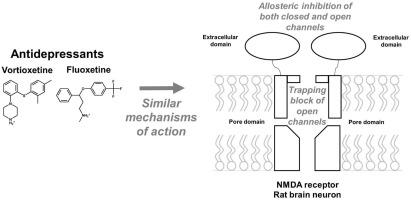
N-methyl-D-aspartate receptors (NMDARs) are involved in the pathophysiology of depression and are inhibited by many antidepressants. In this work, we studied the action of the vortioxetine, a relatively new multitarget antidepressant, on native NMDARs in rat hippocampal CA1 pyramidal neurons and compared it to the action of structurally similar antidepressant fluoxetine. Vortioxetine inhibited these receptors with IC50 value of 11 ± 1 μM at −80 mV holding voltage, being about three-fold more potent than fluoxetine in these conditions. The inhibition by both compounds was not competitive. Both vortioxetine and fluoxetine demonstrated complex voltage dependence with voltage-dependent and voltage-independent components. The voltage-dependent component corresponded to trapping channel block, while the voltage-independent component – to allosteric inhibition. Vortioxetine and fluoxetine were able to inhibit both open and closed NMDAR channels. Thus, NMDARs can be among important targets for vortioxetine or structurally related drugs. In addition, structural similarity of vortioxetine and fluoxetine allows to assume that these compounds may share other molecular targets besides serotonin transporter and NMDARs.
n -甲基- d -天冬氨酸受体(NMDARs)参与抑郁症的病理生理,并被许多抗抑郁药物抑制。本文研究了新型多靶点抗抑郁药沃替西汀对大鼠海马CA1锥体神经元天然NMDARs的作用,并将其与结构相似的抗抑郁药氟西汀的作用进行了比较。沃替西汀在-80 mV保持电压下抑制这些受体的IC50值为11±1 μM,比氟西汀的抑制作用强约3倍。两种化合物的抑制作用不具有竞争性。沃替西汀和氟西汀均表现出复杂的电压依赖性,具有电压依赖性和电压非依赖性成分。电压相关成分对应于捕获通道阻塞,而电压无关成分对应于变构抑制。沃替西汀和氟西汀都能抑制NMDAR通道的开放和关闭。因此,NMDARs可能是沃替西汀或结构相关药物的重要靶点之一。此外,vortioxetine和fluoxetine的结构相似性允许假设这些化合物可能共享除5 -羟色胺转运体和NMDARs之外的其他分子靶点。
期刊介绍:
The European Journal of Pharmacology publishes research papers covering all aspects of experimental pharmacology with focus on the mechanism of action of structurally identified compounds affecting biological systems.
The scope includes:
Behavioural pharmacology
Neuropharmacology and analgesia
Cardiovascular pharmacology
Pulmonary, gastrointestinal and urogenital pharmacology
Endocrine pharmacology
Immunopharmacology and inflammation
Molecular and cellular pharmacology
Regenerative pharmacology
Biologicals and biotherapeutics
Translational pharmacology
Nutriceutical pharmacology.




 京公网安备 11010802042870号
京ICP备2023020795号-1
京公网安备 11010802042870号
京ICP备2023020795号-1

 分享
分享
 求助内容:
求助内容: 应助结果提醒方式:
 扫码关注我们
