Colleen B. Maxwell , Panayiota Stylianou , Hilary Marshall , Alfie J. Hall , Paulene A. Quinn , Leong L. Ng , Donald JL. Jones , Peter Bradding , Katy M. Roach
{"title":"TGFβ1 generates a pro-fibrotic proteome in human lung parenchyma that is sensitive to pharmacological intervention","authors":"Colleen B. Maxwell , Panayiota Stylianou , Hilary Marshall , Alfie J. Hall , Paulene A. Quinn , Leong L. Ng , Donald JL. Jones , Peter Bradding , Katy M. Roach","doi":"10.1016/j.ejphar.2025.177461","DOIUrl":null,"url":null,"abstract":"<div><h3>Introduction</h3><div>Novel treatments for idiopathic pulmonary fibrosis (IPF) are needed urgently. A better understanding of the molecular pathways activated by TGFβ1 in human lung tissue may facilitate the development of more effective anti-fibrotic medications. This study utilized proteomic analysis to test the hypothesis that TGFβ1 induces pro-fibrotic effects on human lung parenchyma proteome, and to evaluate the viability of this model for testing novel therapeutic targets.</div></div><div><h3>Methods</h3><div>Non-fibrotic human lung parenchymal tissue from 11 patients was cultured for 7 days in serum-free (SF) media supplemented with TGFβ1 (10 ng/mL) or vehicle control, and the putative antifibrotic K<sub>Ca</sub>3.1 ion channel blocker senicapoc or vehicle control. The tissue was homogenised, digested for bottom-up proteomics, and analysed using liquid chromatography-tandem mass spectrometry (LC-MS/MS). Principal component analysis, differential expression analysis, pathway analysis, and drug repurposing analysis were performed.</div></div><div><h3>Results</h3><div>TGFβ1 stimulation for 7 days induced a strong fibrotic protein response relevant to IPF pathology. A total of 2391 proteins were quantified, 306 upregulated and 285 downregulated (FDR-adjusted p-value<0.05). Of these, 118 were upregulated and 28 downregulated at log<sub>2</sub>(FC) > 0.58. These changes were attenuated by senicapoc (100 nM). Drug repurposing analysis identified 265 drugs predicted to inhibit the effects of TGFβ1 in this model. These included clotrimazole, a K<sub>Ca</sub>3.1 blocker, and nintedanib, a drug licenced for the treatment of IPF, providing validation of this approach.</div></div><div><h3>Conclusion</h3><div>A pro-fibrotic proteome is induced in human lung parenchyma exposed to TGFβ1, sensitive to pharmacological intervention. This approach has the potential to enhance therapeutic drug screening for IPF treatment.</div></div>","PeriodicalId":12004,"journal":{"name":"European journal of pharmacology","volume":"997 ","pages":"Article 177461"},"PeriodicalIF":4.7000,"publicationDate":"2025-06-15","publicationTypes":"Journal Article","fieldsOfStudy":null,"isOpenAccess":false,"openAccessPdf":"","citationCount":"0","resultStr":null,"platform":"Semanticscholar","paperid":null,"PeriodicalName":"European journal of pharmacology","FirstCategoryId":"3","ListUrlMain":"https://www.sciencedirect.com/science/article/pii/S0014299925002158","RegionNum":3,"RegionCategory":"医学","ArticlePicture":[],"TitleCN":null,"AbstractTextCN":null,"PMCID":null,"EPubDate":"2025/3/4 0:00:00","PubModel":"Epub","JCR":"Q1","JCRName":"PHARMACOLOGY & PHARMACY","Score":null,"Total":0}
引用次数: 0
Abstract
Introduction
Novel treatments for idiopathic pulmonary fibrosis (IPF) are needed urgently. A better understanding of the molecular pathways activated by TGFβ1 in human lung tissue may facilitate the development of more effective anti-fibrotic medications. This study utilized proteomic analysis to test the hypothesis that TGFβ1 induces pro-fibrotic effects on human lung parenchyma proteome, and to evaluate the viability of this model for testing novel therapeutic targets.
Methods
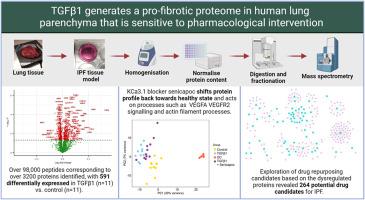
Non-fibrotic human lung parenchymal tissue from 11 patients was cultured for 7 days in serum-free (SF) media supplemented with TGFβ1 (10 ng/mL) or vehicle control, and the putative antifibrotic KCa3.1 ion channel blocker senicapoc or vehicle control. The tissue was homogenised, digested for bottom-up proteomics, and analysed using liquid chromatography-tandem mass spectrometry (LC-MS/MS). Principal component analysis, differential expression analysis, pathway analysis, and drug repurposing analysis were performed.
Results
TGFβ1 stimulation for 7 days induced a strong fibrotic protein response relevant to IPF pathology. A total of 2391 proteins were quantified, 306 upregulated and 285 downregulated (FDR-adjusted p-value<0.05). Of these, 118 were upregulated and 28 downregulated at log2(FC) > 0.58. These changes were attenuated by senicapoc (100 nM). Drug repurposing analysis identified 265 drugs predicted to inhibit the effects of TGFβ1 in this model. These included clotrimazole, a KCa3.1 blocker, and nintedanib, a drug licenced for the treatment of IPF, providing validation of this approach.
Conclusion
A pro-fibrotic proteome is induced in human lung parenchyma exposed to TGFβ1, sensitive to pharmacological intervention. This approach has the potential to enhance therapeutic drug screening for IPF treatment.
期刊介绍:
The European Journal of Pharmacology publishes research papers covering all aspects of experimental pharmacology with focus on the mechanism of action of structurally identified compounds affecting biological systems.
The scope includes:
Behavioural pharmacology
Neuropharmacology and analgesia
Cardiovascular pharmacology
Pulmonary, gastrointestinal and urogenital pharmacology
Endocrine pharmacology
Immunopharmacology and inflammation
Molecular and cellular pharmacology
Regenerative pharmacology
Biologicals and biotherapeutics
Translational pharmacology
Nutriceutical pharmacology.



 京公网安备 11010802042870号
京ICP备2023020795号-1
京公网安备 11010802042870号
京ICP备2023020795号-1

 分享
分享

 求助内容:
求助内容: 应助结果提醒方式:
 扫码关注我们
