Nadine Ihle, Laura Grüßner, Ceren Alkim, T A Stefanie Nguyen, Thomas Walther, Cláudio J R Frazão
{"title":"Cofactor engineering for improved production of 2,4-dihydroxybutyric acid via the synthetic homoserine pathway.","authors":"Nadine Ihle, Laura Grüßner, Ceren Alkim, T A Stefanie Nguyen, Thomas Walther, Cláudio J R Frazão","doi":"10.3389/fbioe.2025.1504785","DOIUrl":null,"url":null,"abstract":"<p><p>(L)-2,4-dihydroxybutyrate (DHB) is a versatile compound that can serve as a precursor for the synthesis of the methionine analog 2-hydroxy-4-(methylthio)butyrate and new advanced polymers. We previously implemented in <i>Escherichia coli</i> an artificial biosynthetic pathway for the aerobic production of DHB from glucose, which relies on the deamination of (L)-homoserine followed by the reduction of 2-oxo-4-hydroxybutyrate (OHB) and yields DHB by an enzyme-bearing NADH-dependent OHB reductase activity. Under aerobic conditions, using NADPH as a cofactor is more favorable for reduction processes. We report the construction of an NADPH-dependent OHB reductase and increased intracellular NADPH supply by metabolic engineering to improve DHB production. Key cofactor discriminating positions were identified in the previously engineered NADH-dependent OHB reductase (<i>E. coli</i> malate dehydrogenase I12V:R81A:M85Q:D86S:G179D) and tested by mutational scanning. The two point mutations D34G:I35R were found to increase the specificity for NADPH by more than three orders of magnitude. Using the new OHB reductase enzyme, replacing the homoserine transaminase with the improved variant Ec.AlaC A142P:Y275D and increasing the NADPH supply by overexpressing the <i>pntAB</i> gene encoding the membrane-bound transhydrogenase yielded a strain that produced DHB from glucose at a yield of 0.25 mol<sub>DHB</sub> mol<sub>Glucose</sub> <sup>-1</sup> in shake-flask experiments, which corresponds to a 50% increase compared to previous producer strains. Upon 24 h of batch cultivation of the most advanced DHB producer strain constructed in this work, a volumetric productivity of 0.83 mmol<sub>DHB</sub> L<sup>-1</sup> h<sup>-1</sup> was reached.</p>","PeriodicalId":12444,"journal":{"name":"Frontiers in Bioengineering and Biotechnology","volume":"13 ","pages":"1504785"},"PeriodicalIF":4.8000,"publicationDate":"2025-02-20","publicationTypes":"Journal Article","fieldsOfStudy":null,"isOpenAccess":false,"openAccessPdf":"https://www.ncbi.nlm.nih.gov/pmc/articles/PMC11882521/pdf/","citationCount":"0","resultStr":null,"platform":"Semanticscholar","paperid":null,"PeriodicalName":"Frontiers in Bioengineering and Biotechnology","FirstCategoryId":"5","ListUrlMain":"https://doi.org/10.3389/fbioe.2025.1504785","RegionNum":3,"RegionCategory":"工程技术","ArticlePicture":[],"TitleCN":null,"AbstractTextCN":null,"PMCID":null,"EPubDate":"2025/1/1 0:00:00","PubModel":"eCollection","JCR":"Q1","JCRName":"BIOTECHNOLOGY & APPLIED MICROBIOLOGY","Score":null,"Total":0}
引用次数: 0
Abstract
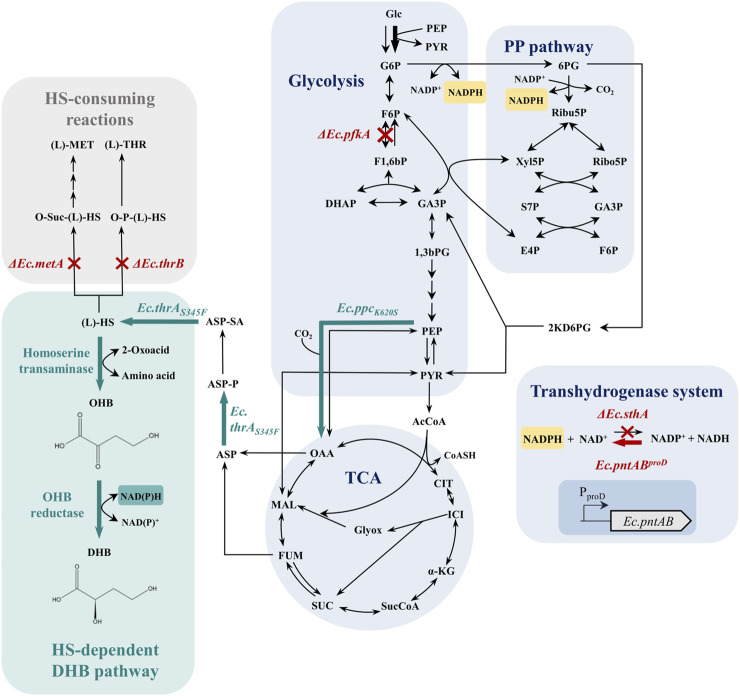
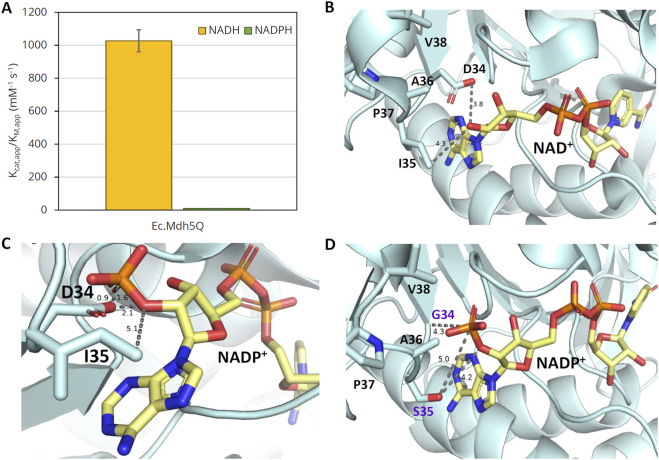
(L)-2,4-dihydroxybutyrate (DHB) is a versatile compound that can serve as a precursor for the synthesis of the methionine analog 2-hydroxy-4-(methylthio)butyrate and new advanced polymers. We previously implemented in Escherichia coli an artificial biosynthetic pathway for the aerobic production of DHB from glucose, which relies on the deamination of (L)-homoserine followed by the reduction of 2-oxo-4-hydroxybutyrate (OHB) and yields DHB by an enzyme-bearing NADH-dependent OHB reductase activity. Under aerobic conditions, using NADPH as a cofactor is more favorable for reduction processes. We report the construction of an NADPH-dependent OHB reductase and increased intracellular NADPH supply by metabolic engineering to improve DHB production. Key cofactor discriminating positions were identified in the previously engineered NADH-dependent OHB reductase (E. coli malate dehydrogenase I12V:R81A:M85Q:D86S:G179D) and tested by mutational scanning. The two point mutations D34G:I35R were found to increase the specificity for NADPH by more than three orders of magnitude. Using the new OHB reductase enzyme, replacing the homoserine transaminase with the improved variant Ec.AlaC A142P:Y275D and increasing the NADPH supply by overexpressing the pntAB gene encoding the membrane-bound transhydrogenase yielded a strain that produced DHB from glucose at a yield of 0.25 molDHB molGlucose-1 in shake-flask experiments, which corresponds to a 50% increase compared to previous producer strains. Upon 24 h of batch cultivation of the most advanced DHB producer strain constructed in this work, a volumetric productivity of 0.83 mmolDHB L-1 h-1 was reached.
期刊介绍:
The translation of new discoveries in medicine to clinical routine has never been easy. During the second half of the last century, thanks to the progress in chemistry, biochemistry and pharmacology, we have seen the development and the application of a large number of drugs and devices aimed at the treatment of symptoms, blocking unwanted pathways and, in the case of infectious diseases, fighting the micro-organisms responsible. However, we are facing, today, a dramatic change in the therapeutic approach to pathologies and diseases. Indeed, the challenge of the present and the next decade is to fully restore the physiological status of the diseased organism and to completely regenerate tissue and organs when they are so seriously affected that treatments cannot be limited to the repression of symptoms or to the repair of damage. This is being made possible thanks to the major developments made in basic cell and molecular biology, including stem cell science, growth factor delivery, gene isolation and transfection, the advances in bioengineering and nanotechnology, including development of new biomaterials, biofabrication technologies and use of bioreactors, and the big improvements in diagnostic tools and imaging of cells, tissues and organs.
In today`s world, an enhancement of communication between multidisciplinary experts, together with the promotion of joint projects and close collaborations among scientists, engineers, industry people, regulatory agencies and physicians are absolute requirements for the success of any attempt to develop and clinically apply a new biological therapy or an innovative device involving the collective use of biomaterials, cells and/or bioactive molecules. “Frontiers in Bioengineering and Biotechnology” aspires to be a forum for all people involved in the process by bridging the gap too often existing between a discovery in the basic sciences and its clinical application.





 京公网安备 11010802042870号
京ICP备2023020795号-1
京公网安备 11010802042870号
京ICP备2023020795号-1

 分享
分享
 求助内容:
求助内容: 应助结果提醒方式:
 扫码关注我们
