Nikita S Kalluri, Elena Padilla-Garza, Tessa Kehoe, Chloe Andrews, Julianna Schantz-Dunn, Jennifer Riley, Mary Pomerleau, Anne Cc Lee, Sarbattama Sen
{"title":"Implementation of a Language-Concordant, Culturally Tailored Inpatient Lactation Program.","authors":"Nikita S Kalluri, Elena Padilla-Garza, Tessa Kehoe, Chloe Andrews, Julianna Schantz-Dunn, Jennifer Riley, Mary Pomerleau, Anne Cc Lee, Sarbattama Sen","doi":"10.1001/jamanetworkopen.2025.0274","DOIUrl":null,"url":null,"abstract":"<p><strong>Importance: </strong>Benefits of breastfeeding are extensive, but racial and ethnic disparities persist. Mama Sana (Spanish for healthy mother) is a bilingual, culturally tailored program that aims to reduce breastfeeding inequities.</p><p><strong>Objective: </strong>To examine differences in lactation support and breastfeeding outcomes among Spanish-speaking Hispanic birthing parents who participated in Mama Sana compared with a historical control (pre-Mama Sana) group.</p><p><strong>Design, setting, and participants: </strong>In this cohort study, patients who participated in the Mama Sana program during their delivery hospitalization from January 2022 to September 2023 were compared with a historical control group who delivered prior to the implementation of the program (July 2019 to December 2021). The study took place at an academic medical center in Boston with a high-risk obstetric service. Data were analyzed from January to September 2024.</p><p><strong>Exposure: </strong>Beginning in January 2022, a bilingual native Spanish-speaker licensed as a registered dietitian and certified lactation counselor provided lactation support to participants during their delivery hospitalization with follow-up phone calls after discharge (until 6 months post partum).</p><p><strong>Main outcomes and measures: </strong>The primary outcome was exclusive breastfeeding at discharge. Secondary outcomes included any breastfeeding at discharge, any breastfeeding and exclusive breastfeeding at 6 weeks post partum, and change in maternal body mass index (BMI). Process measures included inpatient lactation consult placement and receipt of any and language-concordant lactation support. The χ2 test was used to analyze outcomes, process measures, and balancing measures.</p><p><strong>Results: </strong>In this study, 417 patients were included (Mama Sana group, 175 patients; mean [SD] age, 28.9 [6.1] years; pre-Mama Sana group: 242 patients; mean [SD] age, 29.8 [6.1] years). Sociodemographic characteristics including age and BMI were similar between groups. Mama Sana participants were less likely to be multiparous or to have diabetes compared with the pre-Mama Sana group. At hospital discharge, 36 of 175 Mama Sana participants (20.6%) were exclusively breastfeeding compared with 39 of 242 pre-Mama Sana (16.1%) (adjusted risk difference [aRD], 2.5%; 95% CI, -1.2 to 6.4). Significantly more Mama Sana participants engaged in any breastfeeding prior to hospital discharge (172 of 175 [98.3%] vs 222 of 242 [91.7%]; aRD, 7.1%; 95% CI, 2.8% to 11.5%) and at the 6 week postpartum visit (81 of 102 [79.4%] vs 109 of 170 [64.1%]; aRD, 15.6%; 95% CI, 4.8% to 26.4%) compared with the pre-Mama Sana group. More Mama Sana participants had a lactation consult placed (109 of 175 [62.3%] vs 108 of 242 [44.6%]; P < .001) and received lactation support in Spanish (175 of 175 [100%] vs 49 of 242 [20.3%]; P < .001) than those in the pre-Mama Sana group.</p><p><strong>Conclusions and relevance: </strong>In this cohort study, Mama Sana's language-concordant, culturally tailored lactation program was associated with higher rates of lactation support and some breastfeeding outcomes, which suggests the program may be a useful approach to perinatal care equity.</p>","PeriodicalId":14694,"journal":{"name":"JAMA Network Open","volume":"8 3","pages":"e250274"},"PeriodicalIF":9.7000,"publicationDate":"2025-03-03","publicationTypes":"Journal Article","fieldsOfStudy":null,"isOpenAccess":false,"openAccessPdf":"https://www.ncbi.nlm.nih.gov/pmc/articles/PMC11889473/pdf/","citationCount":"0","resultStr":null,"platform":"Semanticscholar","paperid":null,"PeriodicalName":"JAMA Network Open","FirstCategoryId":"3","ListUrlMain":"https://doi.org/10.1001/jamanetworkopen.2025.0274","RegionNum":1,"RegionCategory":"医学","ArticlePicture":[],"TitleCN":null,"AbstractTextCN":null,"PMCID":null,"EPubDate":"","PubModel":"","JCR":"Q1","JCRName":"MEDICINE, GENERAL & INTERNAL","Score":null,"Total":0}
引用次数: 0
Abstract
Importance: Benefits of breastfeeding are extensive, but racial and ethnic disparities persist. Mama Sana (Spanish for healthy mother) is a bilingual, culturally tailored program that aims to reduce breastfeeding inequities.
Objective: To examine differences in lactation support and breastfeeding outcomes among Spanish-speaking Hispanic birthing parents who participated in Mama Sana compared with a historical control (pre-Mama Sana) group.
Design, setting, and participants: In this cohort study, patients who participated in the Mama Sana program during their delivery hospitalization from January 2022 to September 2023 were compared with a historical control group who delivered prior to the implementation of the program (July 2019 to December 2021). The study took place at an academic medical center in Boston with a high-risk obstetric service. Data were analyzed from January to September 2024.
Exposure: Beginning in January 2022, a bilingual native Spanish-speaker licensed as a registered dietitian and certified lactation counselor provided lactation support to participants during their delivery hospitalization with follow-up phone calls after discharge (until 6 months post partum).
Main outcomes and measures: The primary outcome was exclusive breastfeeding at discharge. Secondary outcomes included any breastfeeding at discharge, any breastfeeding and exclusive breastfeeding at 6 weeks post partum, and change in maternal body mass index (BMI). Process measures included inpatient lactation consult placement and receipt of any and language-concordant lactation support. The χ2 test was used to analyze outcomes, process measures, and balancing measures.
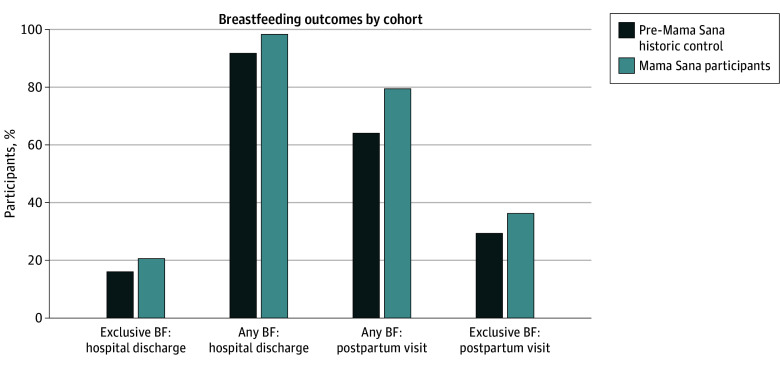
Results: In this study, 417 patients were included (Mama Sana group, 175 patients; mean [SD] age, 28.9 [6.1] years; pre-Mama Sana group: 242 patients; mean [SD] age, 29.8 [6.1] years). Sociodemographic characteristics including age and BMI were similar between groups. Mama Sana participants were less likely to be multiparous or to have diabetes compared with the pre-Mama Sana group. At hospital discharge, 36 of 175 Mama Sana participants (20.6%) were exclusively breastfeeding compared with 39 of 242 pre-Mama Sana (16.1%) (adjusted risk difference [aRD], 2.5%; 95% CI, -1.2 to 6.4). Significantly more Mama Sana participants engaged in any breastfeeding prior to hospital discharge (172 of 175 [98.3%] vs 222 of 242 [91.7%]; aRD, 7.1%; 95% CI, 2.8% to 11.5%) and at the 6 week postpartum visit (81 of 102 [79.4%] vs 109 of 170 [64.1%]; aRD, 15.6%; 95% CI, 4.8% to 26.4%) compared with the pre-Mama Sana group. More Mama Sana participants had a lactation consult placed (109 of 175 [62.3%] vs 108 of 242 [44.6%]; P < .001) and received lactation support in Spanish (175 of 175 [100%] vs 49 of 242 [20.3%]; P < .001) than those in the pre-Mama Sana group.
Conclusions and relevance: In this cohort study, Mama Sana's language-concordant, culturally tailored lactation program was associated with higher rates of lactation support and some breastfeeding outcomes, which suggests the program may be a useful approach to perinatal care equity.
期刊介绍:
JAMA Network Open, a member of the esteemed JAMA Network, stands as an international, peer-reviewed, open-access general medical journal.The publication is dedicated to disseminating research across various health disciplines and countries, encompassing clinical care, innovation in health care, health policy, and global health.
JAMA Network Open caters to clinicians, investigators, and policymakers, providing a platform for valuable insights and advancements in the medical field. As part of the JAMA Network, a consortium of peer-reviewed general medical and specialty publications, JAMA Network Open contributes to the collective knowledge and understanding within the medical community.




 京公网安备 11010802042870号
京ICP备2023020795号-1
京公网安备 11010802042870号
京ICP备2023020795号-1

 分享
分享
 求助内容:
求助内容: 应助结果提醒方式:
 扫码关注我们
