Zhen-Zhong Chen, Ke-Jun Zhu, Bin Pan, Chao Lou, Wei-Yang Yu, Deng-Wei He
{"title":"Percutaneous pedicle screw fixation in the surgical treatment of monosegmental pyogenic spondylodiscitis.","authors":"Zhen-Zhong Chen, Ke-Jun Zhu, Bin Pan, Chao Lou, Wei-Yang Yu, Deng-Wei He","doi":"10.1186/s13018-025-05660-z","DOIUrl":null,"url":null,"abstract":"<p><strong>Objective: </strong>The study assessed the efficacy of percutaneous pedicle screw fixation (PPSF) as a treatment approach for monosegmental pyogenic spondylodiscitis (PS), particularly in patients with compromised health conditions that reduce their ability to endure extensive surgical procedures.</p><p><strong>Methods: </strong>From January 2019 and December 2021, a total of 38 patients with PS who underwent PPSF at our hospital were included in the study. Clinical outcomes were assessed using physical examinations, serological tests, Visual Analog Scale (VAS) scores, Oswestry Disability Index (ODI) scores, and imaging assessments.</p><p><strong>Results: </strong>The mean duration of PPSF among all patients was 73.9 ± 13.9 min, with an average intraoperative blood loss of 52.4 ± 18.4 mL. Pathogenic bacteria were identified in 17 out of 38 cases, representing a detection rate of 44.7%. The mean follow-up period was 21.3 ± 8.3 months. Postoperative assessment of inflammatory markers indicated that infections were effectively controlled in 33 patients, resulting in symptomatic improvement. However, within 2 to 4 weeks postoperatively, 5 patients required a two-stage anterior debridement-fusion following the initial internal fixation. Compared to those who underwent posterior internal fixation alone, these patients had significantly higher Spinal Instability Spondylodiscitis Scores (12.000 ± 1.000 vs. 9.030 ± 2.114, p < 0.05) and a significantly greater prevalence of preoperative epidural abscesses (80% vs. 12.1%, p < 0.01).</p><p><strong>Conclusions: </strong>PPSF may serve as a viable option for patients with monosegmental PS, providing a minimally invasive surgical approach for patients who are unable to tolerate traditional open surgery due to compromised health or advanced age. For patients with significant spinal instability or abscess formation, a two-stage anterior debridement-fusion may be required. However, single-stage posterior internal fixation can effectively relieve pain and improve the overall condition of patients, thereby enhancing their ability to tolerate subsequent anterior surgical interventions.</p>","PeriodicalId":16629,"journal":{"name":"Journal of Orthopaedic Surgery and Research","volume":"20 1","pages":"241"},"PeriodicalIF":2.8000,"publicationDate":"2025-03-06","publicationTypes":"Journal Article","fieldsOfStudy":null,"isOpenAccess":false,"openAccessPdf":"https://www.ncbi.nlm.nih.gov/pmc/articles/PMC11884076/pdf/","citationCount":"0","resultStr":null,"platform":"Semanticscholar","paperid":null,"PeriodicalName":"Journal of Orthopaedic Surgery and Research","FirstCategoryId":"3","ListUrlMain":"https://doi.org/10.1186/s13018-025-05660-z","RegionNum":3,"RegionCategory":"医学","ArticlePicture":[],"TitleCN":null,"AbstractTextCN":null,"PMCID":null,"EPubDate":"","PubModel":"","JCR":"Q1","JCRName":"ORTHOPEDICS","Score":null,"Total":0}
引用次数: 0
Abstract
Objective: The study assessed the efficacy of percutaneous pedicle screw fixation (PPSF) as a treatment approach for monosegmental pyogenic spondylodiscitis (PS), particularly in patients with compromised health conditions that reduce their ability to endure extensive surgical procedures.
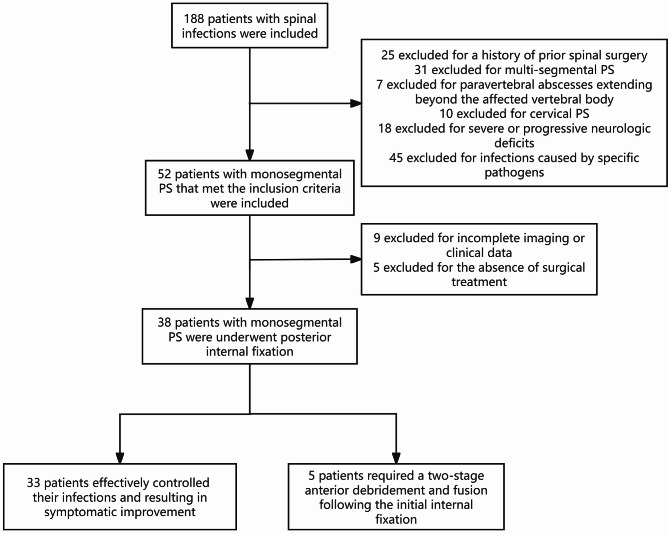
Methods: From January 2019 and December 2021, a total of 38 patients with PS who underwent PPSF at our hospital were included in the study. Clinical outcomes were assessed using physical examinations, serological tests, Visual Analog Scale (VAS) scores, Oswestry Disability Index (ODI) scores, and imaging assessments.
Results: The mean duration of PPSF among all patients was 73.9 ± 13.9 min, with an average intraoperative blood loss of 52.4 ± 18.4 mL. Pathogenic bacteria were identified in 17 out of 38 cases, representing a detection rate of 44.7%. The mean follow-up period was 21.3 ± 8.3 months. Postoperative assessment of inflammatory markers indicated that infections were effectively controlled in 33 patients, resulting in symptomatic improvement. However, within 2 to 4 weeks postoperatively, 5 patients required a two-stage anterior debridement-fusion following the initial internal fixation. Compared to those who underwent posterior internal fixation alone, these patients had significantly higher Spinal Instability Spondylodiscitis Scores (12.000 ± 1.000 vs. 9.030 ± 2.114, p < 0.05) and a significantly greater prevalence of preoperative epidural abscesses (80% vs. 12.1%, p < 0.01).
Conclusions: PPSF may serve as a viable option for patients with monosegmental PS, providing a minimally invasive surgical approach for patients who are unable to tolerate traditional open surgery due to compromised health or advanced age. For patients with significant spinal instability or abscess formation, a two-stage anterior debridement-fusion may be required. However, single-stage posterior internal fixation can effectively relieve pain and improve the overall condition of patients, thereby enhancing their ability to tolerate subsequent anterior surgical interventions.
目的:该研究评估了经皮椎弓根螺钉固定(PPSF)作为单节段性化脓性脊椎炎(PS)的治疗方法的有效性,特别是对于健康状况不佳、无法忍受大面积手术的患者。方法:2019年1月至2021年12月,共纳入38例在我院接受PPSF治疗的PS患者。临床结果通过体格检查、血清学测试、视觉模拟量表(VAS)评分、Oswestry残疾指数(ODI)评分和影像学评估进行评估。结果:所有患者PPSF的平均持续时间为73.9±13.9 min,平均术中出血量为52.4±18.4 mL。38例患者中检出病原菌17例,检出率为44.7%。平均随访时间21.3±8.3个月。术后炎症指标评估显示33例患者感染得到有效控制,症状得到改善。然而,在术后2至4周内,5例患者在初始内固定后需要进行两期前路清创融合。与单纯后路内固定相比,这些患者的脊柱不稳定性椎间盘炎评分明显更高(12.000±1.000 vs. 9.030±2.114,p)。结论:PPSF可作为单节段性PS患者的可行选择,为由于健康状况不佳或高龄而无法耐受传统开放手术的患者提供微创手术途径。对于有明显脊柱不稳定或脓肿形成的患者,可能需要两阶段前路清创融合。但单期后路内固定能有效缓解疼痛,改善患者的整体状况,从而增强患者对后续前路手术干预的耐受能力。
期刊介绍:
Journal of Orthopaedic Surgery and Research is an open access journal that encompasses all aspects of clinical and basic research studies related to musculoskeletal issues.
Orthopaedic research is conducted at clinical and basic science levels. With the advancement of new technologies and the increasing expectation and demand from doctors and patients, we are witnessing an enormous growth in clinical orthopaedic research, particularly in the fields of traumatology, spinal surgery, joint replacement, sports medicine, musculoskeletal tumour management, hand microsurgery, foot and ankle surgery, paediatric orthopaedic, and orthopaedic rehabilitation. The involvement of basic science ranges from molecular, cellular, structural and functional perspectives to tissue engineering, gait analysis, automation and robotic surgery. Implant and biomaterial designs are new disciplines that complement clinical applications.
JOSR encourages the publication of multidisciplinary research with collaboration amongst clinicians and scientists from different disciplines, which will be the trend in the coming decades.



 京公网安备 11010802042870号
京ICP备2023020795号-1
京公网安备 11010802042870号
京ICP备2023020795号-1

 分享
分享
 求助内容:
求助内容: 应助结果提醒方式:
 扫码关注我们
