Samuel J. Faucher, Matthew R. Shaner, Stefan T. Omelchenko, Galit Anikeeva, Ian S. McKay
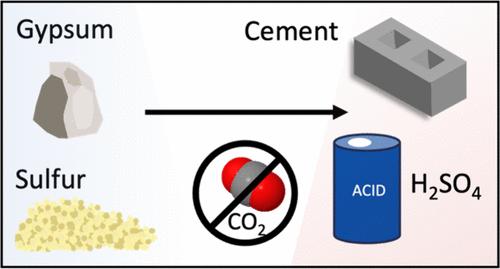
{"title":"Gypsum as a Feedstock for Low-Cost, Decarbonized Portland Cement and Sulfuric Acid","authors":"Samuel J. Faucher, Matthew R. Shaner, Stefan T. Omelchenko, Galit Anikeeva, Ian S. McKay","doi":"10.1021/acssuschemeng.4c08838","DOIUrl":null,"url":null,"abstract":"Production methods for cement and sulfuric acid are likely to change in the era of decarbonization. Cement is responsible for 8% of world carbon dioxide (CO<sub>2</sub>) emissions and urgently needs to be decarbonized, while sulfuric acid (H<sub>2</sub>SO<sub>4</sub>) is produced from elemental sulfur, a fossil fuel byproduct whose supply may dwindle over time. Here, we perform a technoeconomic analysis of processes to coproduce Portland cement and sulfuric acid from gypsum via fossil-free variations of the once-prevalent Müller–Kühne (MK) process. With credit for coproduced sulfuric acid, a sulfur-driven variant of the MK process could achieve cost parity with limestone-derived cement ($40/t clinker) with dramatic (95–99%) reductions in the emission intensity. While MK process variants would saturate sulfuric acid markets well before they dominate world cement demand, these processes could simultaneously support a circular sulfur economy through valorization of gypsum waste and constitute a pathway to cost-effective decarbonized cement from a limestone-free feedstock.","PeriodicalId":25,"journal":{"name":"ACS Sustainable Chemistry & Engineering","volume":"19 4 1","pages":""},"PeriodicalIF":7.3000,"publicationDate":"2025-03-07","publicationTypes":"Journal Article","fieldsOfStudy":null,"isOpenAccess":false,"openAccessPdf":"","citationCount":"0","resultStr":null,"platform":"Semanticscholar","paperid":null,"PeriodicalName":"ACS Sustainable Chemistry & Engineering","FirstCategoryId":"92","ListUrlMain":"https://doi.org/10.1021/acssuschemeng.4c08838","RegionNum":1,"RegionCategory":"化学","ArticlePicture":[],"TitleCN":null,"AbstractTextCN":null,"PMCID":null,"EPubDate":"","PubModel":"","JCR":"Q1","JCRName":"CHEMISTRY, MULTIDISCIPLINARY","Score":null,"Total":0}
引用次数: 0
Abstract
Production methods for cement and sulfuric acid are likely to change in the era of decarbonization. Cement is responsible for 8% of world carbon dioxide (CO2) emissions and urgently needs to be decarbonized, while sulfuric acid (H2SO4) is produced from elemental sulfur, a fossil fuel byproduct whose supply may dwindle over time. Here, we perform a technoeconomic analysis of processes to coproduce Portland cement and sulfuric acid from gypsum via fossil-free variations of the once-prevalent Müller–Kühne (MK) process. With credit for coproduced sulfuric acid, a sulfur-driven variant of the MK process could achieve cost parity with limestone-derived cement ($40/t clinker) with dramatic (95–99%) reductions in the emission intensity. While MK process variants would saturate sulfuric acid markets well before they dominate world cement demand, these processes could simultaneously support a circular sulfur economy through valorization of gypsum waste and constitute a pathway to cost-effective decarbonized cement from a limestone-free feedstock.
在脱碳时代,水泥和硫酸的生产方法可能会发生变化。水泥的二氧化碳排放量占全球的8%,迫切需要脱碳,而硫酸(H2SO4)是由单质硫生产的,单质硫是化石燃料的副产品,其供应量可能会随着时间的推移而减少。在这里,我们通过对曾经流行的m ller - k (MK)工艺的无化石变化,对从石膏中共同生产波特兰水泥和硫酸的工艺进行了技术经济分析。由于联合生产硫酸,硫磺驱动的MK工艺变体可以实现与石灰石衍生水泥(40美元/吨熟料)相当的成本,并显著降低(95-99%)排放强度。虽然MK工艺变体在主导世界水泥需求之前就会使硫酸市场饱和,但这些工艺可以同时通过石膏废物的增值来支持循环硫经济,并构成一条从无石灰石原料生产具有成本效益的脱碳水泥的途径。
期刊介绍:
ACS Sustainable Chemistry & Engineering is a prestigious weekly peer-reviewed scientific journal published by the American Chemical Society. Dedicated to advancing the principles of green chemistry and green engineering, it covers a wide array of research topics including green chemistry, green engineering, biomass, alternative energy, and life cycle assessment.
The journal welcomes submissions in various formats, including Letters, Articles, Features, and Perspectives (Reviews), that address the challenges of sustainability in the chemical enterprise and contribute to the advancement of sustainable practices. Join us in shaping the future of sustainable chemistry and engineering.




 京公网安备 11010802042870号
京ICP备2023020795号-1
京公网安备 11010802042870号
京ICP备2023020795号-1

 分享
分享
 求助内容:
求助内容: 应助结果提醒方式:
 扫码关注我们
