Penglei Xu, Huiluan Qin, Chen Wang, Feiyang Zhang, Zhixin Yu, Ran Duan, Chuncheng Chen, Qi Shen and Chunyan Sun
{"title":"N⋯Br halogen bond enhanced visible-light degradation of decabromodiphenyl ether on organic amine intercalated zinc sulfide†","authors":"Penglei Xu, Huiluan Qin, Chen Wang, Feiyang Zhang, Zhixin Yu, Ran Duan, Chuncheng Chen, Qi Shen and Chunyan Sun","doi":"10.1039/D5QI00006H","DOIUrl":null,"url":null,"abstract":"<p >Polybrominated diphenyl ethers (PBDEs) have raised increasing concerns due to their biotoxicity and persistence. Herein, the visible-light photodegradation of decabromodiphenyl ether (BDE209) is achieved on diethylenetriamine (DETA) intercalated wide band gap ZnS, mediated by a photosensitized complex formed <em>via</em> a N⋯Br halogen bond. By regulating the amount of DETA, ZnS(DETA)<small><sub>1/2<em>n</em></sub></small>, referred to as ZD, exhibit tunable photocatalytic activity towards BDE209. The most rapid degradation is observed on ZD-4, with 98% removal achieved within 6 hours. Density functional theory (DFT) calculations reveal that the halogen bond is preferentially formed between the amino N and <em>para</em>-Br atom in BDE209 with a bond length of 2.7548 Å. A novel degradation pathway for BDE209 is proposed, in which the DETA⋯BDE209 complex functions as a visible light photosensitizer, providing photoelectrons to the conduction band of ZnS, thereby participating in the degradation of BDE209 adsorbed on the ZnS surface. This process is significantly more effective than the indirect photolysis of BDE209 by DETA solely. Notably, this degradation phenomenon is also observed in other organic amine coordinated ZnS, suggesting a universal mechanism for BDE209 degradation by photosensitized halogen bond-based complexes. This work provides a novel strategy to utilize weak interfacial halogen bonding for visible-light photosensitized degradation of brominated persistent organic pollutants by wide band gap inorganic semiconductors.</p>","PeriodicalId":79,"journal":{"name":"Inorganic Chemistry Frontiers","volume":" 8","pages":" 3305-3312"},"PeriodicalIF":6.4000,"publicationDate":"2025-03-07","publicationTypes":"Journal Article","fieldsOfStudy":null,"isOpenAccess":false,"openAccessPdf":"","citationCount":"0","resultStr":null,"platform":"Semanticscholar","paperid":null,"PeriodicalName":"Inorganic Chemistry Frontiers","FirstCategoryId":"92","ListUrlMain":"https://pubs.rsc.org/en/content/articlelanding/2025/qi/d5qi00006h","RegionNum":1,"RegionCategory":"化学","ArticlePicture":[],"TitleCN":null,"AbstractTextCN":null,"PMCID":null,"EPubDate":"","PubModel":"","JCR":"Q1","JCRName":"CHEMISTRY, INORGANIC & NUCLEAR","Score":null,"Total":0}
引用次数: 0
Abstract
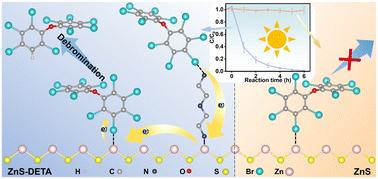
Polybrominated diphenyl ethers (PBDEs) have raised increasing concerns due to their biotoxicity and persistence. Herein, the visible-light photodegradation of decabromodiphenyl ether (BDE209) is achieved on diethylenetriamine (DETA) intercalated wide band gap ZnS, mediated by a photosensitized complex formed via a N⋯Br halogen bond. By regulating the amount of DETA, ZnS(DETA)1/2n, referred to as ZD, exhibit tunable photocatalytic activity towards BDE209. The most rapid degradation is observed on ZD-4, with 98% removal achieved within 6 hours. Density functional theory (DFT) calculations reveal that the halogen bond is preferentially formed between the amino N and para-Br atom in BDE209 with a bond length of 2.7548 Å. A novel degradation pathway for BDE209 is proposed, in which the DETA⋯BDE209 complex functions as a visible light photosensitizer, providing photoelectrons to the conduction band of ZnS, thereby participating in the degradation of BDE209 adsorbed on the ZnS surface. This process is significantly more effective than the indirect photolysis of BDE209 by DETA solely. Notably, this degradation phenomenon is also observed in other organic amine coordinated ZnS, suggesting a universal mechanism for BDE209 degradation by photosensitized halogen bond-based complexes. This work provides a novel strategy to utilize weak interfacial halogen bonding for visible-light photosensitized degradation of brominated persistent organic pollutants by wide band gap inorganic semiconductors.



 京公网安备 11010802042870号
京ICP备2023020795号-1
京公网安备 11010802042870号
京ICP备2023020795号-1

 分享
分享
 求助内容:
求助内容: 应助结果提醒方式:
 扫码关注我们
