Jikai Zhang , Feixuan Yang , Haimeng Wu , Hui Ling Ong , Peter Arnold , Meng Zhang , Yunhong Jiang , Duygu Bahar , Zhishan Yuan , Xin Yang , Yong-Qing Fu
{"title":"Wearable transdermal drug delivery system controlled by wirelessly powered acoustic waves","authors":"Jikai Zhang , Feixuan Yang , Haimeng Wu , Hui Ling Ong , Peter Arnold , Meng Zhang , Yunhong Jiang , Duygu Bahar , Zhishan Yuan , Xin Yang , Yong-Qing Fu","doi":"10.1016/j.jconrel.2025.113619","DOIUrl":null,"url":null,"abstract":"<div><div>Transdermal drug administration offers an alternative route for drug delivery through the skin, and surface acoustic wave (SAW) technology has recently emerged as a promising approach to enhance this process. However, conventional cable-connected SAW control units face several challenges, including inconvenience, poor wearability, limited miniaturization and integration, and restricted reusability. This study introduces a wireless-powered transport strategy for the transdermal delivery of large drug molecules using a thin-film-based SAW platform. This approach leverages interfacial acoustic stimulation, localized acoustic heating, and streaming/micro-cavitation to enhance drug penetration. By eliminating the need for physical connections, the wireless power transfer system reduces potential heating effects and localized tissue damage. To evaluate its performance, synthetic skin-like agarose gel and pig skin tissue were used as models. Hyaluronate rhodamine (5000 Da) was successfully delivered transdermally into pig skin tissue, achieving approximately 77.89 % of the efficiency observed with a conventional cable-connected SAW platform. These findings highlight wireless SAW technology as a promising alternative for enhancing transdermal drug delivery, offering a safer, more effective, and user-friendly therapeutic solution for patients.</div></div>","PeriodicalId":15450,"journal":{"name":"Journal of Controlled Release","volume":"381 ","pages":"Article 113619"},"PeriodicalIF":11.5000,"publicationDate":"2025-05-10","publicationTypes":"Journal Article","fieldsOfStudy":null,"isOpenAccess":false,"openAccessPdf":"","citationCount":"0","resultStr":null,"platform":"Semanticscholar","paperid":null,"PeriodicalName":"Journal of Controlled Release","FirstCategoryId":"3","ListUrlMain":"https://www.sciencedirect.com/science/article/pii/S0168365925002366","RegionNum":1,"RegionCategory":"医学","ArticlePicture":[],"TitleCN":null,"AbstractTextCN":null,"PMCID":null,"EPubDate":"2025/3/9 0:00:00","PubModel":"Epub","JCR":"Q1","JCRName":"CHEMISTRY, MULTIDISCIPLINARY","Score":null,"Total":0}
引用次数: 0
Abstract
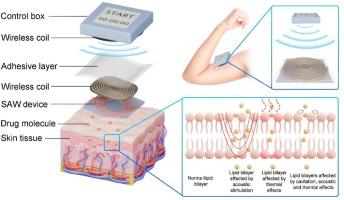
Transdermal drug administration offers an alternative route for drug delivery through the skin, and surface acoustic wave (SAW) technology has recently emerged as a promising approach to enhance this process. However, conventional cable-connected SAW control units face several challenges, including inconvenience, poor wearability, limited miniaturization and integration, and restricted reusability. This study introduces a wireless-powered transport strategy for the transdermal delivery of large drug molecules using a thin-film-based SAW platform. This approach leverages interfacial acoustic stimulation, localized acoustic heating, and streaming/micro-cavitation to enhance drug penetration. By eliminating the need for physical connections, the wireless power transfer system reduces potential heating effects and localized tissue damage. To evaluate its performance, synthetic skin-like agarose gel and pig skin tissue were used as models. Hyaluronate rhodamine (5000 Da) was successfully delivered transdermally into pig skin tissue, achieving approximately 77.89 % of the efficiency observed with a conventional cable-connected SAW platform. These findings highlight wireless SAW technology as a promising alternative for enhancing transdermal drug delivery, offering a safer, more effective, and user-friendly therapeutic solution for patients.
期刊介绍:
The Journal of Controlled Release (JCR) proudly serves as the Official Journal of the Controlled Release Society and the Japan Society of Drug Delivery System.
Dedicated to the broad field of delivery science and technology, JCR publishes high-quality research articles covering drug delivery systems and all facets of formulations. This includes the physicochemical and biological properties of drugs, design and characterization of dosage forms, release mechanisms, in vivo testing, and formulation research and development across pharmaceutical, diagnostic, agricultural, environmental, cosmetic, and food industries.
Priority is given to manuscripts that contribute to the fundamental understanding of principles or demonstrate the advantages of novel technologies in terms of safety and efficacy over current clinical standards. JCR strives to be a leading platform for advancements in delivery science and technology.




 京公网安备 11010802042870号
京ICP备2023020795号-1
京公网安备 11010802042870号
京ICP备2023020795号-1

 分享
分享
 求助内容:
求助内容: 应助结果提醒方式:
 扫码关注我们
