Jiacheng Yu, Runzhi Zhou, Shan Liu, Jintao Zheng, Haoyang Yan, Song Su, Ningli Chai, Ester Segal, Cheng Jiang, Keying Guo, Chen-zhong Li
{"title":"Electrochemical Biosensors for the Detection of Exosomal microRNA Biomarkers for Early Diagnosis of Neurodegenerative Diseases","authors":"Jiacheng Yu, Runzhi Zhou, Shan Liu, Jintao Zheng, Haoyang Yan, Song Su, Ningli Chai, Ester Segal, Cheng Jiang, Keying Guo, Chen-zhong Li","doi":"10.1021/acs.analchem.4c02619","DOIUrl":null,"url":null,"abstract":"Early and precise diagnosis of neurodegenerative disorders like Alzheimer’s (AD) and Parkinson’s (PD) is crucial for slowing their progression and enhancing patient outcomes. Exosomal microRNAs (miRNAs) are emerging as promising biomarkers due to their ability to reflect the diseases’ pathology, yet their low abundance poses significant detection hurdles. This review article delves into the burgeoning field of electrochemical biosensors, designed for the precise detection of exosomal miRNA biomarkers. Electrochemical biosensors offer a compelling solution, combining the sensitivity required to detect low-abundance biomarkers with the specificity needed to discern miRNA profiles distinctive to neural pathological states. We explore the operational principles of these biosensors, including the electrochemical transduction mechanisms that facilitate miRNA detection. The review also summarizes advancements in nanotechnology, signal enhancement, bioreceptor anchoring, and microfluidic integration that improve sensor accuracy. The evidence of their use in neurodegenerative disease diagnosis is analyzed, focusing on the clinical impact, diagnostic precision, and obstacles faced in practical applications. Their potential integration into point-of-care testing and regulatory considerations for their market entry are discussed. Looking toward the future, the article highlights forthcoming innovations that might revolutionize early diagnostic processes. Electrochemical biosensors, with their impressive sensitivity, specificity, and point-of-care compatibility, are on track to become instrumental in the early diagnosis of neurodegenerative diseases, possibly transforming patient care and prognosis.","PeriodicalId":27,"journal":{"name":"Analytical Chemistry","volume":"8 1","pages":""},"PeriodicalIF":6.7000,"publicationDate":"2025-03-09","publicationTypes":"Journal Article","fieldsOfStudy":null,"isOpenAccess":false,"openAccessPdf":"","citationCount":"0","resultStr":null,"platform":"Semanticscholar","paperid":null,"PeriodicalName":"Analytical Chemistry","FirstCategoryId":"92","ListUrlMain":"https://doi.org/10.1021/acs.analchem.4c02619","RegionNum":1,"RegionCategory":"化学","ArticlePicture":[],"TitleCN":null,"AbstractTextCN":null,"PMCID":null,"EPubDate":"","PubModel":"","JCR":"Q1","JCRName":"CHEMISTRY, ANALYTICAL","Score":null,"Total":0}
引用次数: 0
Abstract
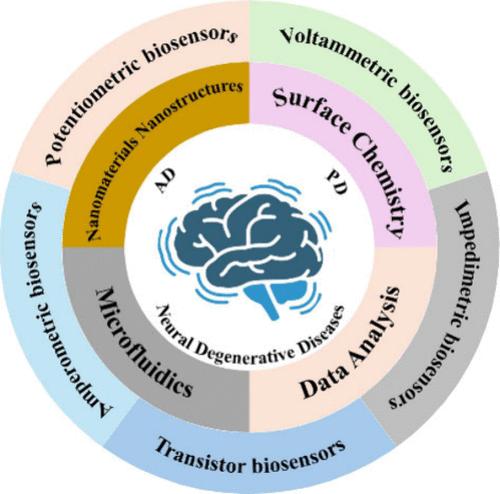
Early and precise diagnosis of neurodegenerative disorders like Alzheimer’s (AD) and Parkinson’s (PD) is crucial for slowing their progression and enhancing patient outcomes. Exosomal microRNAs (miRNAs) are emerging as promising biomarkers due to their ability to reflect the diseases’ pathology, yet their low abundance poses significant detection hurdles. This review article delves into the burgeoning field of electrochemical biosensors, designed for the precise detection of exosomal miRNA biomarkers. Electrochemical biosensors offer a compelling solution, combining the sensitivity required to detect low-abundance biomarkers with the specificity needed to discern miRNA profiles distinctive to neural pathological states. We explore the operational principles of these biosensors, including the electrochemical transduction mechanisms that facilitate miRNA detection. The review also summarizes advancements in nanotechnology, signal enhancement, bioreceptor anchoring, and microfluidic integration that improve sensor accuracy. The evidence of their use in neurodegenerative disease diagnosis is analyzed, focusing on the clinical impact, diagnostic precision, and obstacles faced in practical applications. Their potential integration into point-of-care testing and regulatory considerations for their market entry are discussed. Looking toward the future, the article highlights forthcoming innovations that might revolutionize early diagnostic processes. Electrochemical biosensors, with their impressive sensitivity, specificity, and point-of-care compatibility, are on track to become instrumental in the early diagnosis of neurodegenerative diseases, possibly transforming patient care and prognosis.
期刊介绍:
Analytical Chemistry, a peer-reviewed research journal, focuses on disseminating new and original knowledge across all branches of analytical chemistry. Fundamental articles may explore general principles of chemical measurement science and need not directly address existing or potential analytical methodology. They can be entirely theoretical or report experimental results. Contributions may cover various phases of analytical operations, including sampling, bioanalysis, electrochemistry, mass spectrometry, microscale and nanoscale systems, environmental analysis, separations, spectroscopy, chemical reactions and selectivity, instrumentation, imaging, surface analysis, and data processing. Papers discussing known analytical methods should present a significant, original application of the method, a notable improvement, or results on an important analyte.



 京公网安备 11010802042870号
京ICP备2023020795号-1
京公网安备 11010802042870号
京ICP备2023020795号-1

 分享
分享
 求助内容:
求助内容: 应助结果提醒方式:
 扫码关注我们
