Qiu Peng , Lujuan Wang , Ying Long , Hao Tian , Xuemeng Xu , Zongyao Ren , Yaqian Han , Xianjie Jiang , Zhu Wu , Shiming Tan , Wenjuan Yang , Linda Oyang , Xia Luo , Jinguan Lin , Longzheng Xia , Mingjing Peng , Nayiyuan Wu , Yanyan Tang , Qianjin Liao , Yujuan Zhou
{"title":"SRSF9 mediates oncogenic RNA splicing of SLC37A4 via liquid–liquid phase separation to promote oral cancer progression","authors":"Qiu Peng , Lujuan Wang , Ying Long , Hao Tian , Xuemeng Xu , Zongyao Ren , Yaqian Han , Xianjie Jiang , Zhu Wu , Shiming Tan , Wenjuan Yang , Linda Oyang , Xia Luo , Jinguan Lin , Longzheng Xia , Mingjing Peng , Nayiyuan Wu , Yanyan Tang , Qianjin Liao , Yujuan Zhou","doi":"10.1016/j.jare.2025.03.013","DOIUrl":null,"url":null,"abstract":"<div><h3>Introduction</h3><div>Oral cancer represents a significant proportion of head and neck malignancies, accounting for approximately 3 % of all malignant tumors worldwide.</div></div><div><h3>Objectives</h3><div>Alternative splicing (AS), a post-transcriptional regulatory mechanism, is increasingly linked to cancer development. The precise impact of AS on oral cancer progression is not well understood.</div></div><div><h3>Methods</h3><div>Bioinformatics, semi-quantitative RT-PCR, and minigene reporter system to detect the skipping of SLC37A4 exon 7 in oral cancer. FRAP, live cell immunofluorescence demonstrates that SRSF9 can undergo liquid–liquid phase separation (LLPS). In vivo and in vitro experiments with subcutaneous graft tumors, CCK8, EdU, transwell, and others were used to detect the effects of SRSF9 and its induced SLC37A4-S isoforms on the malignant phenotype of oral cancer cells.</div></div><div><h3>Results</h3><div>Our investigation revealed a multitude of aberrant alternative splicing events within head and neck tumor tissues, most notably the pronounced skipping of exon 7 in the SLC37A4 gene. This splicing anomaly leads to the production of a truncated isoform, SLC37A4-S, which is associated with a poor prognosis and significantly augments the proliferation and metastatic potential of oral cancer cells relative to the wild-type isoform, SLC37A4-L. Mechanically, SRSF9 may play a regulatory role in the aberrant splicing of SLC37A4. Furthermore, SRSF9 is capable of undergoing LLPS, a process driven by its arginine-serine-rich (RS) domain. Disruption of SRSF9 LLPS through the use of inhibitors or mutants effectively prevents its regulatory influence on the splicing of SLC37A4. Significantly, our research demonstrates that both SRSF9 and its regulated splicing isoforms of SLC37A4-S contribute to cisplatin chemotherapy resistance in oral cancer cells.</div></div><div><h3>Conclusion</h3><div>This study elucidates the mechanism by which SRSF9 phase separation mediates splicing in oral cancer, thereby establishing a basis for considering SRSF9 and its associated SLC37A4-S isoforms as potential therapeutic targets for oral cancer treatment.</div></div>","PeriodicalId":14952,"journal":{"name":"Journal of Advanced Research","volume":"79 ","pages":"Pages 505-520"},"PeriodicalIF":13.0000,"publicationDate":"2025-03-08","publicationTypes":"Journal Article","fieldsOfStudy":null,"isOpenAccess":false,"openAccessPdf":"","citationCount":"0","resultStr":null,"platform":"Semanticscholar","paperid":null,"PeriodicalName":"Journal of Advanced Research","FirstCategoryId":"103","ListUrlMain":"https://www.sciencedirect.com/science/article/pii/S2090123225001547","RegionNum":1,"RegionCategory":"综合性期刊","ArticlePicture":[],"TitleCN":null,"AbstractTextCN":null,"PMCID":null,"EPubDate":"","PubModel":"","JCR":"Q1","JCRName":"MULTIDISCIPLINARY SCIENCES","Score":null,"Total":0}
引用次数: 0
Abstract
Introduction
Oral cancer represents a significant proportion of head and neck malignancies, accounting for approximately 3 % of all malignant tumors worldwide.
Objectives
Alternative splicing (AS), a post-transcriptional regulatory mechanism, is increasingly linked to cancer development. The precise impact of AS on oral cancer progression is not well understood.
Methods
Bioinformatics, semi-quantitative RT-PCR, and minigene reporter system to detect the skipping of SLC37A4 exon 7 in oral cancer. FRAP, live cell immunofluorescence demonstrates that SRSF9 can undergo liquid–liquid phase separation (LLPS). In vivo and in vitro experiments with subcutaneous graft tumors, CCK8, EdU, transwell, and others were used to detect the effects of SRSF9 and its induced SLC37A4-S isoforms on the malignant phenotype of oral cancer cells.
Results
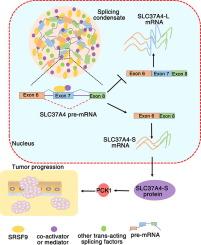
Our investigation revealed a multitude of aberrant alternative splicing events within head and neck tumor tissues, most notably the pronounced skipping of exon 7 in the SLC37A4 gene. This splicing anomaly leads to the production of a truncated isoform, SLC37A4-S, which is associated with a poor prognosis and significantly augments the proliferation and metastatic potential of oral cancer cells relative to the wild-type isoform, SLC37A4-L. Mechanically, SRSF9 may play a regulatory role in the aberrant splicing of SLC37A4. Furthermore, SRSF9 is capable of undergoing LLPS, a process driven by its arginine-serine-rich (RS) domain. Disruption of SRSF9 LLPS through the use of inhibitors or mutants effectively prevents its regulatory influence on the splicing of SLC37A4. Significantly, our research demonstrates that both SRSF9 and its regulated splicing isoforms of SLC37A4-S contribute to cisplatin chemotherapy resistance in oral cancer cells.
Conclusion
This study elucidates the mechanism by which SRSF9 phase separation mediates splicing in oral cancer, thereby establishing a basis for considering SRSF9 and its associated SLC37A4-S isoforms as potential therapeutic targets for oral cancer treatment.
期刊介绍:
Journal of Advanced Research (J. Adv. Res.) is an applied/natural sciences, peer-reviewed journal that focuses on interdisciplinary research. The journal aims to contribute to applied research and knowledge worldwide through the publication of original and high-quality research articles in the fields of Medicine, Pharmaceutical Sciences, Dentistry, Physical Therapy, Veterinary Medicine, and Basic and Biological Sciences.
The following abstracting and indexing services cover the Journal of Advanced Research: PubMed/Medline, Essential Science Indicators, Web of Science, Scopus, PubMed Central, PubMed, Science Citation Index Expanded, Directory of Open Access Journals (DOAJ), and INSPEC.




 京公网安备 11010802042870号
京ICP备2023020795号-1
京公网安备 11010802042870号
京ICP备2023020795号-1

 分享
分享
 求助内容:
求助内容: 应助结果提醒方式:
 扫码关注我们
