Hehe Wang , Chuanzhou Zhu , Manojit M. Swamynathan , Shubhra Rajput , Kalani Jayanetti , Dominick Rendina , Kathryn Takemura , Diane Bogdan , Liqun Wang , Robert C. Rizzo , Martin Kaczocha , Lloyd C. Trotman , Agnieszka B. Bialkowska , Iwao Ojima
{"title":"Fatty acid binding protein 5 inhibitors as novel anticancer agents against metastatic castration-resistant prostate cancer","authors":"Hehe Wang , Chuanzhou Zhu , Manojit M. Swamynathan , Shubhra Rajput , Kalani Jayanetti , Dominick Rendina , Kathryn Takemura , Diane Bogdan , Liqun Wang , Robert C. Rizzo , Martin Kaczocha , Lloyd C. Trotman , Agnieszka B. Bialkowska , Iwao Ojima","doi":"10.1016/j.bmc.2025.118136","DOIUrl":null,"url":null,"abstract":"<div><div>Prostate cancer (PCa) is one of the most common malignancies diagnosed among men and is the second leading cause of cancer-related death. Despite recent advancements in early diagnosis of PCa, androgen deprivation therapy (ADT) remains the most common treatment of PCa. Docetaxel (DTX) and Cabazitaxel (CTX) are two of the most extensively used drugs for metastatic castration-resistant prostate cancer (mCRPC). However, there is a clear medical need for newer and more efficacious therapies for CRPC. FABP5 is overexpressed in prostate cancer cells and chaperones fatty acids to PPARs, which leads to the upregulation of proangiogenic factors, resulting in cell survival and metastasis. The critical role and upregulation of FABP5 in PCa make FABP5 an excellent druggable target for CRPC. We reported a promising anti-PCa activity of truxillic acid monoester (TAME)-based FABP5 inhibitors (SB-FIs) and their synergy with DTX and CTX <em>in vitro</em> and <em>in vivo</em> against PC-3 cells and PC-3 tumor xenografts. In the present work, we performed an extensive SAR study on the potencies of 2nd- and 3rd-generation SB-FIs against PC-3 and RCaP cell lines. RCaP is a mouse PCa cell line, resistant to anti-androgen and first-line taxane chemotherapies, and shows a high level of the <em>Fabp5</em>-gene. This SAR study led to the identification of a number of 3rd-generation SB-FIs with strong cytotoxicity against these two PCa cell lines. Cell cycle analysis of selected SB-FIs revealed a clear evolution of apoptotic potency in the 1st-, 2nd- and 3rd-generation SB-FIs. Since taxanes, DTX and CTX, are ineffective against RCaP cell line, we selected a topoisomerase I inhibitor, topotecan (TPT) as a replacement for taxanes. We screened the library of SB-FIs for synergy with TPT and identified 3 SB-FIs (<strong>L3</strong>, <strong>α-11</strong> and <strong>α-4</strong>), exhibiting strong synergy, which could remarkably expand the therapeutic window of TPT.</div></div>","PeriodicalId":255,"journal":{"name":"Bioorganic & Medicinal Chemistry","volume":"122 ","pages":"Article 118136"},"PeriodicalIF":3.0000,"publicationDate":"2025-05-01","publicationTypes":"Journal Article","fieldsOfStudy":null,"isOpenAccess":false,"openAccessPdf":"","citationCount":"0","resultStr":null,"platform":"Semanticscholar","paperid":null,"PeriodicalName":"Bioorganic & Medicinal Chemistry","FirstCategoryId":"3","ListUrlMain":"https://www.sciencedirect.com/science/article/pii/S096808962500077X","RegionNum":3,"RegionCategory":"医学","ArticlePicture":[],"TitleCN":null,"AbstractTextCN":null,"PMCID":null,"EPubDate":"2025/2/27 0:00:00","PubModel":"Epub","JCR":"Q2","JCRName":"BIOCHEMISTRY & MOLECULAR BIOLOGY","Score":null,"Total":0}
引用次数: 0
Abstract
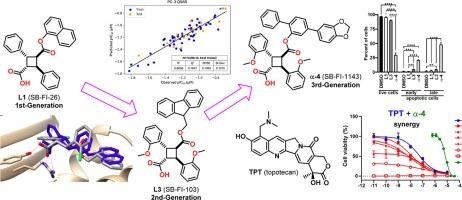
Prostate cancer (PCa) is one of the most common malignancies diagnosed among men and is the second leading cause of cancer-related death. Despite recent advancements in early diagnosis of PCa, androgen deprivation therapy (ADT) remains the most common treatment of PCa. Docetaxel (DTX) and Cabazitaxel (CTX) are two of the most extensively used drugs for metastatic castration-resistant prostate cancer (mCRPC). However, there is a clear medical need for newer and more efficacious therapies for CRPC. FABP5 is overexpressed in prostate cancer cells and chaperones fatty acids to PPARs, which leads to the upregulation of proangiogenic factors, resulting in cell survival and metastasis. The critical role and upregulation of FABP5 in PCa make FABP5 an excellent druggable target for CRPC. We reported a promising anti-PCa activity of truxillic acid monoester (TAME)-based FABP5 inhibitors (SB-FIs) and their synergy with DTX and CTX in vitro and in vivo against PC-3 cells and PC-3 tumor xenografts. In the present work, we performed an extensive SAR study on the potencies of 2nd- and 3rd-generation SB-FIs against PC-3 and RCaP cell lines. RCaP is a mouse PCa cell line, resistant to anti-androgen and first-line taxane chemotherapies, and shows a high level of the Fabp5-gene. This SAR study led to the identification of a number of 3rd-generation SB-FIs with strong cytotoxicity against these two PCa cell lines. Cell cycle analysis of selected SB-FIs revealed a clear evolution of apoptotic potency in the 1st-, 2nd- and 3rd-generation SB-FIs. Since taxanes, DTX and CTX, are ineffective against RCaP cell line, we selected a topoisomerase I inhibitor, topotecan (TPT) as a replacement for taxanes. We screened the library of SB-FIs for synergy with TPT and identified 3 SB-FIs (L3, α-11 and α-4), exhibiting strong synergy, which could remarkably expand the therapeutic window of TPT.
期刊介绍:
Bioorganic & Medicinal Chemistry provides an international forum for the publication of full original research papers and critical reviews on molecular interactions in key biological targets such as receptors, channels, enzymes, nucleotides, lipids and saccharides.
The aim of the journal is to promote a better understanding at the molecular level of life processes, and living organisms, as well as the interaction of these with chemical agents. A special feature will be that colour illustrations will be reproduced at no charge to the author, provided that the Editor agrees that colour is essential to the information content of the illustration in question.



 京公网安备 11010802042870号
京ICP备2023020795号-1
京公网安备 11010802042870号
京ICP备2023020795号-1

 分享
分享
 求助内容:
求助内容: 应助结果提醒方式:
 扫码关注我们
