Qiuyun Guo , Fantao Kong , Xu Yu , Ningning Dai , Qin Li , Ping Wu , Han Tian , Kunming Song , Wenping Sun , Xiangzhi Cui
{"title":"An inter-atomic synergistic Co–Zn diatomic catalyst for efficient H2O2 electrosynthesis in neutral and alkaline media†","authors":"Qiuyun Guo , Fantao Kong , Xu Yu , Ningning Dai , Qin Li , Ping Wu , Han Tian , Kunming Song , Wenping Sun , Xiangzhi Cui","doi":"10.1039/d4gc05661b","DOIUrl":null,"url":null,"abstract":"<div><div>The electrosynthesis of H<sub>2</sub>O<sub>2</sub><em>via</em> the two-electron oxygen reduction reaction (2e<sup>−</sup>-ORR) is a promising alternative method due to its cost-effectiveness and environmentally friendly nature. Atomically dispersed Co single atoms are considered as the active catalyst for the 2e<sup>−</sup>-ORR, but they still suffer from the strong adsorption of the intermediate *OOH resulting in low selectivity for H<sub>2</sub>O<sub>2</sub>. Herein, we propose an inter-atomic synergistic strategy by constructing a heteronuclear diatomic catalyst (Co/ZnPc-S-C<sub>3</sub>N<sub>4</sub>) to optimize the adsorption of *OOH and enhance the performance of H<sub>2</sub>O<sub>2</sub> electrosynthesis. In Co/ZnPc-S-C<sub>3</sub>N<sub>4</sub>, synthesized by a supramolecular strategy through π–π stacking between MPc (M = Co or Zn) and a S-doped C<sub>3</sub>N<sub>4</sub> substrate, the incorporation of Zn induces electron transfer from cobalt to zinc constructing an electron-deficient cobalt center, which inhibits the cleavage of the O–O bond in adsorbed *OOH and favors the two-electron ORR pathway. Thus, Co/ZnPc-S-C<sub>3</sub>N<sub>4</sub> exhibits more than 95% H<sub>2</sub>O<sub>2</sub> selectivity and nearly 100% Faraday efficiency as well as long-term stability in both alkaline and neutral electrolytes, with H<sub>2</sub>O<sub>2</sub> yields of 5.35 and 5.45 mol g<sub>cat</sub><sup>−1</sup> h<sup>−1</sup>, respectively, outperforming the reported analogous catalysts. This work provides an effective strategy for the design of heteronuclear diatomic catalysts, making them promising candidates for the 2e<sup>−</sup>-ORR.</div></div>","PeriodicalId":78,"journal":{"name":"Green Chemistry","volume":"27 11","pages":"Pages 3032-3043"},"PeriodicalIF":9.2000,"publicationDate":"2025-01-14","publicationTypes":"Journal Article","fieldsOfStudy":null,"isOpenAccess":false,"openAccessPdf":"","citationCount":"0","resultStr":null,"platform":"Semanticscholar","paperid":null,"PeriodicalName":"Green Chemistry","FirstCategoryId":"92","ListUrlMain":"https://www.sciencedirect.com/org/science/article/pii/S1463926225001141","RegionNum":1,"RegionCategory":"化学","ArticlePicture":[],"TitleCN":null,"AbstractTextCN":null,"PMCID":null,"EPubDate":"2025/2/18 0:00:00","PubModel":"Epub","JCR":"Q1","JCRName":"CHEMISTRY, MULTIDISCIPLINARY","Score":null,"Total":0}
引用次数: 0
Abstract
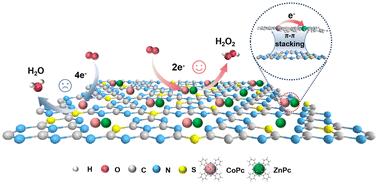
The electrosynthesis of H2O2via the two-electron oxygen reduction reaction (2e−-ORR) is a promising alternative method due to its cost-effectiveness and environmentally friendly nature. Atomically dispersed Co single atoms are considered as the active catalyst for the 2e−-ORR, but they still suffer from the strong adsorption of the intermediate *OOH resulting in low selectivity for H2O2. Herein, we propose an inter-atomic synergistic strategy by constructing a heteronuclear diatomic catalyst (Co/ZnPc-S-C3N4) to optimize the adsorption of *OOH and enhance the performance of H2O2 electrosynthesis. In Co/ZnPc-S-C3N4, synthesized by a supramolecular strategy through π–π stacking between MPc (M = Co or Zn) and a S-doped C3N4 substrate, the incorporation of Zn induces electron transfer from cobalt to zinc constructing an electron-deficient cobalt center, which inhibits the cleavage of the O–O bond in adsorbed *OOH and favors the two-electron ORR pathway. Thus, Co/ZnPc-S-C3N4 exhibits more than 95% H2O2 selectivity and nearly 100% Faraday efficiency as well as long-term stability in both alkaline and neutral electrolytes, with H2O2 yields of 5.35 and 5.45 mol gcat−1 h−1, respectively, outperforming the reported analogous catalysts. This work provides an effective strategy for the design of heteronuclear diatomic catalysts, making them promising candidates for the 2e−-ORR.
期刊介绍:
Green Chemistry is a journal that provides a unique forum for the publication of innovative research on the development of alternative green and sustainable technologies. The scope of Green Chemistry is based on the definition proposed by Anastas and Warner (Green Chemistry: Theory and Practice, P T Anastas and J C Warner, Oxford University Press, Oxford, 1998), which defines green chemistry as the utilisation of a set of principles that reduces or eliminates the use or generation of hazardous substances in the design, manufacture and application of chemical products. Green Chemistry aims to reduce the environmental impact of the chemical enterprise by developing a technology base that is inherently non-toxic to living things and the environment. The journal welcomes submissions on all aspects of research relating to this endeavor and publishes original and significant cutting-edge research that is likely to be of wide general appeal. For a work to be published, it must present a significant advance in green chemistry, including a comparison with existing methods and a demonstration of advantages over those methods.




 京公网安备 11010802042870号
京ICP备2023020795号-1
京公网安备 11010802042870号
京ICP备2023020795号-1

 分享
分享
 求助内容:
求助内容: 应助结果提醒方式:
 扫码关注我们
