{"title":"A chemoselective electrochemical birch carboxylation of pyridines†","authors":"Soumik Sarkar , Rohit , Michael W. Meanwell","doi":"10.1039/d4gc05976j","DOIUrl":null,"url":null,"abstract":"<div><div>Nucleophilic addition to pyridiniums, metal-catalyzed hydrogenation, and cycloadditions constitute a valuable toolbox of modern pyridine dearomatization strategies. Though, in recent years, there have been notable improvements and variations of the canonical Birch reduction to address its notorious safety hazards and poor chemoselectivity, it remains an unexplored mode of reactivity for controlled pyridine dearomatization. Here, we report a simple and safe protocol for the electrochemical Birch carboxylation of pyridines utilizing a sustainable approach and CO<sub>2</sub> as a green C1 building block. This reaction is highly selective for pyridine reduction in the presence of several functional groups incompatible with the canonical Birch reduction and enables direct access to decorated piperidine scaffolds.</div></div>","PeriodicalId":78,"journal":{"name":"Green Chemistry","volume":"27 11","pages":"Pages 2900-2906"},"PeriodicalIF":9.2000,"publicationDate":"2025-01-14","publicationTypes":"Journal Article","fieldsOfStudy":null,"isOpenAccess":false,"openAccessPdf":"","citationCount":"0","resultStr":null,"platform":"Semanticscholar","paperid":null,"PeriodicalName":"Green Chemistry","FirstCategoryId":"92","ListUrlMain":"https://www.sciencedirect.com/org/science/article/pii/S1463926225001104","RegionNum":1,"RegionCategory":"化学","ArticlePicture":[],"TitleCN":null,"AbstractTextCN":null,"PMCID":null,"EPubDate":"","PubModel":"","JCR":"Q1","JCRName":"CHEMISTRY, MULTIDISCIPLINARY","Score":null,"Total":0}
引用次数: 0
Abstract
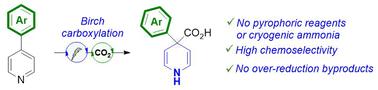
Nucleophilic addition to pyridiniums, metal-catalyzed hydrogenation, and cycloadditions constitute a valuable toolbox of modern pyridine dearomatization strategies. Though, in recent years, there have been notable improvements and variations of the canonical Birch reduction to address its notorious safety hazards and poor chemoselectivity, it remains an unexplored mode of reactivity for controlled pyridine dearomatization. Here, we report a simple and safe protocol for the electrochemical Birch carboxylation of pyridines utilizing a sustainable approach and CO2 as a green C1 building block. This reaction is highly selective for pyridine reduction in the presence of several functional groups incompatible with the canonical Birch reduction and enables direct access to decorated piperidine scaffolds.
期刊介绍:
Green Chemistry is a journal that provides a unique forum for the publication of innovative research on the development of alternative green and sustainable technologies. The scope of Green Chemistry is based on the definition proposed by Anastas and Warner (Green Chemistry: Theory and Practice, P T Anastas and J C Warner, Oxford University Press, Oxford, 1998), which defines green chemistry as the utilisation of a set of principles that reduces or eliminates the use or generation of hazardous substances in the design, manufacture and application of chemical products. Green Chemistry aims to reduce the environmental impact of the chemical enterprise by developing a technology base that is inherently non-toxic to living things and the environment. The journal welcomes submissions on all aspects of research relating to this endeavor and publishes original and significant cutting-edge research that is likely to be of wide general appeal. For a work to be published, it must present a significant advance in green chemistry, including a comparison with existing methods and a demonstration of advantages over those methods.



 京公网安备 11010802042870号
京ICP备2023020795号-1
京公网安备 11010802042870号
京ICP备2023020795号-1

 分享
分享
 求助内容:
求助内容: 应助结果提醒方式:
 扫码关注我们
