Inga-Marie Lahrsen , Eleonora Bargiacchi , Johannes Schilling , André Bardow
{"title":"Greening two chemicals with one bio-alcohol: environmental and economic potential of dehydrogenation to hydrogen and acids†","authors":"Inga-Marie Lahrsen , Eleonora Bargiacchi , Johannes Schilling , André Bardow","doi":"10.1039/d4gc05443a","DOIUrl":null,"url":null,"abstract":"<div><div>Biomass is a promising feedstock for reducing greenhouse gas emissions in the chemical industry. Biomass availability, however, is limited. Still, many bio-based processes focus on producing a single product. Thereby, valuable feedstock potential is often lost with undesired co-products. In this study, we assess the environmental and economic potential of bio-based multi-product systems and provide insights on the sustainability benefits of co-producing hydrogen and high-value acids from bio-alcohols compared to fossil and green alternatives. We select dehydrogenation as a promising early-stage technology for producing hydrogen and four co-product candidates: formic acid, acetic acid, lactic acid, and succinic acid. All investigated dehydrogenation multi-product systems show the potential to reduce climate impacts and to become profitable. A higher carbon tax can improve the economic potential. Acetic acid is the most promising co-product compared to both fossil and green benchmarks with potential benefits in various environmental impact categories. In contrast, co-producing lactic acid shows substantial trade-offs compared to the benchmark technologies. Expected eutrophication impacts associated with biomass use occur in all dehydrogenation routes. Our analysis highlights that multi-product systems can increase benefits compared to single-product systems from both environmental and economic perspectives.</div></div>","PeriodicalId":78,"journal":{"name":"Green Chemistry","volume":"27 11","pages":"Pages 2968-2979"},"PeriodicalIF":9.2000,"publicationDate":"2025-01-14","publicationTypes":"Journal Article","fieldsOfStudy":null,"isOpenAccess":false,"openAccessPdf":"","citationCount":"0","resultStr":null,"platform":"Semanticscholar","paperid":null,"PeriodicalName":"Green Chemistry","FirstCategoryId":"92","ListUrlMain":"https://www.sciencedirect.com/org/science/article/pii/S1463926225001153","RegionNum":1,"RegionCategory":"化学","ArticlePicture":[],"TitleCN":null,"AbstractTextCN":null,"PMCID":null,"EPubDate":"","PubModel":"","JCR":"Q1","JCRName":"CHEMISTRY, MULTIDISCIPLINARY","Score":null,"Total":0}
引用次数: 0
Abstract
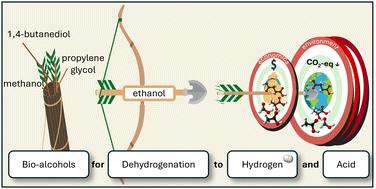
Biomass is a promising feedstock for reducing greenhouse gas emissions in the chemical industry. Biomass availability, however, is limited. Still, many bio-based processes focus on producing a single product. Thereby, valuable feedstock potential is often lost with undesired co-products. In this study, we assess the environmental and economic potential of bio-based multi-product systems and provide insights on the sustainability benefits of co-producing hydrogen and high-value acids from bio-alcohols compared to fossil and green alternatives. We select dehydrogenation as a promising early-stage technology for producing hydrogen and four co-product candidates: formic acid, acetic acid, lactic acid, and succinic acid. All investigated dehydrogenation multi-product systems show the potential to reduce climate impacts and to become profitable. A higher carbon tax can improve the economic potential. Acetic acid is the most promising co-product compared to both fossil and green benchmarks with potential benefits in various environmental impact categories. In contrast, co-producing lactic acid shows substantial trade-offs compared to the benchmark technologies. Expected eutrophication impacts associated with biomass use occur in all dehydrogenation routes. Our analysis highlights that multi-product systems can increase benefits compared to single-product systems from both environmental and economic perspectives.
期刊介绍:
Green Chemistry is a journal that provides a unique forum for the publication of innovative research on the development of alternative green and sustainable technologies. The scope of Green Chemistry is based on the definition proposed by Anastas and Warner (Green Chemistry: Theory and Practice, P T Anastas and J C Warner, Oxford University Press, Oxford, 1998), which defines green chemistry as the utilisation of a set of principles that reduces or eliminates the use or generation of hazardous substances in the design, manufacture and application of chemical products. Green Chemistry aims to reduce the environmental impact of the chemical enterprise by developing a technology base that is inherently non-toxic to living things and the environment. The journal welcomes submissions on all aspects of research relating to this endeavor and publishes original and significant cutting-edge research that is likely to be of wide general appeal. For a work to be published, it must present a significant advance in green chemistry, including a comparison with existing methods and a demonstration of advantages over those methods.



 京公网安备 11010802042870号
京ICP备2023020795号-1
京公网安备 11010802042870号
京ICP备2023020795号-1

 分享
分享
 求助内容:
求助内容: 应助结果提醒方式:
 扫码关注我们
